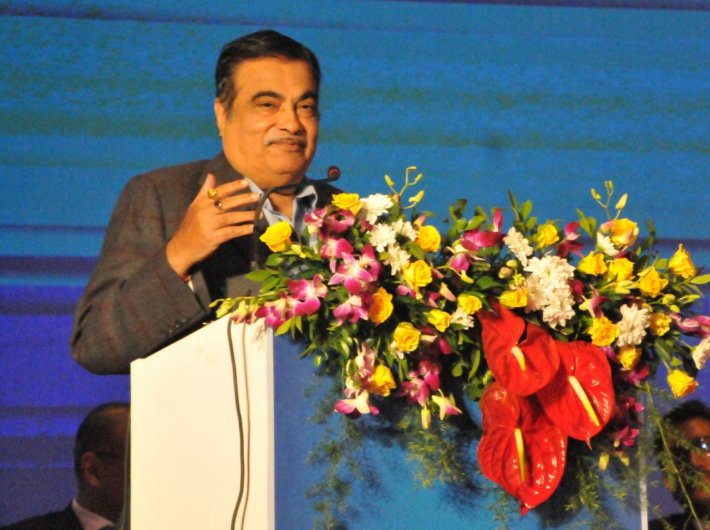
Minister invites investments in infra assets, says reducing logistic costs will boost economy
The infrastructure sector offers a wide range of investment opportunities, union minister for road transport and highways (MoRTH) Nitin Gadkari said here Friday, encouraging investors to come forward and make investments in assets classes like highways, multimodal logistics parks, wayside amenities, ropeways, warehousing zones among other infra projects.
Seeking to inspire confidence among investors and stakeholders, Gadkari said that projects used to get stalled earlier due to land acquisition issues but the government has decided that no project will be awarded until 90% land acquisition is completed and environment clearance is obtained.
“Keep your confidence 110%. The IRR (internal rate of return) in the road sector is very high and hence there is no need to worry about economic viability,” he said while addressing the National Conference on Investment Opportunities in Highways, Transport and Logistics.
Speaking on benefits of upcoming projects under the Bharatmala Programme, the minister said that travel time from Mumbai to Delhi by road will reduce from 48 hours to 12 hours within one year. Road projects and multimodal infrastructure projects will also reduce logistics costs and boost manufacturing, increase exports and help the economy grow.
He said the Bharatmala project is the umbrella flagship program for national highway development with focus on improving the efficiency of freight and passenger movement as well as development of allied infrastructure projects.
Citing the example of Mumbai-Pune highway, he said that it has brought a higher rate of returns to the state and the government. “Reliance had quoted Rs 3,600 crore for the project. However, we decided to build it through MSRDC in Rs. 1,600 crore. Later the Maharashtra government monetized it for Rs 3,000 crore and just recently the same project was again monetized for Rs 8000 crore.”
He also said that the potential of water transport must be explored as it is much cheaper than road and railways. “Using multi-modal transport leads to economic growth,” he said.
Gadkari also said that the setting up of Multi-Modal Logistics Parks (MMLPs) at strategic locations in the country will bring down India’s logistics costs and help boost the national economy. He said the government has decided to set up as many as 35 MMLPs at carefully chosen locations, at a total capital cost of Rs. 50,000 crore. The MMLPs have been conceptualized to enable seamless intermodal freight movement and offer multiple functionalities such as freight aggregation and distribution. Storage and warehousing solutions and value-added services like custom clearances and IT services will also be provided to users.
“Decreasing the cost of logistics will add to economic growth. In China, it is between 8% and 10%, in the US and Europe it is 12%-13%, in India it is 14%-16%. LNG, CNG, and green hydrogen will further reduce costs of logistics. This will reduce our imports, increase our exports and help us realize the prime minister’s vision of Aatmanirbhar Bharat,” he said.
Speaking on benefits of the Vehicle Scrapping Policy of the government, the union minister said it will reduce pollution, improve tax revenues, help growth of automobile sector, boost exports and also create jobs. “It is a win-win situation in which investment on high scale can come in,” he said.
The Voluntary Vehicle-Fleet Modernization Policy aims to create an ecosystem for phasing out of unfit and polluting vehicles. The policy aims to reduce pollution by scrapping more than 1 crore unfit vehicles, improve road and passenger safety, boost auto sales, improve fuel efficiency, formalize scrappage industry and boost availability of low-cost materials for the industry. Out of the more than 1 crore vehicles to be scrapped, around 5.8 lakh are registered in the state of Maharashtra.
Under the policy, around 50-70 Registered Vehicle Scrapping Facilities (RVSFs) will be set up across the country during the next five years to cater to the expected demand for scrapping of unfit vehicles in a safe manner. The comprehensive infrastructure being set up will also increase value extraction from around 70 percent at present to 90-95 percent.
Gadkari said the automobile industry in India which is worth Rs 7.5 lakh crore in size will double to Rs 15 lakh crores in five years.
On electric vehicles, he said, “We are issuing an advisory on flex engines. In two-three years, our vehicles will get converted into electric vehicles. Running cost of electric vehicles will be similar to or less than vehicles run on petrol.”
Gadkari said that alternative fuels like ethanol will ultimately help the scrapping industry also and asked the Maharashtra transport department to launch ethanol-driven auto-rickshaws in Pune as the city has three ethanol dispensing stations.