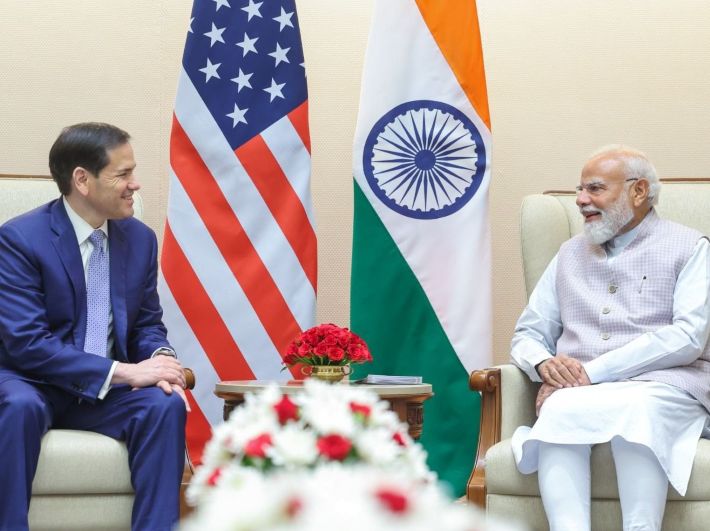
Rubio’s visit was aimed at infusing life into the bilateral relationship that had become almost dormant and that required credible and trustworthy measures on all fronts to make it workable
A week after Donald Trump’s visit to China – the first by an American president in nine years, US secretary of state Marco Rubio arrived in India on May 23 on a four-day visit aimed at resetting Washington DC’s relations with New Delhi and attending the third Quad ministerial meeting.
This visit’s twin objective was crafted very cleverly with primary focus to reassure India that America, under president Trump, no longer seeks to undermine New Delhi’s strategic, economic and political importance, while simultaneously reinforcing the broader Indo-Pacific partnership.
In retrospect, one may term it as a churning within the US following Trump’s return from China, a visit which generated more optics than provided anything substantial to America during the US president’s two-day visit.
For example, the US wanted China to purchase more than $17 billion worth of American agricultural products annually. However, Beijing did not confirm that it would purchase American agricultural products of that value. Furthermore, the US wanted China to resume a steady flow of rare earth minerals. But Beijing made it clear that its export controls on rare earths and other critical minerals were lawful and that export applications would be reviewed only if they complied with Chinese regulations and were intended for civilian use.
On tariff, China said it hoped the US would keep its promise to limit tariffs on Chinese exports to levels set in October 2025. However, the US’s statement did not commit anything on the tariff issue. On Boeing aircraft, Beijing indicated that it was prepared to purchase 200 Boeing planes, provided the US guaranteed the supply of sufficient jet engines and related components to China.
On the diplomatic and strategic front too, China did not give any meaningful space to the US. For instance, Beijing categorically maintained that Taiwan remains a redline issue for it and that any mishandling of the matter could place bilateral relations “in jeopardy”. Altogether, the China trip for president Trump, who had flown CEOs and bosses of all top American companies to Beijing in the hope of cutting good deals, remained ineffective. Despite this, wearing a brave face, Trump claimed his China visit was successful.
In truth, China gave a clear message to Trump that it would engage with America on its own terms and would not compromise on issues it considers central to its national interests and sovereignty.
Against this background, Rubio’s visit to India generated considerable interests in the diplomatic corridors across the world. The visit was well choreographed, with the US ambassador to India, Sergio Gor adding charm to it by hosting celebrations marking the 250th anniversary of American independence as a memorable event. It was attended by Rubio, external affairs minister S. Jaishankar, foreign secretary Vikram Misri and other dignitaries.
However, to make the occasion something more special, ambassador Gor dialled up Trump live and held the phone to the microphone to make guests hear the president’s remarks. “I just want to say hello to everybody. I love the prime minister. (Narendra) Modi is great, he is my friend and I just want to say a very good evening to everybody,” Trump said, catching the audience completely by surprise. As if it was not enough, he further said, “I just want to say, you are great. We have never been closer to India, and India can count on me 100 % and our country.”
It was Trump’s typical way of mollycoddling, which was packed with everything sans warmth and credibility. Since returning to the White House in January 2025, he has declared Modi as his friend on several occasions. While smartly using his self-declared friendship with Modi as a cover, he insulted and penalized India and Indians, thus eroding “what was once a blossoming US-India relationship,” Brahma Chellaney, strategic affairs commentator, said.
Last month, Trump shared a social media post which described India and China as “hell-holes,” and called immigrants from these countries “gangsters with laptops” who have “stepped on our flag.” On May 24, during a joint press conference held by Jaishankar and Rubio in Hyderabad House in New Delhi, when a question was asked about racist comments against India and Indian Americans, Rubio said, “Every country in the world has stupid people. I am sure that there are stupid people here. There are stupid people in the United States who make dumb comments all the time.”
Clearly, the US secretary of state was seen trying to smoothen rough edges that have recently emerged in relationship between India and the US. This was markedly visible when in response to the immigration issue, he said the ongoing immigration reforms were not aimed specifically at India but were part of a broader global overhaul of the US migration system. Describing the US as “the most welcoming country in the world for immigration,” he said nearly one million people become permanent residents in the US every year.
On the US’s growing proximity with Pakistan, he obliquely hinted that his country’s relationship with Islamabad was a tactical one while describing India as “one of the US’s most important strategic partners” and a “leading trade partner.” He even tried to dispel perceptions that India-US bilateral ties had lost momentum in Trump’s second term.
Overall, Rubio’s visit to India was aimed at infusing life into the bilateral relationship that had become almost dormant and that required credible and trustworthy measures on all fronts to make it workable. In this context, Rubio’s meeting with Modi and offering an invitation to him to visit America rather turned out to be a gesture that lacked authority.
Critics argued that Rubio should instead have presented Modi with a formal invitation letter from Trump. They also questioned his diplomatic approach in India. He bypassed established protocol by going straight to Modi for talks rather than first holding working-level bilateral discussions with his counterpart Jaishankar.
Such steps did not enthuse the critics, who viewed them as Americans arrogance and their sheer disregard for protocols and convention. Perhaps, this was the reason why there was no mention of Modi accepting invitation to visit the US in Jaishankar or any other official statements from India.
In fact, India is itself awaiting Trump’s visit, for which Modi had already extended an invitation during his February 2025 visit to the US. It is widely speculated that Trump may visit India later this year for the Quad leadership summit. Nonetheless, it is hard to assume India will enjoy a comfortable engagement with the US, given Trump’s mercurial behaviour and his tendency to take decisions in an unpredictable and unconventional manner.