Chennai municipal corporation’s initiative of involving the public before executing major projects is a win-win move for all stakeholders
K Kasinathan, 62, has been residing in Kottivakkam area of Chennai since 1980. For him, people’s participation does not end with their voting in elections but they should also be actively involved in government schemes and programmes. It is for the first time that Kasinathan, along with 120 other residents of Kottivakkam and the adjoining localities of Palavakkam and Neelankarai, have been given a chance to have a say on the future of their town.
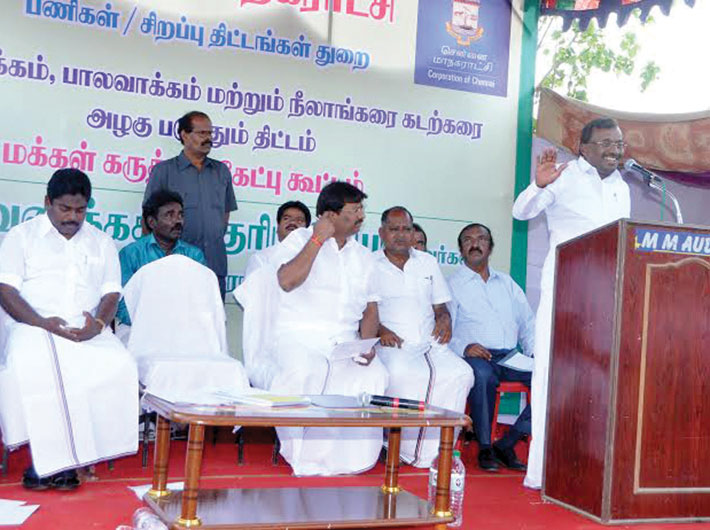
At a public hearing organised by th Chennai municipal corporation at Kottivakkam beach on March 3, the residents of these three localities gave their nod for the '55 crore beach beautification project in Kottivakkam, Palavakkam and Neelankarai. A sculpture art gallery, 4.1 km jogging track, cricket pitch, football ground and volleyball court are part of the design for this project that is to be implemented according to the provisions of coastal regulation zone-II norms.
People from beach walkers associations of the three localities were also part of the meeting. (There are around 1,400 visitors to the Neelankarai beach during weekends, over 600 visitors to Palavakkam and 700 to Kottivakkam.) At the meeting people were explained about the project. The proposed designs were placed in front of them through a power-point presentation. And then residents’ opinion and consent was taken before the corporation could take up work at the stretch starting from Kottivakkam upto Neelankarai beach, says Nandakumar, executive engineer, special projects, Chennai municipal corporation.
Joint commissioner of Chennai municipal corporation, Dr Vijay Pingale, says: “Before we develop a particular stretch of the beach we have to take into account what will be the traffic pattern, will there be sufficient access for the fishermen community to the sea, will there be access for local communities. We try to accommodate their concerns before finalising the project.” There have been instances where people protested the work in their locality but the project was in the interest of the entire city, so it is where stakeholders’ meetings really work.
At the Kottivakkam beach meeting the corporation officials further assured the residents of the area that the entire work will be executed without disturbing the local vegetation. The project is in the final DPR stage and tenders will be invited after the Lok Sabha polls on April 24.
For P Natarajan, 37, secretary, Dr Radhakrishnan Nagar welfare association, Thiruvanmiyur, getting rain water harvesting well constructed in their area was an achievement: “Corporation people were building storm water drains in our area which certainly would not have served the purpose since there is a lot of sand in this area. We protested. We tried explaining our concerns and viewpoint and the authority was open to our idea. Now we have rainwater harvesting well on the footpath.”
And what made the corporation understand the importance of people’s participation?
It was during a footpath widening work at Besant Nagar Second Avenue last year when residents were up in arms against the project and the corporation people were forced to stop the work. Mainly car users opposed the work as they had their apprehensions that with widening of foothpath, width of roads will reduce and this in turn will result in traffic congestion; plus, there will be no parking space. The corporation tried to rope in residents of the area. The zonal officers from corporation, with the help of local corporators, approached the resident’s welfare association and a meeting was arranged with the corporation officials on November 14 last year. After a two-hour discussion, the authorities and residents of the area reached a consensus following which the work commenced. “We explained to them that we were not taking away their right of way. On both the sides vehicles were parked, footpaths were narrow so people were forced to walk on carriageways leading to conflicts between pedestrians and vehicular traffic,” says Dr Pingale, adding, “that was the first time we faced major resistance from public, so we thought before entering residential areas with such projects it is better to first generate awareness among people, understand their concerns and put forth our point of view so that there will be smooth coordination between them and us. We have learnt from our mistakes. It is always better to involve people. If people give strong feedback sometimes we need to alter the designs but we are open to it if it helps us in improving the face of the city. Moreover, if you are convinced about your own project you should be able to convince public too, if the project is in their interest.”
Learning a lesson from this, the corporation is involving public before executing major projects: stakeholders’ meetings were held before finalising pedestrian plaza work in Mylapore, an area dominated by traders; or proposed pedestrianisation of Pondy Bazaar, a busy market area; or widening of footpaths in KK Nagar locality. With the pedestrian plaza concept vehicular movement will be completely restricted to a particular area.
Now, over the weekends, parks in different localities packed with 100-150 people, experts giving power-point presentations, men and women participating in question-answer rounds, is becoming a regular feature in the city.
Earlier stakeholders’ meetings were confined to projects related to over-bridges and flyovers where the work was taken up involving consultants; now such meetings are mandatory for all projects that will have any major impact on public.
However, ensuring people’s participation has been a challenge for the authorities too, as people have disagreements with several policies and programmes.
“We have received mixed response for the project on footpath widening. Still, I receive phone calls from few Besant Nagar residents who say that the idea of widening footpath is bad. I tell them don’t comment with half-finished picture; we will meet here after few months and then discuss. The corporation has identified 55 roads in the city for footpath widening, of which 25 are in the final stage. All this is being done bringing in technological solutions. There will be cameras installed and it will be ensured that footpaths are available for people to walk and not used for parking of vehicles,” joint commissioner Pingale adds.