Immunisation programme needs a shot in the arm

What the state-level data show, and what needs to be done

Bhaswati Mukhopadhyay | January 7, 2019


#Mission Indradhanush   #Routine Immunisation   #Ayushman Bharat   #immunisation  
Courtesy: Flickr/DFID

Health of a nation doesn’t only mean economic health; it also means physical and mental health of its people, especially the children who are the future citizens. Immunisation may well be the answer to economic well-being as it stems disability, morbidity and mortality. And vaccinations that are administered between birth and age of 6 years are especially the most critical ones.
 
It’s almost a given that the more people are immunised, the higher will be the economic progress and prosperity of a nation, as a healthy population has better education and better cognitive power. This fosters productivity too. 
 
The focus on Ayushman Bharat, Routine Immunisation and Mission Indradhanush is testimony to the fact that the government appreciates the correlation. In fact, if you look at infant mortality, there’s data to show a decline in the number of infant deaths from 8.67 lakh in 2016 to 8.02 lakh in 2017, according to the United Nations Inter-agency Group for Child Mortality Estimation (UNIGME).

 
What lies beneath
Let’s scratch the surface to see what lies beneath.  
 
The data that 2018 Public Affairs Index (PAI), that prepares frameworks and arrives at gap analysis for governance issues, had mined on immunisation from NFHS, calculated the growth rates for the reference years 2005-06 and 2015-16.
 
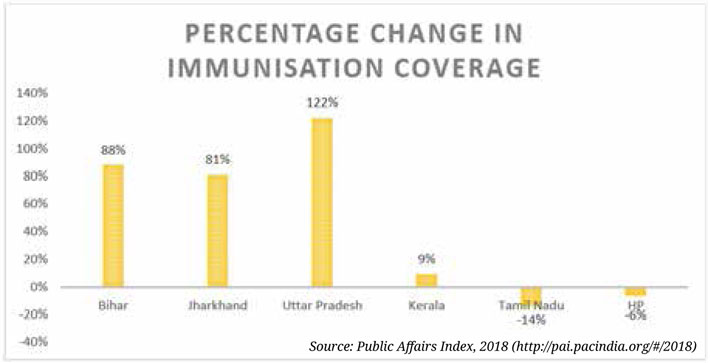
Interestingly, although Bihar and Jharkhand were at the bottom of governance ranking, the states had caught up with the ‘developed states’ in immunisation coverage by showing remarkable progress in the area. While Bihar showed an 88 percent jump in immunisation coverage between 2005-06 and 2015-16, Jharkhand showed an increase of 81 percent. In Tamil Nadu, the second-best governed state, it fell by about 14 percent! Kerala, the other state that topped the governance ranking chart, showed only 9 percent growth rate.
 

Mission Indradhanush
Launched: December 2014

Aim: To strengthen and re-energize the drive towards full immunization with all available vaccines for children up to two years of age and pregnant women.

  • The government identified 201 high focus districts that have the highest number of partially immunized and unimmunized children.
  • Full immunization coverage was used to grow by 1 percent a year. The rate increased to 6.7 percent per year through the first two phases of Mission. Four phases have been conducted till August 2017 and more than 2.53 crore children and 68 lakh pregnant women have been vaccinated.


Immunisation coverage in Uttar Pradesh, ranked 15th on governance among the large states, soared 122 percent in the same period. In the small states’ category, the PAI analysis showed that Himachal Pradesh, the best governed small state, was losing its grip on immunisation. Despite being the laggards in governance, both Jharkhand and Bihar – states with high population levels – are close to the national average of 62 percent in immunisation, as reported in 2015-16.
 
Sum and substance
So, why are some of the best governed not doing well on such a vital aspect of health coverage? Possible explanations could be that:
  • Kerala had reached an immunisation coverage which was higher than many others, so the year-on-year incremental growth was naturally slower
  • What if the immunisation data for some states are mapped to the spending on education and health? A look at total budget expenditure for education and health as a percentage of GSDP in these states throw up interesting insights. 
In Bihar, where immunisation coverage had expanded substantially, the budget expenditure on both education and health as a percentage of GSDP also shows an increase around the same time, rising at least in double digits.
 

Intensified Mission Indradhanush
Launched: October 2017

Aim: To further intensify the immunization programme, to reach each and every child up to two years of age and all those pregnant women who have been left uncovered under the routine immunisation programme (UIP).

  • Under UIP, the government provides vaccination free of cost against vaccine-preventable diseases including diphtheria, pertussis, tetanus, polio, measles, severe form of childhood tuberculosis, hepatitis B, meningitis and pneumonia (Hemophilus influenza type B infections), Japanese encephalitis (JE) in JE endemic districts with introduction of newer vaccines such as rotavirus vaccine, IPV, adult JE vaccine, pneumococcal conjugate vaccine (PCV) and measles-rubella (MR) vaccine in UIP/national immunization programme.


According to the latest data of 2014-15, Tamil Nadu and Kerala’s total expenditure on education was about 2 percent and 2.55 percent of GSDP, respectively. In Bihar and Jharkhand those were higher at 6.4 percent and 2.64 percent, respectively. Both in Kerala and TN, the expenditure on education as a percentage of GSDP, had declined between 2005-06 and 2014-15.
 
The total expenditure on health as a percentage of GSDP was 0.73 percent and 0.97 percent in TN and Kerala, respectively, in comparison to the 1.45 percent and 1.14 percent in Bihar and Jharkhand, respectively. In Jharkhand, in fact, the spending on health had increased by about 50 percent over the decade. The better governed states were seemingly spending less on education and health, maybe thereby impacting immunisation coverage levels.
 
Three-step approach
Immunisation drives, too, need a shot in the arm in order for the coverage to get wider and all encompassing. The data from the health ministry for 2014-15 shows less than 1 percent of the total current health expenditure of Rs 4.5 lakh crore has been spent on immunisation programmes.
Here are some of the steps that can ensure universal coverage: 
  • Trust between health services and communities is the key in immunisation. The deeper the trust, the easier it is to engage the community.
  • Make women the harbingers of change. Health-literate and knowledge of incentive-based schemes can not only empower women but also make them change agents, thereby looping in more children. 
  • A two-way communication can give immunisation a real shot in the arm – there should be an opportunity for the community to freely voice their concerns and doubts, and also ask questions. 
 
Mukhopadhyay is consultant with Public Affairs Centre, a not-for-profit think tank committed to good governance. 
Data mining support by Udita Dutta, programme officer, PAC.
 
(The article appears in January 15, 2019 edition)

Comments


Other News

Caring for cancer patients: the expanded network of facilities

Health is a State subject, and the primary responsibility for providing healthcare services, including cancer care, rests with the respective state governments. However, the Department of Health and Family Welfare provides technical and financial support to States and Union Territories across the country

Capabilities, aspirations of India’s youth limitless: Modi

The capabilities and aspirations of India’s youth are limitless, prime minister Narendra Modi said in his remarks to the media at the start of monsoon session of the parliament on Monday.  "In the past month, the country has achieved many milestones, filling citiz

India gets the first hydrogen train

Prime minister Narendra Modi on Friday laid the foundation stone and dedicated to the nation various development projects worth around ₹14,700 crore in Jind, Haryana.   The PM positioned the city as a shining reflection of the good governance model. Emphasizing that the entire Haryana

Climate change is stealing sleep

Climate change has at least doubled the temperature-related sleep loss across 1,338 major cities worldwide over the past five decades, highlighting an emerging but often overlooked public health consequence of rising global temperatures. A new study by Climate Central estimates that between 2020 and

Cabinet approves Mobile Phone Manufacturing Scheme

The union cabinet chaired by PM Narendra Modi has approved the Mobile Phone Manufacturing Scheme (MPMS) with a budgetary outlay of Rs 62,500 crore. It aims to further scale up the production, deepen domestic value addition, strengthen supply chain resilience, enhance global competitiveness. It

Building infrastructure is only half the job

Recent stories of stolen railway wires, disappearing communication towers and missing public infrastructure are often treated as bizarre law-and-order failures of India. Yet they raise a more fundamental question. Why does the State often discover the disappearance of a public asset only after it has alrea

Upcoming Conferences


Archives

Current Issue

Opinion

Facebook Twitter Google Plus Linkedin Subscribe Newsletter

Twitter