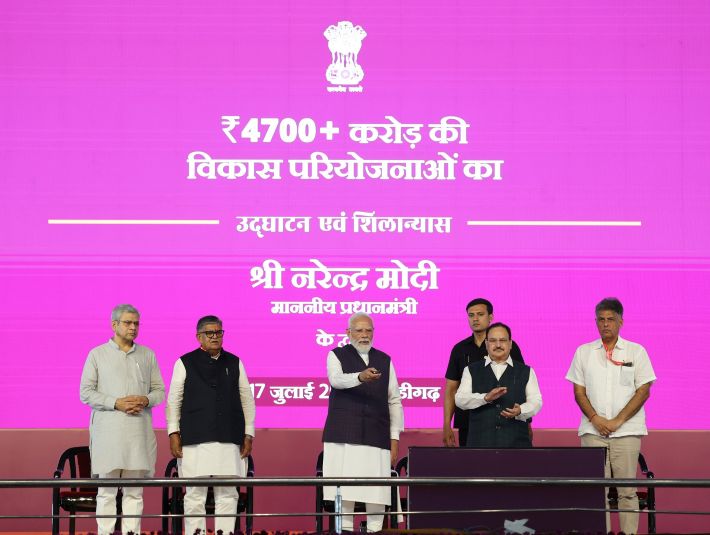
PM lays foundation stone, and dedicates to the nation development projects worth ₹14,700 crore in Jind
Prime minister Narendra Modi on Friday laid the foundation stone and dedicated to the nation various development projects worth around ₹14,700 crore in Jind, Haryana.
The PM positioned the city as a shining reflection of the good governance model. Emphasizing that the entire Haryana has firmly embarked on a new trajectory of progress over the past years, he noted that the day's events are actively infusing this mission with powerful fresh momentum. "Today's program is filling this exact mission of the government with completely new energy," asserted Modi.
Declaring that the region's name has now been permanently etched into the pages of history, he announced the launch of the country's first hydrogen-powered train. Drawing a visionary parallel to the historic first train journey between Bombay and Thane, he stated that future generations will similarly immortalize this corridor whenever advanced green mobility is discussed. "I congratulate all of you and the entire country for this momentous step related to the deep modernization of Indian Railways," affirmed Modi.
Detailing the massive infrastructural push, the PM listed over Rs 14,000 crore worth of new projects spanning railways, highways, and cultural heritage dedicated directly to the state's welfare. Highlighting a massive healthcare expansion, he announced the dedication of Pandit Neki Ram Sharma Medical College in Bhiwani and Maharishi Chyavan Medical College along with Rao Tularam Hospital in Narnaul, aimed at creating pristine new avenues for aspiring medical professionals. "These new institutions will make the healthcare services of Haryana even more empowered and highly accessible," noted Modi.
Tracing the technological evolution of the global railway sector, the PM recalled how the 19th century was fundamentally defined by steam engines while the 20th century was defined by electrical power. Looking toward the future, he emphasized that the 21st century will be driven by hydrogen mobility, officially starting with the newly inaugurated 90-km route between Jind and Sonipat. "Today, Indian Railways has taken a massive leap in this 21st-century technology, which holds immense potential for future expansion," observed Modi.
Putting the nation's achievement into a global perspective, the PM noted that hydrogen train technology only came into practical existence worldwide 7-8 years ago. He highlighted that only a highly exclusive handful of nations currently possess the capability to operate such trains, and even those remain in preliminary stages. "You will be immensely proud to hear about the true capabilities of this newly launched Indian hydrogen train," remarked Modi.
Shifting focus to critical geopolitical challenges, the PM highlighted the strategic logistical advantages derived from the massive transformations within Indian Railways over the past twelve years. Pointing to the ongoing volatile conflict in West Asia, he explained how the indispensable supply maritime routes for petroleum, diesel, LPG, and fertilizers have been continuously surrounded by severe disruptions for months. "Through this vital maritime route, India imports a massive quantity of essential fuels and agricultural inputs," observed Modi.
Underscoring the dual socio-economic benefits of enhanced connectivity, the PM explained that expansive road and rail networks simultaneously provide immense public convenience while exponentially accelerating regional development. Officially launching the local section of the Delhi-Amritsar-Katra Expressway, the Jind-Gohana National Highway, and the Ambala-Kala Amb four-lane project, he envisioned many interstate logistical benefits. "Such expansive connectivity work provides immense comfort while heavily multiplying the speed of overall development," noted Modi.
Concluding his address, Modi described the state as racing along a rapid path of development powered equally by the dual economic wheels of agriculture and industry. Blessing the newly inaugurated projects to further massively accelerate this momentum, he expressed absolute confidence in the region's vital contribution to the national journey. "This rapid development of Haryana will undoubtedly and powerfully energize our ongoing journey toward a Vikisit Bharat," he asserted.