
Implement helmet law: Road safety experts

Activists write to Gadkari, express concerns at dilution by states

geetanjali

Geetanjali Minhas | December 27, 2019

#Road Safety   #Ministry of Road Transport and Highways   #Nitin Gadkari   #National Coalition of Road Safety  
(Photo courtesy: Road Safety Network Gujarat, @RSNGujarat)

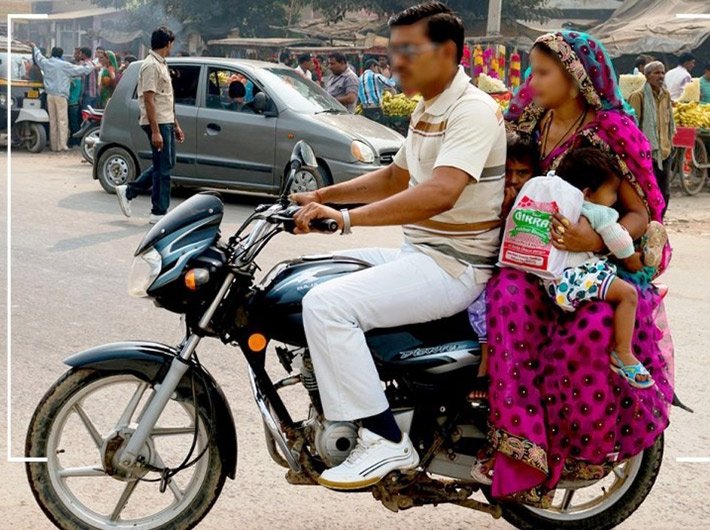
The National Coalition of Road Safety, a coalition of road safety organisation promoting safe roads in India, has urged minister of road transport and highways, Nitin Gadkari to strengthen and immediately enforce the amended ‘helmet law’ (section 129 of the Motor Vehicles Act) that removes the power of states to provide any exemption in the use of helmets.

Under the earlier rule, except for Sikhs wearing a turban, all persons riding on a motorised two-wheeler were required to wear a helmet. Owing to public pressure, most states have been dragging their feet on implementation of the new provisions and have used this provision to provide exemptions for the use of helmets; like in urban areas or use by women.

Save the exemption provided to Sikhs wearing turban, the Motor Vehicles Amendment Act 2019 has now removed powers of states to provide any other exemptions. Since the Act has received the assent of the president it is now applicable to the entire country. Various sections of the Act must now be notified by the central government to bring them into force. The amended Act also increases the penalty for not wearing a helmet to Rs 1,000 and requires a mandatory suspension of the driver’s licence for a period of three months.

With the amended section 129 not included in the list of sections that have been brought into force, the National Coalition of Road Safety is concerned about its enforcement and therefore the road safety. Recently, Gujarat exempted the use of helmets in urban areas. The move has been severely criticised by road safety experts.

“This loophole is being used by states such as Gujarat to provide exemptions even though the supreme court has issued directions for strict implementation of the helmet rule,” says Sanskriti Menon of Centre for Environment Education (CEE), a Coalition partner.

Ashim Sanyal, COO of Consumer VOICE, a Coalition member, says that “even at low speeds, in the event of a crash, a two-wheeler rider can suffer severe injuries which can even lead to a permanent disability. Recovery from an injury can take months and sometimes years in addition to loss of income and high medical bills which can take an emotional and psychological toll on the family. The country also suffers an economic loss due to crashes, injuries, and loss of productive work.”

Ranjit Gadgil, program director, Parisar, another alliance partner, says that it is essential that the new section is immediately brought into force so that any such exemptions by states would become automatically null and void. “While the new law requires the standards for the helmets to be specified, the ministry can use the existing BIS standard, then modify or add to it later,” he suggests.

As per the latest report on road accidents in the country published by the Ministry of Road Transport and Highways, fatalities of two-wheeler users stood at 55,336 out of which 43,614 occurred due to non-use of helmets with most victims in the age group of 18-35 when India aims to reduce its road traffic fatalities and severe injuries to half by 2020. According to the World Health Organization, wearing helmets reduces the chance of a fatality by 40% and severe injury by 70% in a crash.

Comments


Other News

From one cow to a dairy business

In 2012, Anita Dash wasn`t dreaming of building a dairy brand. She wasn`t studying business models or planning market expansion. Like countless mothers across India, her focus was on something much simpler: giving her children a better future.   At the time, her most valuable

Ethanol blending: The two sides of a story

India`s crude oil consumption is estimated to be around 88.5% imported from abroad. This one single figure is also responsible for why ethanol has become both an economic strategy and fuel policy at the same time. In an economy like India, which depends so heavily on foreign oil, any increase in internat

Food inflation: Not a macroeconomic statistic but a developmental indicator

India`s retail inflation shows a reassuring picture at first glance. According to the latest data, Consumer Price Index (CPI) inflation edged up to 4.38% in June 2026 from 3.93% in May 2026, but continued to remain within the Reserve Bank of India`s (RBI) target band of 4% (+/- 2%). However, beneath this

Skin in the game or masterful market timing?

When a company founder opens their personal chequebook to buy shares in their own business, stock markets usually applaud. To the average retail investor, it feels like the ultimate vote of confidence, a sign that the people running the show have real skin in the game and believe brighter days are ahead.

India’s freedom struggle was shaped by wider Asian political thought

As we mark 80th anniversary of independence, ‘Asianism and the Fall of Empire’ (HarperCollins India) by historian Mithi Mukherjee offers a new perspective on Ind

What is colonialism? A relook at modern history

The Chromatic World Order: The Fiction That Rules Our World  By Sajid Mohamed Aakar Books  

Upcoming Conferences


-->

Archives

Current Issue

Opinion

Facebook Twitter Google Plus Linkedin Subscribe Newsletter

Twitter






