
India will be powerful, not aggressive: Bhaiyyaji

Ravindra Sathe’s book ‘Rashtrabhav’ explores the framework for redefining nationhood, identity and civic responsibility in modern India

geetanjali

Geetanjali Minhas | April 21, 2026 | Mumbai

#Nationalism   #BJP   #RSS  


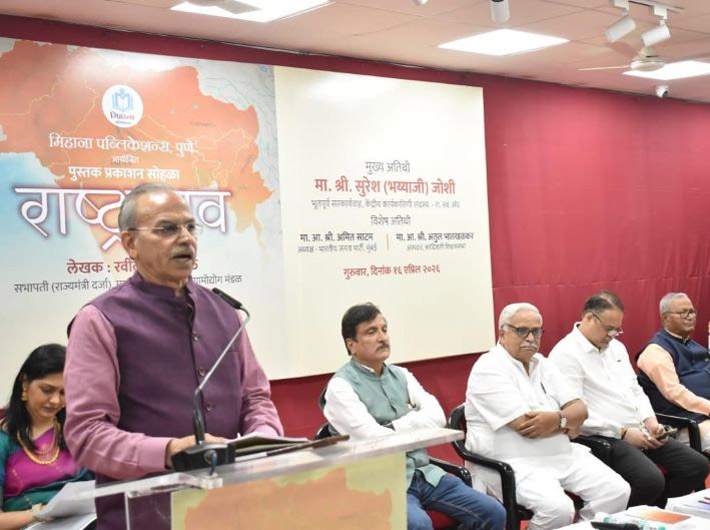
India is poised to emerge as a global power but will remain rooted in its civilisational ethos of non-aggression and harmony, former RSS General Secretary Suresh 'Bhaiyyaji' Joshi has said.
 
He was speaking at the launch of “Rashtrabhav,” a book by Ravindra Sathe, chairman of the Maharashtra Khadi and Village Industries Board. The event organised by Mihana Publications on April 16 at Vasant Smruti, Dadar was attended by Rahul Narvekar, speaker, Maharashtra assembly, Dada Idate, Amit Satam, president of Mumbai BJP; and BJP MLA Atul Bhatkhalkar, among others. It underscored an emerging narrative in India’s public discourse: nation-building as a cultural, moral, and civilizational project-rather than just a political or economic one.
 
Joshi said that while many nations equate power with military expansion, India’s philosophy is fundamentally different.
 
“India will become powerful, but it will never become aggressive, expansionist, or oppressive,” he said, adding that India’s national identity is grounded in non-violence, cultural continuity, and social harmony principles that distinguish it from conventional global power models.
 
Atul Bhatkhalkar noted that “Rashtrabhav” explores nationalism through historical, cultural, social, economic, and political dimensions.
 
A key theme of the discussion was the distinction between land and nation: where land represents geography and nation represents a shared emotional and cultural consciousness.
 
Speakers stressed that nationalism is sustained through language, traditions, and collective memory. The erosion of these, they warned, weakens the very foundation of nationhood.
 
Referring to thinkers like Swami Vivekananda, Bhatkhalkar said India’s historical mission has not been conquest, but spiritual guidance.
 
Echoing this, Sathe said his book aims to make citizens more aware of India’s civilizational heritage and inspire them to preserve it. He added that his intellectual journey began during his involvement in the Ram Janmabhoomi movement, which motivated him to write extensively on nationalism.
 
Joshi introduced the concept of Dharma as a framework for understanding contemporary governance and society. Emphasising upon Achar Dharma (individual conduct) and Samaj Dharma (social responsibility), he said these ideas, are increasingly reflected in governance approaches that prioritize duties alongside rights – illustrated by initiatives such as Kartavya Path.
 
“This signals a broader shift toward a duty-based civic model, where national development is tied to moral and social responsibility rather than purely legal compliance.”
 
A significant part of Joshi’s remarks focused on what he described as ‘undoing historical distortions.’ He characterized the Babri Masjid demolition as an act of national restoration rather than a religious conflict -framing it within a larger effort to reclaim civilizational identity.
 
“This perspective aligns with wider developments such as: the construction of the Ram Mandir in Ayodhya, renaming of colonial-era places and reforms in legal frameworks to remove colonial legacies. These steps represent a broader ideological shift from the margins to the center of public policy,” he said.
 
In his concluding remarks, Joshi said that the goal is not merely political transformation, but a deeper cultural and societal evolution.
 
He noted that while citizenship can be defined legally, building a nation requires cultivating a shared civilizational identity. “This involves aligning national duty with cultural revival and historical consciousness.”
 
India’s trajectory is toward becoming a powerful yet non-aggressive nation—where identity, spirituality, and governance are closely intertwined.


Comments


Other News

AI: Code, Control, Conquer

India today stands at a critical juncture in the area of artificial intelligence. While the country is among the fastest adopters of AI in the world, it remains heavily reliant on technologies developed elsewhere. This paradox, experts warn, cannot persist if India seeks technological sovereignty.

RBI pauses to assess inflation risks, policy transmission

The Reserve Bank of India (RBI) has begun the new fiscal year with a calibrated pause, keeping the repo rate unchanged at 5.25 per cent in its April Monetary Policy Committee (MPC) meeting. The decision, taken unanimously, reflects a shift from aggressive policy action to cautious observation after a signi

New pathways for tourism growth

Traditionally, India’s tourism policy has been based on three main components: the number of visitors, building tourist attractions and providing facilities for tourists. Due to the increase in climate-related issues and environmental destruction that occurred over previous years, policymakers have b

Is the US a superpower anymore?

On April 8, hours after warning that “a whole civilisation will die tonight,” US president Donald Trump, exhibiting his unique style of retreating from high-voltage brinkmanship, announced that he agreed to a two-week ceasefire with Iran. The weekend talks in Islamabad have failed and the futur

Machines communicate, humans connect

There is a moment every event professional knows—the kind that arrives without warning, usually an hour before the curtain rises. Months of meticulous planning are in place. And then comes the call: “We’ll also need a projector. For the slides.”   No email

Why India is entering a ‘stagflation lite’ phase

India’s macroeconomic narrative is quietly shifting—from a rare “Goldilocks” equilibrium of stable growth and contained inflation to a more fragile phase where external shocks are beginning to dominate domestic policy outcomes. The numbers still look reassuring at first glance: GDP


Archives

Current Issue

Opinion

Facebook Twitter Google Plus Linkedin Subscribe Newsletter

Twitter






