
Indian policymakers’ estimates of the percentage of women in the labour force ranged from 20% to 70%. The most recently available data says 27%
GN Bureau | September 26, 2017
The highest proportion of policymakers with not much or no knowledge of the Sustainable Development Goals (SDGs) was found in India (38%), said a report by an international advocacy group.
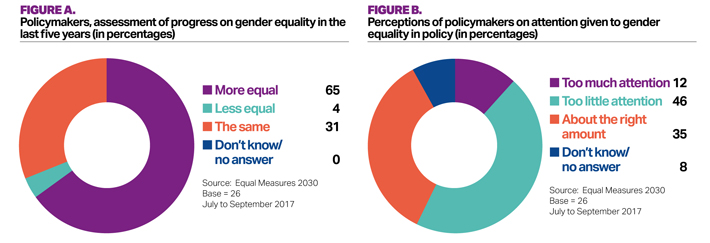
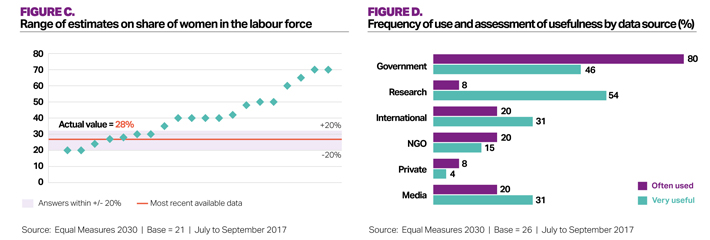
Equal Measures 2030, an advocacy group, which spoke to policymakers in India, Colombia, Indonesia, Kenya and Senegal, said that Indian policymakers’ estimates of the percentage of women in the labour force ranged from 20% to 70% (the most recently available data says 27%).
The wide variation in responses raises questions about whether policymakers are aware, have access to or are sufficiently guided by the relevant, current data needed to assess progress for girls and women towards the SDGs, said the report.
The report also highlighted that on early marriage rate for women (latest year available), 12 percent policymakers knew it. But 69 percent were in the category “I don’t recall but know where the information is” and 19 percent were in the category “I don’t know and don’t know where this information is.”
 On share of seats held by women in parliament in 2016, 35 percent were in the category “I know this”, but 65 percent were in the category “I don’t recall but know where the information is”.
On share of women in labour force in 2015, 19 percent knew this. But, 69 percent responded “I don’t recall but know where the information is” and 12 percent said “I don’t know and don’t know where this information is.”
With regard to maternal mortality rate in 2015, 23 percent knew this. As high as 65 percent responded “I don’t recall but know where the information is”, while 12 percent said: “I don’t know and don’t know where this information is”.
The Equal Measures 2030 report said that millions of girls and women are currently “invisible”, preventing them from fully participating in their communities, as well as restricting their access to rights and opportunities. Their invisibility is exacerbated by incomplete, missing, or underutilized data about the barriers that girls and women face, their potential to transform societies, and about what works to improve their well-being.
The gender policy landscape is complex - it cuts across all of the 17 SDGs and impacts all aspects of a girl or a woman’s life. Policymakers face daily decisions in all areas of policy - whether health, education, justice or public finance - that have a direct implication on the rights and opportunities of girls and women and that require effective coordination across multiple ministries. In many countries, ministries devoted to gender equality issues tend to be under-resourced and marginalized from government decision-making. Globally, less than a quarter of parliamentarians are women, which demonstrates the scale of the challenge.
The fact remains that, if the SDGs are to be achieved, it will be because policymakers (in the 193 countries that signed up to the goals) put in place the laws, policies and funding necessary to implement the goals on the ground, said the report.
When a company founder opens their personal chequebook to buy shares in their own business, stock markets usually applaud. To the average retail investor, it feels like the ultimate vote of confidence, a sign that the people running the show have real skin in the game and believe brighter days are ahead.
As we mark 80th anniversary of independence, ‘Asianism and the Fall of Empire’ (HarperCollins India) by historian Mithi Mukherjee offers a new perspective on Ind
The Chromatic World Order: The Fiction That Rules Our World By Sajid Mohamed Aakar Books
The Monsoon Session, 2026 of Parliament which commenced on July 20 was adjourned sine die on Thursday. The session provided 19 sittings spread over a period of 25 days. During the session 11 Bills were introduced in Lok Sabha and 2 Bills were introduced in Rajya Sabha. 12 B
Over the past four decades, India`s consumer protection landscape has undergone a remarkable transformation. What began with the Consumer Protection Act, 1986 as a simple mechanism to empower ordinary citizens has evolved into a comprehensive framework capable of addressing challenges ranging from mislea
More than 30 doctors, medical scientists and public health professionals have urged the government to take decisive action against the aggressive advertising and marketing of junk food, calling for a watershed ban on advertisements for foods high in fat, sugar and salt (HFSS) and ultra-processed foods (UPF











