
It's a "tired man's budget": Swaraj

"It lacks dynamism and vision to overcome food insecurity and price rise"

PTI | February 27, 2010
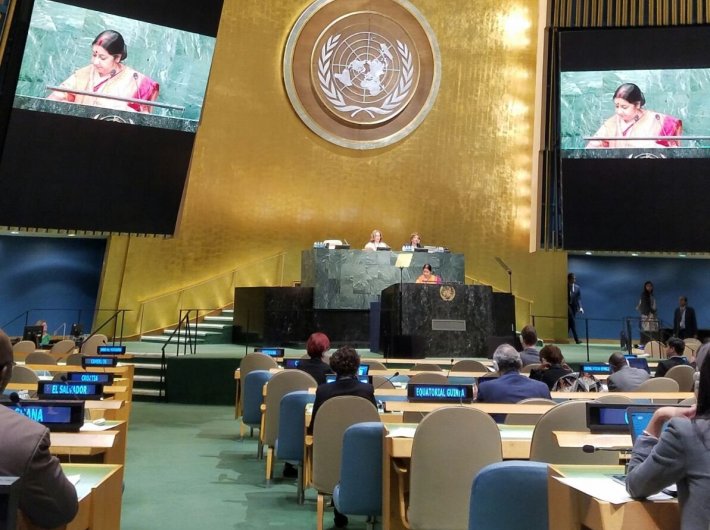

Leader of Opposition Sushma Swaraj at Ficci annual meet on Saturday

Leader of Opposition in the Lok Sabha Sushma Swaraj on Saturday said the government has presented a "tired man's budget" which lacked dynamism and the vision to overcome food insecurity and price rise.

"This is a tired man's budget. There is no dynamism in it...it lacks vision," Swaraj said at a FICCI-organised function here.

She maintained that the allocation for increasing agricultural productivity and irrigation, among several other subjects, were too less to usher in any significant growth.

The senior BJP leader enumerated the programmes launched by the erstwhile NDA regime and alleged that the UPA had been "lethargic" in implementing them. She named the Golden Quadrilateral scheme and the interlinking of rivers as two such projects which were "slowed down" by the UPA.

Corruption, she insisted, was one reason for the delay.

On the sensitive issue of food security, Swaraj said the government had faltered as it was yet not clear about the exact number of people Below the Poverty Line who need to be covered under the Food Security Act.

"Moreover, there has been a fall of 8 per cent in the land under agriculture since last year. From 680 lakh hectares under agriculture it has come down to 626 lakh hectares, leading to a fall in production of foodgrains," she said.

The Leader of Opposition also pointed out lack of storage facilities in the government-owned FCI godowns. She also accused the Centre of providing less foodgrains to the states for disposal under the Public Distribution System.

Without proper vision and the will to implement the plans, Millennium Development Goals and Vision 2020 will not yield results, she maintained.

"We are midway for the Vision 2020 goals and need to analyse whether we are moving at the required pace. There is no scope for repentance," Swaraj said.

The Vidisha MP asserted that hunger was the biggest challenge before the country today and quoted Economic Survey figures to argue that poverty and inequality had increased in the country since the last fiscal year.

"The country needs another Green Revolution," she said.

She recalled that the BJP manifesto had identified eradication of hunger, corruption and fear as its goals if it was voted to power.

"National security, both internal and external, is a challenge. Half of the districts in the country are not under government control as the writ of either Maoists or Naxals or insurgents runs there," Swaraj said.

"Peace is a pre-requisite for development," she added.

On corruption, Swaraj said that it was a "termite" eating the whole nation.

Comments


Other News

V. M. Tarkunde: A legal luminary par excellence

14 Lawyers: Portraits from The Bar By Raju Ramachandran  Juggernaut, 248 pages, Rs. 799  

The Cost of Obesity

The latest episode of Checks and Balances focuses on the ticking time bomb of obesity in India, and Geetanjali Minhas of Governance Now spoke with a panel of experts. You can watch the episode here: https://youtu.be/mH

US-Iran deal: Path to peace or prelude to deeper regional quagmire?

In the midst of deep mistrust, the US and Iran are reported to have reached a framework deal for ending the West Asian conflict. But whether it will result in any meaningful breakthrough or pave the way for any lasting peace in the region, is in the realm of speculation.   During

Lived life, philosophy, spirituality and other enigmas

The Ashes Are Warm: Memories of a Lifetime Spent with UG Krishnamurti By Mahesh Bhatt and Sunita Pant Bansal Rupa Publications, 384 pages, Rs 495  

In Varanasi, fringe expansion vs. core heritage

For centuries, the urban framework of Varanasi was defined not just by its relationship with the sacred Ganga but by its multifaceted network of urban commons. Historic kunds, seasonal talabs (ponds), and open maidans served as the city’s basic ecological infrastructure. Th

What ails India`s skill development ecosystem

India’s skill development programmes were designed with a goal to make the young population ready with market-required skills and competencies, and to provide them with better employment opportunities. Yet the outcomes have fallen short of that goal: though over 1.6 crore individuals were trained acr


Archives

Current Issue

Opinion

Facebook Twitter Google Plus Linkedin Subscribe Newsletter

Twitter







