
Kashmir to lose special status

Home minister moves resolution to scrap Art 370, Art 35A

GN Bureau | August 5, 2019

#Kashmir   #Jammu and Kashmir   #Narendra Modi   #Amit Shah   #Article 370   #Article 35A   #Ladakh  
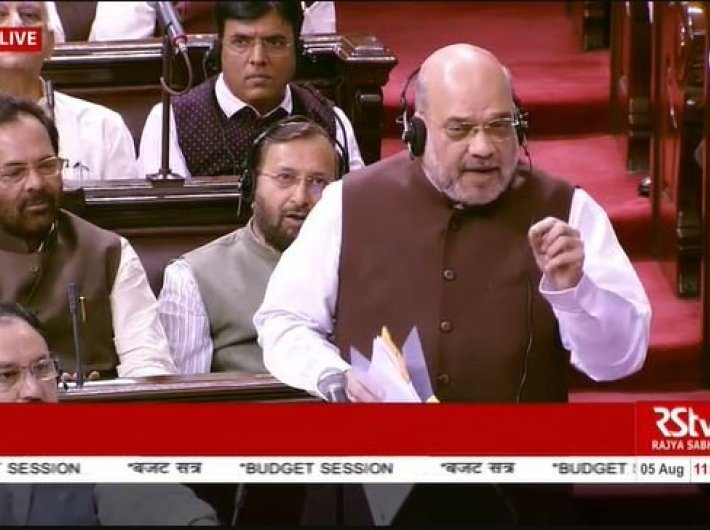
Home minister Amit Shah in Rajya Sabha on Monday (image via Twitter)

In a historic move with long political repercussions, the Narendra Modi government on Monday moved to scrap the special status granted via Article 370 to Jammu and Kashmir, ending decades of debates over the controversial provisions and fulfilling a key promise of the ruling BJP.

Home minister Amit Shah moved a resolution in the Rajya Sabha that all clauses of Article 370 will not be applicable to Jammu and Kashmir. Furthermore, the government proposes to reorganize J&K, keeping Ladakh region as a union territory without legislature, and the turning the rest of the state as a union territory with legislature.

While the move, described as historic by Shah, came as a surprise, the government had prepared ground for it, taking precautions against any reactions from the ground. Last week, the ongoing Amarnath Yatra  in Kashmir was abruptly canceled, and on Sunday leading politicians including former chief ministers Mehbooba Mufti and Omar Abdullah were put under house arrest. Late Sunday night, Section 144 of the CrPC banning assembly of five or more people was imposed in Srinagar district. More security forces were being deployed in the restive border state.

Scrapping Article 370 – through which Kashmir became part of India but retains special status – along with a Ram temple in Ayodhya and a Uniform Civil Code have long been on the BJP agenda.

In parliament, the opposition created ruckus, with Ghulam Nabi Azad of Congress calling it a murder of the Constitution.  
 

Comments


Other News

Climate change is stealing sleep

Climate change has at least doubled the temperature-related sleep loss across 1,338 major cities worldwide over the past five decades, highlighting an emerging but often overlooked public health consequence of rising global temperatures. A new study by Climate Central estimates that between 2020 and

Cabinet approves Mobile Phone Manufacturing Scheme

The union cabinet chaired by PM Narendra Modi has approved the Mobile Phone Manufacturing Scheme (MPMS) with a budgetary outlay of Rs 62,500 crore. It aims to further scale up the production, deepen domestic value addition, strengthen supply chain resilience, enhance global competitiveness. It

Building infrastructure is only half the job

Recent stories of stolen railway wires, disappearing communication towers and missing public infrastructure are often treated as bizarre law-and-order failures of India. Yet they raise a more fundamental question. Why does the State often discover the disappearance of a public asset only after it has alrea

New Delhi’s Indo-Pacific strategy enters a new phase

India appears to be investing fresh dynamism in its Indo-Pacific strategy. At the time when the US, under president Donald Trump, has adopted a conciliatory approach towards China and has changed the name of America’s Indo-Pacific Command to just Pacific Command, India has quietly moved towards con

CAG flags major fiscal lapses in Maharashtra

Maharashtra`s fiscal management has come under sharp scrutiny after the Comptroller and Auditor General (CAG) of India, in its State Finances Audit Report for 2024-25, flagged significant budgetary inefficiencies, accounting irregularities, understatement of key fiscal indicators and widespread governanc

The health sector research we are not doing

Some neglect is loud. This kind is quiet. It sits in research never commissioned, data never collected, questions never asked. In South Asia, that quiet has let the region’s worst health problems stay understudied, underfunded, and out of sight of those who could act.  

Upcoming Conferences


Archives

Current Issue

Opinion

Facebook Twitter Google Plus Linkedin Subscribe Newsletter

Twitter






