Some neglect is loud. This kind is quiet. It sits in research never commissioned, data never collected, questions never asked. In South Asia, that quiet has let the region’s worst health problems stay understudied, underfunded, and out of sight of those who could act.
Nearly two billion people live here and carry a large share of the world’s disease burden. The research funding aimed at the region sometimes bears little relation to that scale. This kind of pattern is not newly discovered. The Global Forum for Health Research named the pattern the 10/90 gap in 2000, when under 10 percent of the world’s health research spending went to the diseases behind 90 percent of the global burden. The gap has deep, structural roots, but that is starting to change, as governments, funders and researchers begin working to close it.
India’s own accounting shows where the harm concentrates. Its most detailed state-level estimates, which is the State Level Disease Burden Initiative (ICMR, PHFI and IHME 2017), rank ischaemic heart disease as the leading cause of death and lost healthy years. Chronic lung disease, stroke, diarrhoeal disease, respiratory infections, tuberculosis, road injuries and suicide fill the ranks below.
The exposures South Asia barely studies sit upstream of those same conditions.
Lead and arsenic contaminate soil, water, air and food across the region. Childhood lead exposure causes irreversible cognitive harm and lifelong losses in earnings. According to an IIT Kharagpur 2021 study, about 90 million people in India, and 50 million in Bangladesh (WHO) draw arsenic-laced groundwater. A 2023 analysis in The Lancet Planetary Health tied lead to 5.5 million cardiovascular deaths worldwide in 2019, six times the standard Global Burden of Disease figure. A 20-year study in Bangladesh, published in JAMA in 2025, found that lowering arsenic in wells cut deaths from heart disease and cancer.
The measurement that would track this barely exists. A 2024 statewide survey in Bihar found over 90 percent of children tested carried blood lead above the WHO reference level. Real surveillance is close to absent, and the children with the highest exposure go unmeasured.
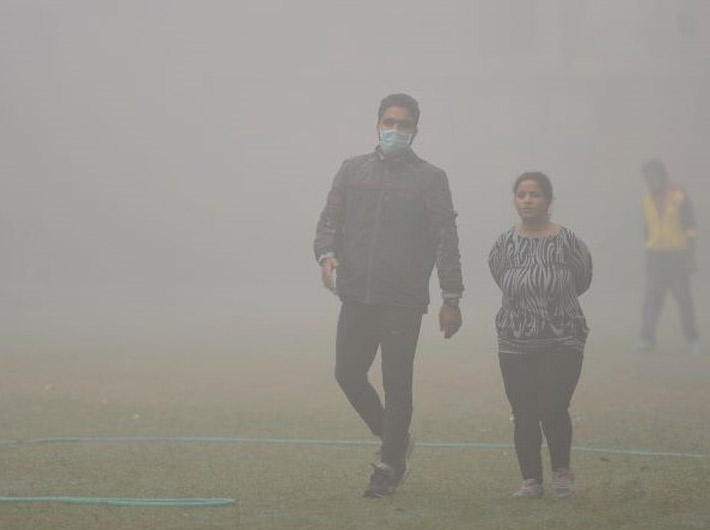
Air pollution is the rare exposure India does measure. According to the State Level Disease Burden Initiative report-2017, it ranked second only to child and maternal malnutrition among India’s health risks. The 2025 Lancet Countdown attributed more than 1.7 million Indian deaths in 2022 to fine-particle pollution, up 38 percent since 2010. The World Bank puts premature deaths across South Asia near 2 million a year, and the Air Quality Life Index 2025 estimates pollution has cut average life expectancy in Delhi by more than 8 years. Household smoke from biomass falls hardest on women and young children. Even here, the long-term studies that trace exposure to outcome stay thin.
Heat belongs in the same accounting, uncounted in the 2016 estimates. A 2024 study found two consecutive days of extreme heat raised daily mortality by almost 15 percent across 10 Indian cities. Heat deaths settle on the same cardiovascular and respiratory conditions, yet official counts catch only a sliver. Most heat mortality never reaches a death certificate as heat due to several reasons including lack of awareness and research.
Mental health is the most underfunded part of public health in the region, and the burden data shows it. Mental disorders are among the largest sources of disability, and suicide ranks among the top causes of death and lost years of life. Government spending in most LMICs on it stays below one percent of health budgets. Women, rural populations and the poor sit outside the scope of inquiry.
Occupational health is neglected the same way. Work-related risks made up roughly three percent of India’s measured burden (State Level Disease Burden Report 2017), and even that rests on thin data for the hundreds of millions of informal workers who carry its physical cost.
The issues discussed are common, disabling, and almost absent from the research agenda.
Evidences from the last two decades will point out that infectious diseases attract ample resources, while endemic, slow-moving conditions look less urgent, even when their toll runs higher. Much of that gap reflects how little local evidence has reached those who fund research. That needs and is starting to change. National institutions are documenting these exposures and making the case to funders, and even small domestic studies are building awareness on environmental and mental health. One study in Bihar and Jharkhand found more than 200 lead-pollution sites tied to battery recycling, 90 percent above US soil-lead standards, the kind of evidence that turns an invisible problem into one worth acting on.
South Asian governments and research institutions can put more money into the public health research that has been overlooked, and treat environmental exposure, air quality, mental health and occupational disease as core infrastructure, alongside disease surveillance. Stronger regional cooperation, through platforms like SAARC, would carry this further: acting in tandem, countries can pool comparative data at a scale none could reach alone, and that evidence builds both the case and the opportunities for funders to invest where the need is greatest.
South Asia's disease burden concentrates where deprivation and pollution meet, among those with the least say over what science studies. For years the research agenda followed global patterns that may not be applicable to a particular country. But the shift is underway, and it needs to go much further. Local institutions need to measure these exposures and put the evidence forward, so that conditions which were invisible are starting to get named. What gets named can start to get resources, but turning early awareness into sustained investment will take far more of this work. What a society chooses to measure shapes what it eventually solves, and that choice is slowly turning toward the people who carry the heaviest burden.
Dr Sanyal, public health and development professional with 11 years experience, is a Fellow with Pahle India Foundation, New Delhi.