A new study reconstructs nearly 4,000 years of climate and vegetation history of Majuli Island in Assam
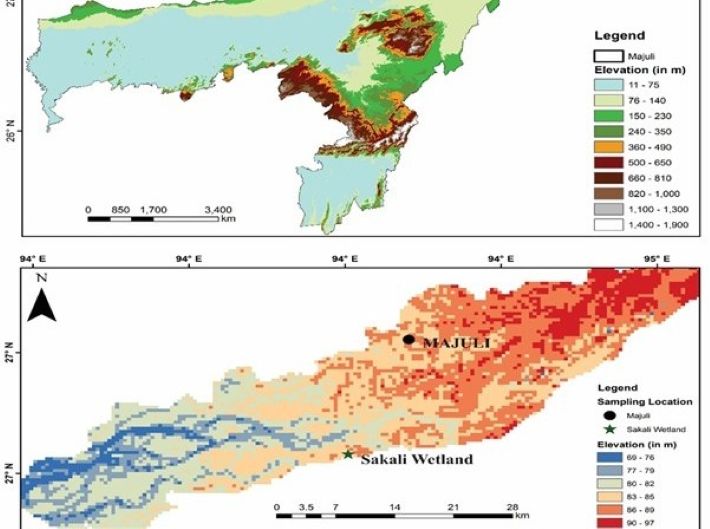
Majuli Island, perched between the Brahmaputra River to the south and east, the Subansiri River to the west, and a branch of the Brahmaputra to the north, has been severely affected by recurrent flooding and intense riverbank erosion. Despite its global importance in acquiring UNESCO tentative status for cultural significance, the region lacked any comprehensive long-term palaeoecological reconstruction based on palynological evidence resting on integrated modern and fossil pollen records. Pollen serves, as one of the most reliable indicators of past environmental conditions as they are durable and can remain preserved in sediments for thousands to millions of years.
Scientists from the Birbal Sahni Institute of Palaeosciences (BSIP), Lucknow, an autonomous institute of the Department of Science and Technology (DST) have carried out a pioneering palaeoecological study on the Majuli Island, which has undergone severe land loss and is highly vulnerable to deforestation, urbanization, and recurrent flooding, according to an official release.
They collected 150 cm deep sediment core from Sakali Wetland on Majuli Island and used it to combine analysis of pollen (to reconstruct past vegetation) with grain-size studies (to understand river dynamics and flood intensity), creating the first-ever comprehensive environmental record for the island. The study reconstructs Mid-Late Holocene environmental changes, filling a critical gap in understanding regional climate, vegetation, and wetland dynamics in the Upper Brahmaputra Valley.
Supported by modern pollen analogues and pollen based quantitative palaeoclimatic reconstruction method called Coexistence Approach, the research estimates past Mean Annual Temperature (MAT) and Mean Annual Precipitation (MAP) during 4040 to 500 cal. yrs. BP. The results indicate an early warm and humid phase (4040–2260 cal. yrs. BP) with dense forest cover, suggesting resilience during the 4.2 ka dry climatic event. This was followed by phases of fluctuating monsoon intensity and flood regimes, including a relatively moist period during 1100–500 cal. yrs. BP., corresponding to the Medieval Climatic Anomaly. The last around 500 years show declining temperature and precipitation, consistent with the Little Ice Age, along with increased anthropogenic influence and expansion of scattered vegetation.
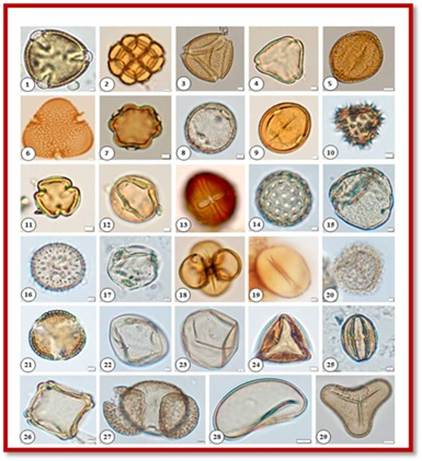 Palynomorphs recovered from the sediments of Majuli Island, Assam.
Butea monosperma, 2. Acacia nilotica, 3. Schleichera, 4. Syzygium, 5. Lagerstroemia, 6. Bombax Cieba, 7. Terminalia, 8. Emblica, 9. Sapotaceae, 10. Asteraceae, 11 & 12. Fabaceae, 13. Melastoma, 14. Chenopodiaceae, 15. Symplocos, 16. Lemna, 17. Onagraceae, 18. Typha, 19. Nymphaea, 20. Nymphoides, 21. Brassica, 22. Non-cereal, 23. Cereal, 24. Cyperaceae, 25. Coriandrum, 26. Alnus, 27. Pinus, 28. Monolete, 29. Degraded trilete.
The study led by Arya Pandey (DST-INSPIRE SRF) and Dr. Swati Tripathi, Scientist-E (Supervisor) BSIP, in collaboration with Dr. Sadhan Kumar Basumatary (BSIP), Dr. Salman Khan (Germany) Dr. Hema Singh (BHU), Dr. Biswajeet Thakur (BSIP), and Dr. Anupam Sharma (BSIP) evaluates the role of fluvial processes of the Brahmaputra and the associated river systems around Majuli in shaping the depositional environment and influencing ecological dynamics on the island.
Grain-size data indicate a shift from low- to high-energy fluvial conditions, reflecting increasing hydrodynamic instability over time and advancing understanding of climate-vegetation–fluvial interactions in river island ecosystems.
The integration of pollen and grain-size analyses improves understanding of past flood intensity, sediment transport, and erosion processes, which is crucial for river management and disaster mitigation in the Brahmaputra basin.
The results demonstrate clear synchronicity between local vegetation dynamics and major global climatic events, highlighting the sensitivity of the region to broader climate forcing. The findings also identify phases of ecological resilience and vulnerability, providing a scientific basis for biodiversity conservation, wetland restoration, and sustainable land-use planning.
Published in Review of Palaeobotany and Palynology (Elsevier), this study presents the first comprehensive multi-proxy (pollen and grain-size) reconstruction of long-term climate-vegetation dynamics and river processes on Majuli Island and could informed policymaking and climate adaptation strategies, benefiting communities affected by recurrent flooding and land loss.