
Concerned over another ‘encroachment’ at the Yamuna bed, public intellectuals and social activists raise an alarm about a to-be event of the Art of Living foundation
GN Bureau | February 17, 2016

A group of public intellectuals and social activists have written a letter to the president, the prime minister and concerned government representatives urging them to stop encroachment and destruction of Yamuna floodplains. Their concern has stemmed from the announcement of an event, scheduled on March 16, to celebrate the 35th anniversary of the 'Art of Living' foundation, a private organisation formed by Sri Sri Ravi Shankar.
The intellectuals and activists have said that construction work which has already started at the Yamuna bed is destabilising and destructing the ecosystem of the river. The floodplains are getting encroached and damaged largely, which used to play a crucial role in maintaining biodiversity and health of the river, they add.
Addressing the letter to the president and the prime minister who apparently have plans to attend the event, the group says that their participation might appear to lend legitimacy to an illegal activity. They support their argument by writing, “the event is being planned after clearing, compacting, dumping of earth and construction underway over some 1,000 acres of the active flood plain of river Yamuna in Delhi, and the matter being sub-judice at the National Green Tribunal … as prima facie the said preparations are in violation of the NGT judgment of 13 January, 2015 …”
To further back their argument, the group has attached a pictorial report highlighting through comparative photos of September 15, 2015 and February 5, 2016, on how “a verdant flood plain has got systematically destroyed and is being converted for the event.” This additional encroachment, the group said, will only make the situation worse. In the past, construction activities for the commonwealth games, millennium bus depot, Akshardham temple and others have been in controversies for alleged encroachment of the Yamuna plains.
The letter adds that according to India’s current national water policy, “Conservation of rivers, river corridors, water bodies and infrastructure should be undertaken in a scientifically planned manner through community participation… Environmental needs of Himalayan regions, aquatic eco-system, wet lands and embanked flood plains need to be recognized and taken into consideration while planning.” The group contends that in the current case, national water policy stands violated.
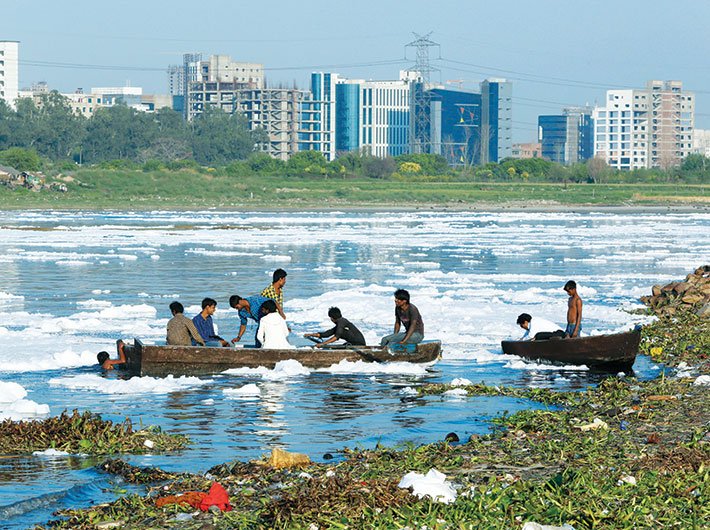
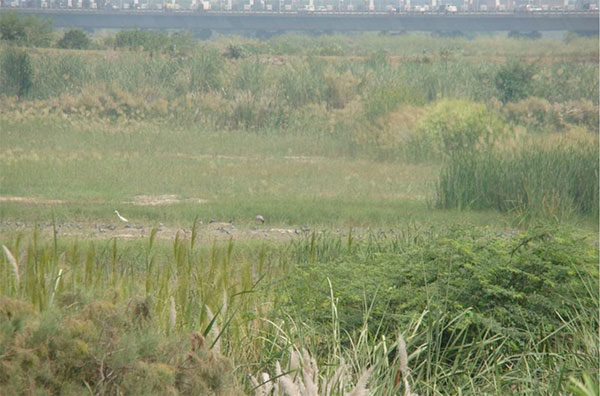
September 15, 2015 February 5, 2016
The group feels that even though the event would run for a few days, the devastation resulting from its preparatory and operational phase (some 35 lakh persons are expected to participate with a stage planned to be constructed over some seven acres of land) would outlast decades in terms of river Yamuna's health, which already is in no great shape.
People who have written the letter:
1. EAS Sarma, former secretary
2. Medha Patkar, Narmada Bachao Andolan
3. Madhu Bhaduri, former ambassador of India
4. Paritosh Tyagi, chairman & managing trustee, IDC Foundation
5. Bharat Jhunjhunwala, former professor, IIM-B
6. Dr Latha Anantha, River Research Centre
7. Samir Mehta, River Basin Friends
8. Dr Sudhirendar Sharma, Ecological Foundation
9. Vimal Bhai, Matu Jan Sangathan
10. Malika Virdi, Himal Prakriti
11. Emmanuel Theophilus, Himal Prakriti
12. Ramnarayan. K, Himal Prakriti
13. Parineeta Dandekar, South Asia Network on Dams, Rivers and People
14. Himanshu Thakkar, South Asia Network on Dams, Rivers and People
In a significant gain for citizen protection in the digital economy, the Department of Telecommunications (DoT) has helped prevent suspected cyber fraud losses of more than ₹5,000 crore through its Financial Fraud Risk Indicator (FRI) within fifteen months of its launch on May 22, 2025. This money did
The Defence Acquisition Council (DAC), under the chairmanship of Raksha Mantri Rajnath Singh, on Monday accorded Acceptance of Necessity (AoN), that is, in-principle administrative approval to various acquisition proposals of the defence forces at an estimated cost of about Rs 1,10,000 crore.
There`s a certain moment in diplomacy that`s too personal to be captured in a communiqué, too small to make the front page, but more revealing than the front page. This week, prime minister Narendra Modi reached Tashkent and, amid the pomp of state visits, managed to evoke the old Bollywood tunes
India became the 123rd WTO member to ratify the multilateral Agreement on Fisheries subsidies (AoFS) when it deposited the Instrument of Acceptance for Phase 1 on July 20, 2026. The ratification is restricted to disciplining Illegal, Unreported and Unregulated fishing (IUU), protection for overfished
India has become accustomed to hearing the 7% growth number. It is now less a milestone than an expectation. Yet the paradox is becoming clearer: maintaining 7% growth may be considerably harder than achieving it once. India’s real GDP grew 7.7% in FY2025–26, following growth of 6.5% in FY202
Justice Abhay Oka, who retired from the Supreme Court in May 2025, has said that the Constitution of India cannot be altered. Explaining the landmark Kesavananda Bharati judgment (1973) on the basic structure of the Constitution, he said, “This is one judgment that has saved democracy in India.&rdq











