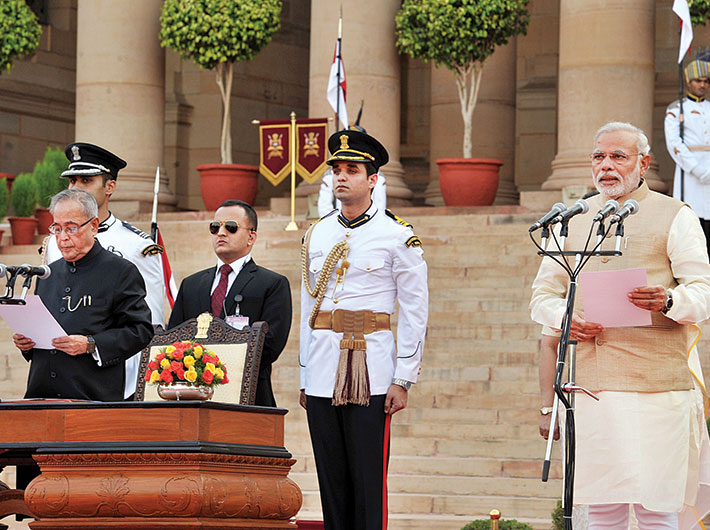
Those who feel left out of the celebrations after Modi's victory must be brought on board for the larger cause
Some events remain firmly etched in our collective memory. Nelson Mandela’s oath-taking ceremony in 1994 was an awe-inspiring event that marked the end of apartheid. The democratic verdict in South Africa was an assurance that the world was increasingly inching towards inclusiveness. When Barack Obama refuted the notion that democracy is all about numbers and took oath as the president of the world’s oldest democracy in 2008, large sections of humanity felt the world was a better place. His swearing-in ceremony was the realisation of the dream that a racial minority would not be at disadvantage in a democracy.
Narendra Modi, was sworn in as India’s 15th prime minister in grand style. But the content of the gala swearing-in ceremony was not in tune with the spirit of the oath-takings of 1994 in South Africa and 2007 in the US. It did raise certain disturbing issues in the context of subcontinent despite the presence of the Saarc heads of state – an event without precedent.
For the first time in India, the party that won a comfortable majority in the Lok Sabha does not have a single Muslim representative. This one stark reality highlights the exclusive nature of the ceremony though Modi did induct one Muslim face, Najma Heptullah, in his council of ministers as a consolation to the minorities.
Of course, the entire blame for such an exclusivist trend cannot be put on one individual or party. Far from it, it is a pathetic reflection on the inadequacy of our political culture that such a scenario has emerged in the 21st century India.
There is little doubt that if identity politics on communal divide is firmed up, those claiming to represent the majority would gain. But such a cynical calculation would grossly undermine the idea of India and render the founding principles of the constitution meaningless. But what about those who claim to champion the cause of the minority? Do they deserve less blame for contributing to the alienation of a section of society? Even those uninitiated in politics would confirm that it is indeed a repulsive spectacle to see Congress president Sonia Gandhi courting Shahi Imam of Delhi’s Jama Masjid to flaunt her secular credentials. The same holds true for other self-proclaimed secularists who found more comfort in masquerading criminals as Muslim leaders as a token of their faith in secularism.
The 2014 election results must be an occasion for introspection by political parties and their leaders to initiate measures for course correction. Perhaps prime minister Modi was quite aware of the limitations of this overwhelming mandate and took the right step in inviting the leaders of the Saarc nations to participate in his swearing-in ceremony. Despite his often provocative anti-Pakistan rhetoric during election campaigns, Modi displayed pragmatism in breaking ice with his Pakistani counterpart Nawaz Sharif. Similarly, he refused to let either Mamata Bannerjee or J Jayalalithaa dictate India’s foreign policy with regard to Bangladesh or Sri Lanka. This is in sharp contrast to the UPA regime, which buckled under the pressure of these two ladies who held bilateral ties with Bangladesh and Sri Lanka to ransom because of their politics.
Apparently Modi has tried to overcome his domestic limitations by extending the arena of his swearing-in to a larger audience in the subcontinent. This was indeed a clever move given the fact that peace and prosperity of each nation of South Asia are interlinked. With Modi emerging as the most powerful leader India has seen in the past three decades, he is in a unique position to reassure the neighbours about the peaceful and prosperous coexistence. By all indications, Modi has achieved a diplomatic success. But this transitory sense of hubris must not miss the larger issue at hand, which is purely domestic. Those who feel left out of the celebrations after Modi’s victory must be brought on board for the larger cause. The oath-taking ceremony at the forecourt of the Rashtrapati Bhavan on May 26 will then become memorable event for the posterity.