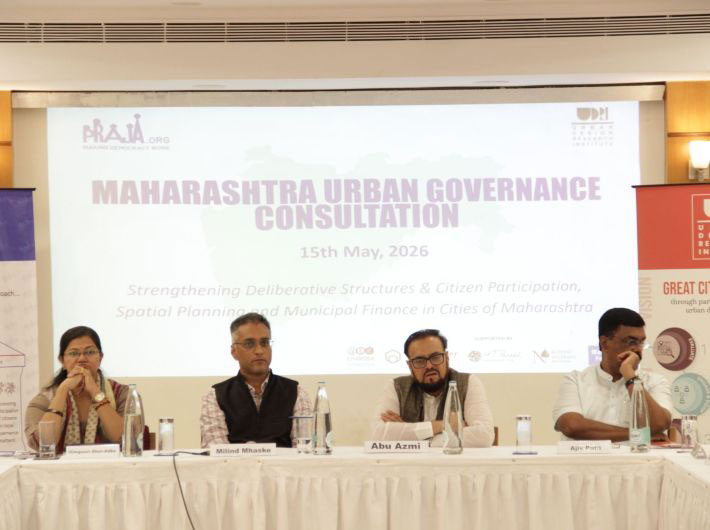
Praja Foundation consultation in Mumbai highlights gaps in municipal finance, citizen participation, digital governance and deliberative structures across 29 city corporations
A statewide consultation organised by Praja Foundation has highlighted major governance, financial, and citizen participation gaps across Maharashtra’s Municipal Corporations, calling for urgent reforms to strengthen urban local bodies in line with the 74th Constitutional Amendment Act.
The “State Consultation on Strengthening Deliberative Structures, Citizen Participation, Municipal Finance & Planning in Cities of Maharashtra” brought together urban governance experts, researchers, practitioners, and stakeholders in Mumbai on Friday to discuss the future of city governance in Maharashtra.
One of the key findings revealed that only 16 out of Maharashtra’s 29 Municipal Corporations currently have Corporation Procedure Rules (CPR), leaving nearly half the corporations without structured rules for deliberation and decision-making. The report noted that weak institutional frameworks continue to limit transparency, accountability, and effective governance at the city level.
Municipal finances also emerged as a major concern. Property Tax contributes only 7.7% of total municipal income across cities despite being one of the largest potential revenue sources for urban local bodies. The study further revealed that Mumbai generates 69.4% of its municipal income through Own Source Revenue, while the average across Maharashtra’s Municipal Corporations stands at only 31.8%, indicating heavy dependence on state government transfers.
The consultation also pointed to inadequate citizen participation systems in most cities. As many as 22 Municipal Corporations do not have a dedicated ‘Needs and Wants’ portal through which citizens can communicate priorities and suggestions directly to city governments. Only a few corporations, including Nashik, Navi Mumbai, Pune, Vasai Virar, Kalyan Dombivli, Ahilyanagar and Latur, have mechanisms enabling citizens to provide suggestions and feedback on governance and projects.
The report further observed that several Municipal Corporations still lack robust digital governance infrastructure, including functional websites, mobile applications, open data portals, and integrated grievance redressal systems.
The consultation reviewed the implementation status of the 74th Constitutional Amendment Act, 1992, which was enacted to strengthen decentralised urban governance. Discussions focused on the need for an empowered Mayor, councillors, councils, and committees to improve local democratic functioning.
According to the findings, the Mayor in Maharashtra currently lacks executive authority and does not have a tenure coterminous with the elected city government. Under the existing Mumbai Municipal Corporation Act, 1888 and Maharashtra Municipal Corporation Act, 1949, the Mayor is indirectly elected by councillors and does not have powers such as writing the Annual Confidential Report (ACR) of the Municipal Commissioner. Kerala was cited as the only state where the Mayor has authority to write the Commissioner’s ACR.
The consultation also highlighted the absence of mandatory capacity-building provisions for elected representatives and municipal officials. Experts recommended regular training, institutional support, office infrastructure, and dedicated staff for councillors and committee chairpersons to improve governance outcomes.
Another major issue raised was the incomplete devolution of the 18 functions listed under the Twelfth Schedule of the Constitution. Mumbai remains the only city in Maharashtra with a majority of these functions devolved, while other cities continue to function with limited administrative authority.
Key recommendations emerging from the consultation included extending the Mayor’s tenure from 2.5 years to five years, granting executive authority to the Mayor over the Commissioner, creating stronger committee systems, and empowering Municipal Corporations to independently frame bye-laws.
The report also stressed the need for transparent deliberative processes, structured council meetings, accessible public records, improved financial decision-making frameworks, and stronger citizen engagement systems. Recommendations included creating open data portals, establishing feedback and “Needs and Wants” platforms, implementing complaint closure verification systems, and expanding digital grievance redressal mechanisms.
The consultation concluded that stronger deliberative democratic structures, empowered city governments, and institutionalised citizen participation are essential for building accountable, financially sustainable, and responsive urban governance systems across Maharashtra.