
Need to digitise value chain of textile industry: Amitabh Kant

Experts discuss the contribution of the textile sector in India’s economic growth at Textiles India trade fair in Gujarat

pranita

Pranita Kulkarni | July 3, 2017 | Gandhinagar

#Nirmala Sitharaman   #Venkaiah Naidu   #Smriti Irani   #Gujarat   #Textiles India   #Narendra Modi   #Radha Mohan Singh  
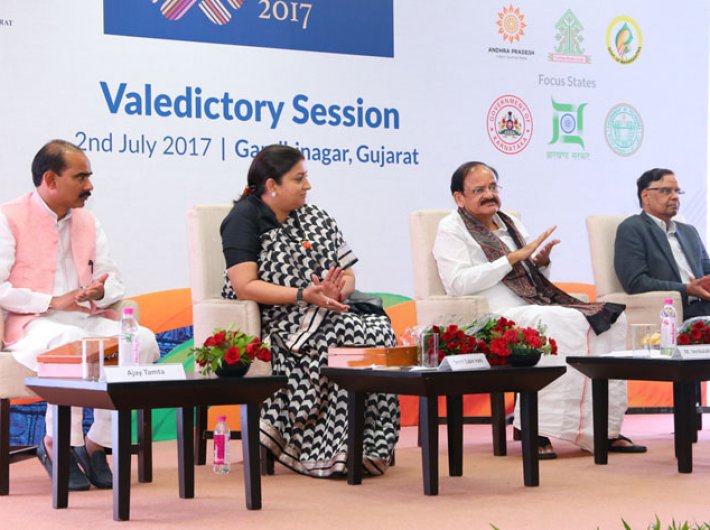
(Left to Right) Minister of state for textiles, Ajay Tamta, union minister for textiles, Smriti Irani, union minister for urban development, housing & urban poverty alleviation and information & broadcasting, M Venkaiah Naidu, and vice chairman, NITI Aayog, Arvind Panagariya at the valedictory session of Textiles India 2017, in Gandhinagar, Gujarat on July 02, 2017

“If India has to grow rapidly, it cannot grow without exports. We still import a lot of raw material like laces, buttons, elastics etc, which makes production expensive for the (clothing) manufacturers,” noted NITI Aayog CEO Amitabh Kant at the concluding day of Textiles India 2017  held in Gandhinagar, Gujarat.

He highlighted the importance of exports in the textile sector and the ease of doing business in India. 
 
He added that there is a need to digitise the entire value chain of the textile industry and that the industry can be boosted with a culture of collaboration and innovation. He said that he’s not a believer of subsidies and added that the country needs to move from “job-protecting labour laws” to “job-creating labour laws.”
 
The international trade fair, which was helmed by union textiles minister Smriti Irani and inaugurated by prime minister Narendra Modi, concluded on Sunday.
 
Ministers Venkaiah Naidu, Radha Mohan Singh, Rajiv Pratap Rudy, Ajay Tamta and Nirmala Sitharaman attended the final day of Textiles India 2017.  A number of panels constituting the ministers, industry representatives and senior officials of NITI Aayog talked about the roadmap for the sector aiming at increasing its global market share.
 
Naidu credited Irani for bringing vibrancy into the sector, which used to be “reserved for the ministers, who are to be sidelined”. He emphasised the need to let the industry have a say in the country’s development. “We have to encourage the trade. Unfortunately, because of our political mindsets, we politicians have developed some sort of allergy to the business. We believe that the industry also has a rightful place in the development of the country,” he said.
 
Speaking about making India a sourcing hub and investment during a panel discussion, Sitharaman said that the focus should be on promoting niche areas that cover indigenous artisans, weavers and craftsmen, as they provide a unique identity to the country’s textile output. She added that in the industry’s efforts to match up to the demand for man-made fibre, the focus has shifted away from these niche areas and that these need to be promoted.
 
Arvind Panagariya, vice-chairman, NITI Aayog iterated a similar view during the valedictory session, where he also said that the allegations of “jobless growth” are logically incorrect. However, he admitted that the jobs in the formal sector are in short supply.
Irani said, “It seems, in last three days, we have discovered that this is our sleeping giant, which is now roaring as the Make in India lion.”
 

Comments


Other News

Import duty on major edible oils cut

The government has reduced the Basic Customs Duty (BCD) on major imported crude edible oils with a view to moderating domestic edible oil prices, providing relief to consumers and mitigating inflationary pressures arising from the sharp increase in international edible oil prices.  

From pyramid to platform: BRICS agenda for Global South

In his opening address at the 18th BRICS Summit in New Delhi on September 12, prime minister Narendra Modi did something India`s diplomacy has been building towards for three years: he moved the ‘Voice of the Global South’ from a slogan to a work plan. Addressing the leaders, he argued that t

How to realise the full transformative potential of PM-JAY

The Pradhan Mantri Jan Arogya Yojana (PM-JAY), a welfare scheme which covers approximately 45 crore beneficiaries across India, provides cashless health cover of Rs. 5 lakh per family per year. It is the largest health insurance scheme which helped crores of poor families by reducing out-of-pocket expend

The missing men in India`s family planning story

Every pregnancy requires two people. Yet India`s family planning programme continues to ask only one of them to bear almost all of its medical consequences. The newly released National Family Health Survey-6 (2023-24) confirms just how entrenched this asymmetry remains: 36.5% of currently married women a

`Development must be judged beyond GDP, with rights and justice at core`

Delivering the IXth Chief Justice M.C. Chagla Memorial Lecture on ‘Human Rights and Sustainable Development Goals’, in Mumbai Friday,  former Chief Justice of India Bhushan R. Gavai questioned whether conventional economic indicators such as gross domestic product (GDP), national income,

RTI exposes Rs 16,909 crore cost blowout on Mumbai-Goa Highway

Seventeen years after the centre first approved the widening of National Highway 66 between Mumbai and Goa into a four-lane highway, a fresh RTI reply has revealed a sharp escalation in the project`s sanctioned cost.   According to the RTI reply obtained by activist Jeetendra

Upcoming Conferences


-->

Archives

Current Issue

Opinion

Facebook Twitter Google Plus Linkedin Subscribe Newsletter

Twitter






