
New year sees birth of NITI Aayog

As promised Modi replaces planning commission with new institution

prahlad

Prahlad Rao | January 1, 2015 | New Delhi
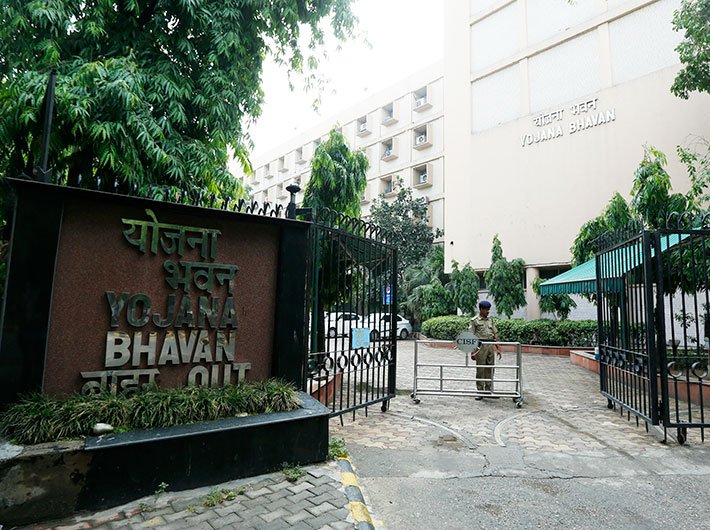


The shift is both in name and objective. The government on Thursday signaled the birth of NITI Aayog, replacing the planning commission . With this the new organisation will focus on policy, which is even more basic than planning.

An official statement said: "The Government has replaced planning commission with a new institution named NITI (National Institution for Transforming India) Aayog. The institution will serve as 'Think Tank' of the government - a directional and policy dynamo.

"NITI Aayog will provide governments at the central and state levels with relevant strategic and technical advice across the spectrum of key elements of policy, this includes matters of national and international import on the economic front, dissemination of best practices from within the country as well as from other nations, the infusion of new policy ideas and specific issue-based support."

The end of the planning commission that we know of came 64 years after it was established in March, 1950. The centralized planning mode of Jawaharlal Nehru has become outdated in modern tech era where changes take place at micro points, and at nano speed.


In his Independence Day speech, prime minister Narendra Modi had indicated that the commission had lost its relevance. Later, he tweeted asking for public feedback on what shape the institution should take.

Subsequently, Modi had held discussions with the chief ministers as the new India has become more federalist than it was six decades ago. [Read more on that meeting here]


The states have become revenue generation savvy even while politically they turn populist, draining the exchequer. Under this changed scenario, the states need to be given greater role in policy formulations, which will be the task of the new Neeti Ayog.

Its members would be the prime minister, cabinet ministers, chief ministers and experts in various sectors.

Why planning commission had to go?


It was conceived as the think tank to formulate and provide a long-time vision for the country. But the commission had become a tool of the central government both in allocation of funds and the policy choices of state governments.

Nehru admired the Soviet Union’s planning process for the industrialization the communist country and tried to replicate that model with the planning commission in 1950 for the development India's agrarian economy. However, India is now a different country and the world’s third largest economy. It calls for new thinking and new path.

    
Also read: Planning is dead, long live strategic thinking


Comments


Other News

RBI pauses to assess inflation risks, policy transmission

The Reserve Bank of India (RBI) has begun the new fiscal year with a calibrated pause, keeping the repo rate unchanged at 5.25 per cent in its April Monetary Policy Committee (MPC) meeting. The decision, taken unanimously, reflects a shift from aggressive policy action to cautious observation after a signi

New pathways for tourism growth

Traditionally, India’s tourism policy has been based on three main components: the number of visitors, building tourist attractions and providing facilities for tourists. Due to the increase in climate-related issues and environmental destruction that occurred over previous years, policymakers have b

Is the US a superpower anymore?

On April 8, hours after warning that “a whole civilisation will die tonight,” US president Donald Trump, exhibiting his unique style of retreating from high-voltage brinkmanship, announced that he agreed to a two-week ceasefire with Iran. The weekend talks in Islamabad have failed and the futur

Machines communicate, humans connect

There is a moment every event professional knows—the kind that arrives without warning, usually an hour before the curtain rises. Months of meticulous planning are in place. And then comes the call: “We’ll also need a projector. For the slides.”   No email

Why India is entering a ‘stagflation lite’ phase

India’s macroeconomic narrative is quietly shifting—from a rare “Goldilocks” equilibrium of stable growth and contained inflation to a more fragile phase where external shocks are beginning to dominate domestic policy outcomes. The numbers still look reassuring at first glance: GDP

Labour law in India: A decade of transition

The story of labour law in India is not just about laws and codes, but also about how the nation has continued to negotiate the position of the workforce within its economic framework. The implementation of the Labour Codes across the country in November 2025 marks a definitive endpoint in the process. Yet


Archives

Current Issue

Opinion

Facebook Twitter Google Plus Linkedin Subscribe Newsletter

Twitter