
Vande Bharat Express to cover New Delhi-Varanasi journey in 8 hours

Vishwas Dass | February 15, 2019 | Delhi

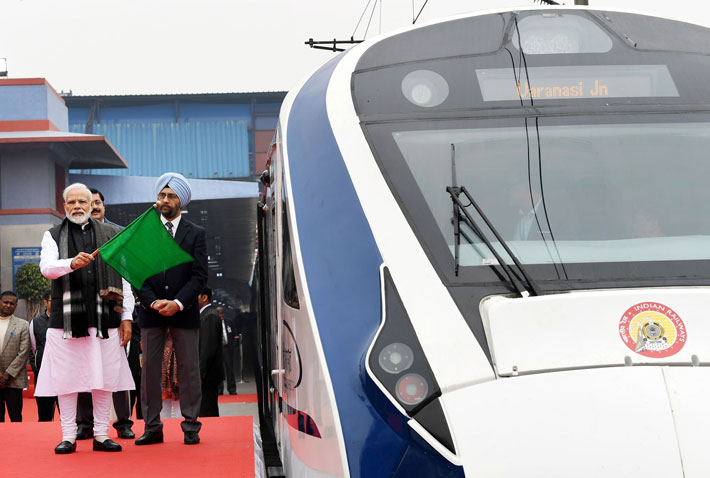
Indian Railways entered a new era as prime minister Narendra Modi on Friday flagged off the country’s first semi high-speed train, Vande Bharat Express, from the New Delhi railway station.
The new train is also seen as a success story of the NDA government’s ‘Make in India’ initiative, as its major systems have been designed and built indigenously. Impact of this train, matching global standards of performance, safety and passenger comfort and yet costing less than half of global prices, has the potential to be a game changer in the global rail business, an official statement said.
The PM flagged off the maiden run of the train after inspecting the facilities in the train and addressed a gathering on this occasion. Railways minister Piyush Goyal is leading a team of officials and media persons aboard the train on its inaugural run. It will stop at Kanpur and Allahabad where it will be received by dignitaries and the people.
Modi said the government had worked hard to improve the railways infrastructure and Vande Bharat Express was a testimony of this hard work. He congratulated the Indian railways for being one of organisations that pioneered the Make in India initiative. Rail coach factories were being modernised and diesel engines are being converted into electric ones.
The train left at 11.19 am for Varanasi and was expected to reach the destination within 8 hours.
Source: Vishwas Dass
Thousands of curious people had lined up along the tracks, clicking photographs and making videos as the train passed through stations like Shivaji Bridge in Delhi, Ghaziabad junction and Tundala Junction near the national capital. As the train passed villages, people were seen forming a human chain along the tracks to have a glimpse of India's first semi high-speed train.
Over 500 people including journalists, railway officials and other staff were travelling on the train with heavy security arrangements put in place.
One has to shell out Rs 1,760 for chair car seat and around Rs 3,310 for executive class seat for travelling between New Delhi and Varanasi.
Girish Pillai, member traffic, railway board, said the train set is a different technology which doesn’t have a locomotive. He said the railways have registered 100 percent booking for the first commercial inaugural run of Vande Bharat express on February 17.
He said acceleration and deaccaleration is different and better in this train compared to conventional ones. He said Vande Bharat would be taking around eight hours to reach Varanasi from New Delhi against 14 hours taken by other trains.
He said fare is carefully decided for the passengers and is lesser than the Gatiman express. He also said the fare is 1.4 time of the fare of chair car of Shatabdi. He said the Delhi-Varanasi route is the best one and a maximum number of Rajdhani trains run on this section. This is a busy route and that is why it was chosen for the Vande Bharat Express.
Pillai said fencing will be done only in the vulnerable routes where the train passes through dense towns.
Vande Bharat: At first glance
Vande Bharat Express can run up to a maximum speed of 160 kmph and has travel classes like Shatabdi train but with better facilities. It aims to provide a totally new travel experience to passengers. The train will cover the distance between New Delhi and Varanasi in 8 hours and will run on all days except Mondays and Thursdays.
Also read: The story behind India’s first semi high-speed train
All coaches are equipped with automatic doors, GPS-based audio-visual passenger information system, on-board hotspot Wi-Fi for entertainment purposes, and very comfortable seating. All toilets are bio-vacuum type. The lighting is dual mode – diffused for general illumination and personal – for every seat. Every coach has a pantry with facility to serve hot meals, hot and cold beverages. The insulation is meant to keep heat and noise to very low levels for additional passenger comfort.
Vande Bharat Express has 16 air-conditioned coaches of which 2 are executive class coaches. The total seating capacity is 1,128 passengers. It is much more than the conventional Shatabdi rake of equal number of coaches, thanks to shifting of all electric equipment below the coaches and seats in the driving coach also.
Adding up the green footprints, the train has regenerative braking system in the Vande Bharat Express coaches which can save up to 30% of electrical energy.
Speed, Safety and Service are the hallmarks of this train. Integral Coach Factory (ICF), Chennai, a Railways Production unit, has been the force behind a completely in-house design and manufacture, computer modelling and working with a large number of suppliers for system integration in just 18 months.
The Reserve Bank of India (RBI) has begun the new fiscal year with a calibrated pause, keeping the repo rate unchanged at 5.25 per cent in its April Monetary Policy Committee (MPC) meeting. The decision, taken unanimously, reflects a shift from aggressive policy action to cautious observation after a signi
Traditionally, India’s tourism policy has been based on three main components: the number of visitors, building tourist attractions and providing facilities for tourists. Due to the increase in climate-related issues and environmental destruction that occurred over previous years, policymakers have b
On April 8, hours after warning that “a whole civilisation will die tonight,” US president Donald Trump, exhibiting his unique style of retreating from high-voltage brinkmanship, announced that he agreed to a two-week ceasefire with Iran. The weekend talks in Islamabad have failed and the futur
There is a moment every event professional knows—the kind that arrives without warning, usually an hour before the curtain rises. Months of meticulous planning are in place. And then comes the call: “We’ll also need a projector. For the slides.” No email
India’s macroeconomic narrative is quietly shifting—from a rare “Goldilocks” equilibrium of stable growth and contained inflation to a more fragile phase where external shocks are beginning to dominate domestic policy outcomes. The numbers still look reassuring at first glance: GDP
The story of labour law in India is not just about laws and codes, but also about how the nation has continued to negotiate the position of the workforce within its economic framework. The implementation of the Labour Codes across the country in November 2025 marks a definitive endpoint in the process. Yet




