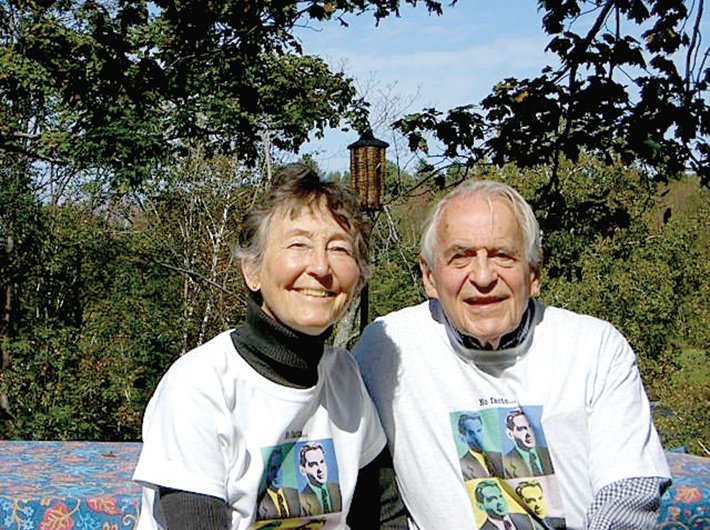
From the archive: an interview with the India specialist and political scientist couple
Susanne Rudolph, a professor emerita at the University of Chicago, passed away this week. We reproduce an interview with her and Lloyd I Rudolph soon after they received the Padma Bhushan in 2014.
“We are both more hopeful and more worried for India today”
Susanne Hoeber Rudolph, Professor Emerita, and Lloyd I Rudolph, Professor Emeritus, both at the University of Chicago, received the prestigious Padma Bhushan on March 30. The Rudolphs are pioneers in the study of the Indian political economy. Llyod Rudolph spoke to Shreerupa Mitra-Jha about the elections and their journey in India.
Your academic association with India began way back in the 1950s, a period marked by an escalating Cold War. I believe you drove your Land Rover from Austria to India. Since then your engagement with the study of Indian political economy has only deepened. How do you see the trajectory of Indian democracy in the last six decades?
Our new book, From London Overland to India and What We Learned There, published by Oxford University Press will be released soon. It is a travelogue of our impressions of a 5,000-mile journey that we made from Europe to Asia.
Coming to your question, when we started out we developed the idea of caste as a productive entity. Caste helped people act collectively, especially the lower castes, which are more numerous. It helped them gain power, gain respectability, negotiate better. When we came to India people told us that there was no associational life in India. But we found that caste groups produced a very strong associational life. What started out as a positive phase of caste associations turned ugly. Caste groups over time became violent. There was a broad sweep from Brahmin raj to gunda raj. Caste revolution gave rise to social revolution.
Coming to government formations, pre-1989 there were always majority outcomes with eight Congress governments. But post-1989 national parties became increasingly threatened with the rise of regional parties and the formation of coalition governments. An extreme example would be DMK’s A. Raja who was imposed on the national government. It is harder to have coherence and maintain authority with the need for bargaining with varied interests. It has become difficult to be effective and non-corrupt.
In your book, Modernity of Tradition (1967), you argued that caste would evolve as a political tool for mass mobilisation rather than fading away as democracy in India matures. You suggested three models for caste mobilisation for democracy: vertical, horizontal and differential. Your observations have proved prescient. How do you see the future of caste mobilisations in Indian politics, especially in view of the success of a movement-turned-party like AAP that has negotiated beyond caste boundaries?
There is a newer demography; younger people, women and gender questions have become important. This does not mean that caste has gone away but there are newer, more effective media and increasingly urban India, so that the old forms of caste association and participation have been overwritten by a new generational code. In our book The Modernity of Tradition, we have argued that traditional structures in India have been adapted and transformed to suit a modernizing society.
You have argued for the resilience of centrist politics in India. How do you then view the rise of Narendra Modi as a pan-Indian political figure?
He is scrambling for the centre. He evokes Gandhi and Nehru and is talking of economic growth, corruption etc. This is a very different agenda from the previous agenda of BJP where the temple, uniform civil code, and the article on Kashmir [were priorities]. These issues which were crucial for the formation of the Vajpayee government are not being spoken about at all. There is nothing about the Hindutva agenda today but an attempt for a more centrist pursuit.
How relevant is the political philosophy of Gandhi today? The ‘idea’ of Gandhi is as much a political means as it is an end. How far has the appropriation of Gandhian principles, by social crusaders like Anna Hazare, contributed to the success of their cause?
He is sort of a trickle-down Gandhi. I would not like to question the sincerity of Anna Hazare but I would not say that Gandhi has been revitalised, but has been used. The appeal to tradition has always been used as a political means.
As pioneers of India studies, you and your contemporaries probably started out studying a fledging Indian democracy’s experiments with negotiating a very pluralist society. However, things have changed substantially since then. Moreover, today, there are many India centres in the leading universities of the world. What do you think should be the priorities of such centers?
Such centers are thriving today. People like William Mazzarella and Ronojoy Sen are doing interesting work. Well, that is on the side of output. Centres have to keep up with the dynamics of change in India. What we need is good funding and area scholars more than ever before. The formalist-rationalist model that is a threat to area study, history, contexts and ideas have to be leashed in.
How would you describe your long journey in India? Is today’s India a cause of concern and frustration for you or do you still set great store by India’s inherent strength and resilience?
The journey has been very rewarding. India has been very central to our lives. We are both more hopeful and more worried for India today.