
Supreme Court judge strength to go up by four to 37

The move to allow the apex court to function more efficiently and effectively ensuring speedy justice

GN Bureau | May 6, 2026

#Supreme Court   #Judiciary   #Cabinet  


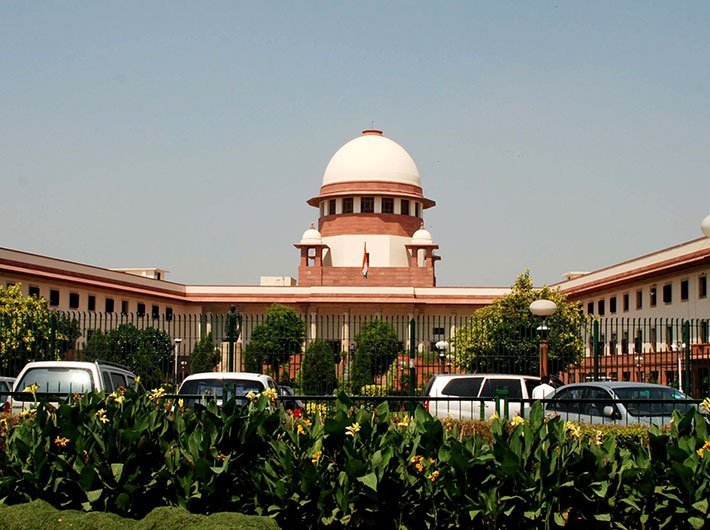
The strength of the Supreme Court is set to go up from 33 judges to 37 judges, paving the way for a more efficient and speedier justice.

The Union Cabinet on Tuesday approved the proposal for introducing The Supreme Court (Number of Judges) Amendment Bill, 2026 in Parliament to amend The Supreme Court (Number of Judges) Act, 1956 for increasing the number of Judges of the Supreme Court of India by 4 from the present 33 to 37 (excluding the Chief Justice of India). 

 
The increase in the number of Judges will allow the apex court to function more efficiently and effectively ensuring speedy justice. 
 
The expenditure on salary of Judges and supporting staff and other facilities will be met from the Consolidated Fund of India. 
 
Article 124 (1) in Constitution of India inter-alia provided “There shall be a Supreme Court of India consisting of a Chief Justice of India and, until Parliament by law prescribes a larger number, of not more than seven other Judges…”. 
 
An act to increase the Judge strength of the Supreme Court of India was enacted in 1956 vide The Supreme Court (Number of Judges) Act 1956. Section 2 of the Act provided for the maximum number of Judges (excluding the Chief Justice of India) to be 10.
 
The Judge strength of the Supreme Court of India was increased to 13 by The Supreme Court (Number of Judges) Amendment Act, 1960, and to 17 by The Supreme Court (Number of Judges) Amendment Act, 1977. The working strength of the Supreme Court of India was, however, restricted to 15 Judges by the Cabinet, excluding the Chief Justice of India, till the end of 1979, when the restriction was withdrawn at the request of the Chief Justice of India. 
 
The Supreme Court (Number of Judges) Amendment Act, 1986 further augmented the Judge strength of the Supreme Court of India, excluding the Chief Justice of India, from 17 to 25. Subsequently, The Supreme Court (Number of Judges) Amendment Act, 2008 further augmented the Judge strength of the Supreme Court of India from 25 to 30.       
 
The Judge strength of the Supreme Court of India was last increased from 30 to 33 (excluding the Chief Justice of India) by further amending the original act vide The Supreme Court (Number of Judges) Amendment Act, 2019.

Comments


Other News

BJP set to capture West Bengal

The political map of the country is set to be redrawn with the BJP set to win the West Bengal assembly elections, apart from Assam and the union territory of Puducherry. In Kerala, meanwhile, the Congress-led UDF is set to regain power. The filmstar Vijay-led TVK has emerged as the front-runner in Tamil Na

Beyond LPG: Is PNG ready for India’s next cooking fuel transition?

India, the second-largest importer and consumer of LPG after China, faces growing pressure due to supply constraints. Most of India`s LPG imports transit through the Strait of Hormuz, a focal point of global turmoil. Given that LPG forms the backbone of household kitchens and the restaurant industry, any s

Maharashtra adopts hybrid model for Census 2026 data collection

The government has initiated preparations for Census 2026 in Maharashtra, introducing a hybrid approach that combines optional self-enumeration with comprehensive door-to-door data collection to ensure complete coverage across the state.   According to senior officials, the Self-

What the nine Indian Nobel winners have in common

A Touch Of Genius: The Wisdom of India’s Nobel Laureates Edited by Rudrangshu Mukherjee Aleph Books, Rs 1499, 848 pages  

Income Tax dept holds Ghatkopar Outreach on new IT Act

The Income Tax Department organised an outreach programme in Ghatkopar, Mumbai, to raise awareness about the key features of the Income Tax Act, 2025, effective April 1, 2026. The initiative is part of a nationwide effort to promote taxpayer awareness, simplify compliance, and strengthen a transparent, eff

Making AI work where governance is closest to people

India’s next governance leap may not solely come from digitisation. It will come from making public systems more intelligent, more adaptive, and more responsive to the dynamics at the grassroots. That opportunity is especially significant at the panchayat level, where governance is not an abstract po


Archives

Current Issue

Opinion

Facebook Twitter Google Plus Linkedin Subscribe Newsletter

Twitter






