
Receives Rs 86.94 crore via this route – more than four times the total of other 15 regional parties in 2015-16
GN Bureau | January 18, 2017

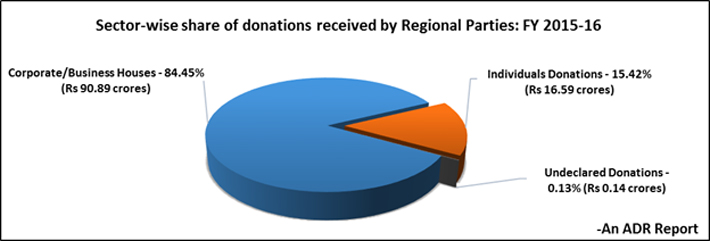
Shiv Sena leads by a wide margin when it comes to the donations received by regional political parties above the 20,000 cut-off (for which parties need not disclose the source). In 2015-16, the Maharashtra-based party received a total of Rs 86.84 crore from 143 donations – more than four times the total amount of donations declared by 15 other regional parties during the same period, shows an analysis by the Association for Democratic Reforms (ADR) and National Election Watch (NEW).
The analysis places Delhi’s ruling Aam Aadmi Party (AAP) at second spot, with Rs 6.605 crore from 1,187 donations.
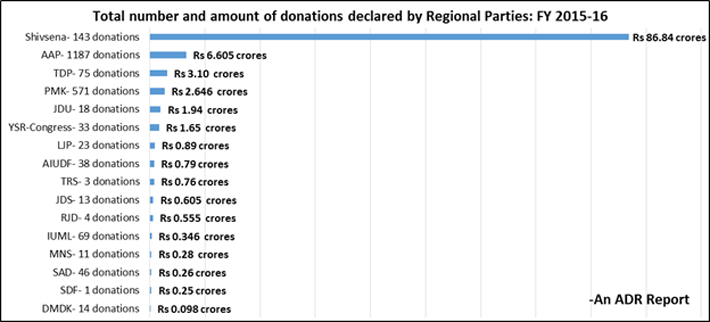
The analysis focuses on donations above Rs 20,000, received by regional political parties, during the financial year 2015-16, as submitted by the parties to the election commission of India (ECI). The parties considered for the report are: AAP, AIADMK, All India United Democratic Front (AIUDF), Biju Janata Dal (BJD), Desiya Murpokku Dravida Kazagam (DMDK), Indian Union Muslim League (IUML), Janata Dal (Secular), Janata Dal (United), Jharkhand Mukti Morcha (JMM), Lok Janshakti Party (LJP), Maharashtra Navnirman Sena (MNS), Naga People's Front (NPF), Pattali Makkal Katchi (PMK), Rashtriya Janata Dal (RJD), Rashtriya Lok Dal (RLD), Shiromani Akali Dal (SAD), Shiv Sena (SHS), Sikkim Democratic Front (SDF), Telangana Rashtra Samithi (TRS), Telugu Desam Party (TDP), and Yuvajana Sramika Rythu Congress Party (YSR-Congress).
The highlights of the report are:
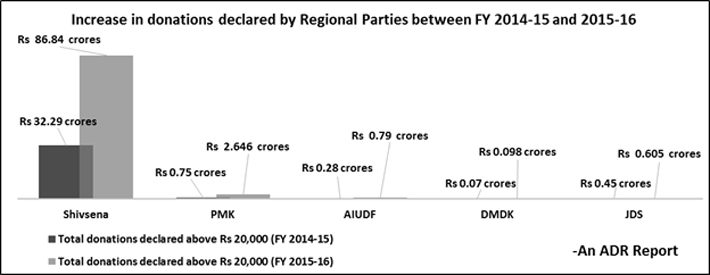
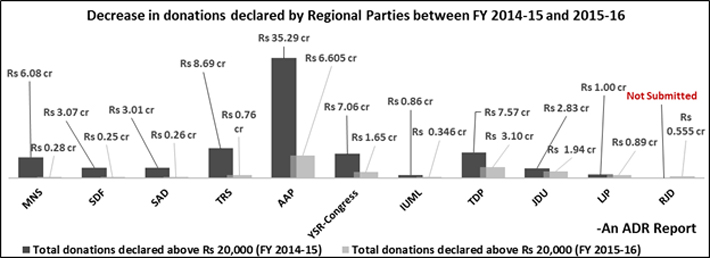
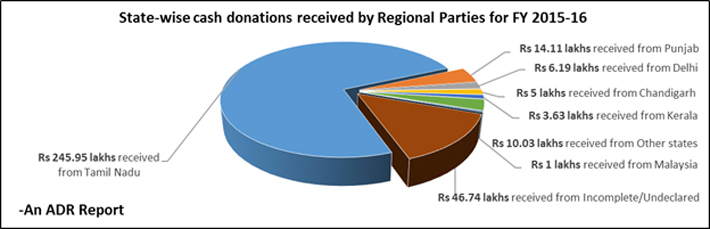
An ECI notification dated August 29, 2014 stated that “…no tax deduction shall be allowed on the contributions made in cash by any person or company to a political party”. This notification was applicable for donations made from FY 2014-15 onwards. But, there has been a marked increase in cash donations to political parties between FY 2014-15 and 2015-16. The 21 regional parties considered for this report, during FY 2014-15, had declared receiving only Rs 30 lakh in cash which formed 0.22% of the total donations to the parties, above Rs 20,000.
ADR/NEW recommendations
India’s southwest monsoon ended with a 13% rainfall deficit in 2026, its weakest performance in a decade, raising concerns over agricultural production, water security and the upcoming rabi season. With El Niño expected to persist into early 2027, experts warn that declining soil moisture, dep
For over a decade, India’s e-commerce story has rested on a simple premise: platforms connect buyers and sellers, while data fuels efficiency, personalisation, and scale. However, as the market matured, its structure has revealed a growing imbalance. E-commerce platforms, especially marketplace ent
The interaction between active Western Disturbances, increased atmospheric moisture and the region’s complex topography aswell as global warming are important factors behind intense rainfall in the Himalayas, leading to flash floods in Nepal, according to meteorologists. Nepal
Last summer, the two of us spent several weeks in rural Madhya Pradesh with a non-profit that works on gender justice through women’s self-help groups. We went in with a notebook full of laws. The Protection of Women from Domestic Violence Act. The Dowry Prohibition Act. Free legal aid for every wo
Digital payments have become a reflex for urban India, but the confidence earned in paying has not yet carried over to borrowing. That is the central finding of `How Urban India Pays Report 2026`, released by Pahlé India Foundation in collaboration with Amazon Pay. Based on a survey of 5,149 consu
Commerce and industry minister Piyush Goyal has called upon businesses in India and the United Kingdom to translate the opportunities created by the India-UK Comprehensive Economic and Trade Agreement (CETA) into expanded trade, investment, partnerships and job creation. Addressing the Bu










