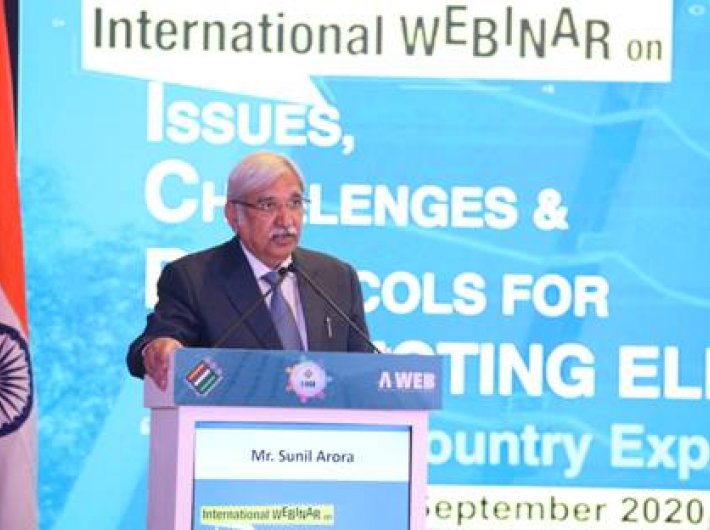
Democracies world over come together to share experiences of conducting elections during pandemic
On completion of one year of the chairmanship of the Association of World Election Bodies (A-WEB), the Election Commission (EC) of India on Monday hosted an international webinar on the theme of “Issues, Challenges and Protocols for Conducting Elections during COVID-19 : Sharing Country Experiences”. It was an occasion for democracies world over to come together to share experiences of conducting elections during Covid-19.
On September 3, 2019 India had taken over as chair of A-WEB for a two-year term during its 4th General Assembly held at Bengaluru. Inaugurating the webinar, the chief election commissioner of India and chairperson, A-WEB, Sunil Arora, spoke of the "tough predicament" faced by election management bodies across the world – whether and how to hold scheduled elections amid a state of public health emergency.
He said the contextual framework of every country was different, the extent and trajectory of the disease varied and so did the capacity of each country to respond to the novel coronavirus and its catastrophic impact. He mentioned countries such as South Korea, Australia, Malawi, Taiwan and Mongolia which went ahead with scheduled elections even as they put in place the enormous arrangements required to ensure the health and safety of people while conducting election.
Arora mentioned that elections in India pose formidable challenges on account of large electorate, geographical and linguistic diversity and differing climatic conditions. Explaining in detail the scale of the upcoming elections to the legislative assembly of Bihar, he mentioned that the total number of electors is 72.9 million.
Explaining the impact of Covid-19 on the election, he highlighted how the pandemic exigencies and social distancing measures necessitated a revisit of the EC’s extant instructions. The maximum number of electors at a polling station was reduced from 1,500 to 1,000, and consequently, the number of polling stations jumped by 40 percent, from 65,000 to 100,000. These changes have huge logistics and manpower implications. The CEC mentioned that the commission would take a decision within the next two to three days, on visiting Bihar.
He also said that the EC has placed a lot of emphasis on extending facilitation to senior citizens, women, persons with disabilities and in current circumstances, ensuring franchise to Covid-positive voters and those in quarantine. In this context, the CEC mentioned how, beginning with the elections to the legislative assembly of Jharkhand in November-December 2019, and elections to the legislative assembly of Delhi in February 2020, the postal ballot facility was extended to voters who are aged more than 80 years, persons with disability and those who engaged in specified essential services. This facility of postal ballot has been extended to Covid-positive electors who are in quarantine/hospitalized.
Arora mentioned the specific and detailed guidelines that have been drawn up on conducting election during the time of Covid. He also mentioned the successful conduct of elections to 18 seats of the Rajya Sabha in June. He noted that elections are due in the states of West Bengal, Assam, Kerala, Puducherry and Tamil Nadu in the first half of the year 2021.
The CEC recalled the AWEB General Assembly, and noted that this webinar is being held under the aegis of India A-WEB Centre on the occasion of completion of one year of ECI’s term as Chair of A-WEB.
Referring to the two publications being released on the occasion, ‘Brief Profiles of the Countries, member EMBs and Partner Organisations of A-WEB’ and ‘COVID 19 and International Election Experience’, he said these would be a useful tool for researchers and practitioners alike. He said that A-WEB India Centre has also progressed considerably towards publishing a world class journal called “AWEB Journal of Elections’. Its first issue will be released in March 2021.
The webinar had participation from over 120 delegates. They represented 45 countries: Angola, Argentina, Australia, Bangladesh, Bhutan, Bosnia & Herzegovina, Botswana, Brazil, Cambodia, Cameroon, Colombia, Democratic Republic of Congo, Dominica, El Salvador, Ethiopia, Fiji, Georgia, Indonesia, Jordan, Kazakhstan, Republic of Korea, Kyrgyz Republic, Liberia, Malawi, Maldives, Moldova, Mongolia, Mozambique, Nigeria, Palestine, Philippines, Romania, Russia, Sao Tome and Principe, Solomon Islands, Sierra Leone, South Africa, Sri Lanka, Suriname, Sweden, Taiwan, Tonga, Turkey, Uzbekistan and Zambia. Four international organizations were also represented at the event: International IDEA, International Foundation of Electoral Systems (IFES), Association of World Election Bodies (A-WEB) and European Centre for Elections.
The A-WEB is largest association of election management bodies (EMBs) worldwide. At present it has 115 EMBs as members and 16 regional associations/organisations as associate members. The EC has been very closely associated with the process of formation of A-WEB since 2011-12.