
The short supply of water creates several problems for people in meeting their daily requirement.
Aishwarya S Iyer | January 8, 2015

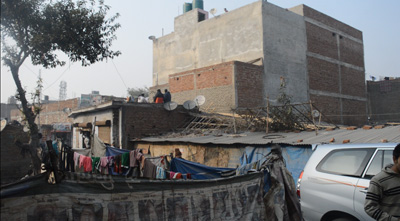
Sangam Vihar, a large “unauthorised” colony in south Delhi, is a case study in the utter neglect of development. Water, for example, is in short supply, and residents face several problems in meeting their daily requirement of it.
The Delhi Jal Board (DJB), constituted under Delhi Jal Board Act 1998, is responsible for production and distribution of drinking water, says its website. One of the services it provides is the supply of potable drinking water when needed.
Reality however is far more complex. When people call up the DJB, to register for tankers for additional water requirement, they are ignored. Vinay Kumar, a resident of Sangam Vihar, said, “When we go to the DJB office located in GK-I and make an entry for the tankers, they do not come. What is the point then of making calls? The DJB gives excuses of how they have sent the tanker, how it isn’t working or how it might be stuck in a traffic jam. We are unaware of these traffic jams which continue for three whole months!”
 Arun Kumar, a DJB official, however, explained, “Very often when our tanks move in with water they are stalled by goons who forcefully take water. This is why we are unable to reach people. The driver is often alone and can’t fight the whole bunch.” Another official, anonymously, pointed towards the involvement of the driver in illegal activities. “Many times we have had to punish and fire drivers for engaging with the goons and looting people,” he said.
The government bore-wells provide water once in 15-20 days, sometimes going up to a month. Water is given for 40 minutes to landlords and 20 minutes to those on rent. Since this erratic supply is not reliable, private bore-wells have become indispensible.
There are people who own private bore-wells and use their own discretion when distributing water causing angst amongst people. Dilip Gupta who operates a private bore said, “We charge anywhere between Rs 250 and Rs 700 for water.” When asked what factors these costs were based on he said it was their own discretion.
Vineeta Devi, a housewife, said, “When we ask the people who operate bore-wells to give us water they threaten to cut the supply. On the other hand, those who provide them with money and alcohol are given water regularly.” People are bullied into submission.
While there are people who can afford water from private suppliers, there are many who cannot. Ramvati Devi is one of them. She says, “As we are poor, we are facing a lot of difficulties as our entire salary is being spent on water. There are no savings.” People borrow money from each other to survive the scarcity, says Bhavana, another resident.
 Dr SCL Gupta, the probable BJP candidate from the constituency, said, “We have nothing in our hands. These private bore-wells are unauthorised, however, unfortunately they are essential. I will only seal those bore-wells where people have complained.”
Dinesh Mohaniya, the Aam Aadmi Party leader who was elected from here in the last assembly elections, said that private bore-wells were shut down when his party was in power. “They were under pressure from us as we had formed government then. Now they are not worried anymore since the government fell.”
People in Sangam Vihar have lost faith in all representation. They feel no one has done them any good. Any approach is used by people to get their work done. “People get their work done using the name of an MLA, something we do not have access to,” said Vinay Kumar who works in a travel company. He also stated how promises made by ministers have done no good to people. “There was a BJP meeting in the first week of December where a commitment was made to setting up water pipes the very next day. However, after that meeting, no one has come with an inch-tape or pipelines to do a follow-up.”
Alok Jha, who helps his father run a small shop, talks of how ministers have made promises which he had been listening to since he was a kid. “People had high expectations out of Mohaniya. However, after coming to power he too didn’t help people. All of them have excuses as hurdles to our development,” says Alok.
Another resident, Ramdiyan Maurya, alleged, “Mohaniya takes money from people and doesn’t give water for months.” Sambhu Singh Bidhuria who is an electric contractor says, “Whether it is BJP, Congress or AAP, all are against public interest. They give [selected] people control over bore-wells, ration shops or alcohol shops and use them for their work against the majority. We are therefore left with no power or say.”
Sangam Vihar falls under the unauthorized colonies cells under the urban development authority. According to the urban development department website, provisional regularisation certificates were distributed to various blocks in Sangam Vihar in 2008. Asked why the regularisation process was taking so long, Dr Gupta said that things like this take time. Sangam Vihar seems to be a classic example of how pockets in Delhi where no money or power resides are punished for being poor.
Himanshu Thakkar, co-ordinator of the South Asia Network on Dams, Rivers and People (SANDRP), stresses on how all water related issues in Delhi are the consequences of mismanagement. “Sewage water is not treated well, rain water harvesting is not practised and ground water is not allowed to replenish. As a city we have managed to pollute one of the biggest rivers which could have been a source of eminent water supply.” According to him, heavy loss of water is also felt with the transfer and distribution of water from one point to another.
He also pointed towards the uneven distribution of water in the city. “More than 500 litres per capita water per day is being given in the NDMC and cantonment areas for which there is no real use. If water was managed well, places like Sangam Vihar would not have been facing any problem.”
Residents of Sangam Vihar might find some solace in water from the Munak canal in Haryana. The Delhi high court on November 27, 2014 asked Haryana to release water into the canal. An official statement from the central government calls for the authorisation of all colonies that have come up till June 1, 2014, extending the date from March 31, 2002.
While the controversy brews around the nuances of this move, people at Sangam Vihar await a better future.
Foundational Literacy and Numeracy (FLN) are often described as the building blocks of education. Yet, their significance goes well beyond a child’s ability to read a sentence, write a response or solve a basic mathematical problem. These foundational skills shape how children understand the world,
For decades, policing has followed a familiar sequence: a crime occurs, the police respond, an investigation produces records and those records become part of the institutional memory of the criminal justice system. Artificial intelligence is beginning to alter that sequence. Instead of merely recording
“We are making a Constitution forever and not only for today.” Shibban Lal Saksena said this in the Constituent Assembly on June 15, 1949. He was warning that a ruling party might one day choose a loyalist to run India’s elections. Seventy-seven years later, the Supreme Court is wrestli
The Cabinet Committee on Economic Affairs (CCEA), chaired by prime minister Narendra Modi, has approved implementation of the ITMS Project by Delhi Police at an estimated cost of Rs.1,789.52 crore, inclusive of taxes. The project will cover 42 identified traffic corridors and will be implemented in three
The extraordinary transaction volumes and value (₹29.82 Lakh crore in August 2026 alone) of the Unified Payments Interface (UPI) have made it not only an Indian success story, but a global one. In 2024, UPI accounted for nearly 49% of the world’s real-time payment transaction volume, with more th
Diplomacy is akin to an art, wherein the summitry, conflict resolution and negotiations form apt constituents of the entire context of deal making and “playing for keeps” in the international arena. The Xi-Trump summit in Washington last week, in which the American president broke all conside










