
Wealth of poor fascinates PM, asks RBI for financial inclusion roadmap

Jaitley promises credibility of decision-making, easing processes to make India's tax structure non-adversarial

GN Bureau | April 2, 2015

#prime minister   #Narendra Modi   #Arun Jaitley   #RBI   #Raghuram Rajan   #jan dhan yojana  


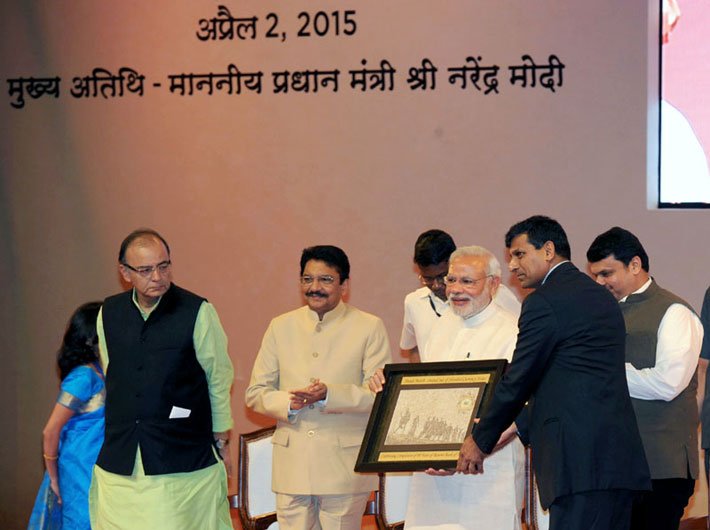
Prime minister Narendra Modi on Thursday asked the Reserve Bank India to prepare 20-year roadmap for financial inclusion while focusing on the success of the prime minister’s jan dhan yojan, which has Rs 14,000 crore deposits. The jan dhan yojana has made the country see the wealth of the poor. "We have only seen the prosperity of the rich but the Jan Dhan Yojana makes us see the wealth of the poor," said Modi.

Modi said he will meet RBI Governor Raghuram Rajan once in every two months and informed that the RBI has taken up the issue of financial inclusion in a very big way.

Speaking at the financial inclusion conference of the RBI in Mumbai, Modi asked banks to take a considerate view in lending to the poor."We should target to make paper and ink used to print Indian currency within the country as part of ‘Make In India’, he said.

He spoke on the farmers problems and said the farmers should not have to resort to suicides because of a lack of funds in a speech delivered in Hindi at an event on financial inclusion at the apex bank.

Over a dozen debt-laden farmers in the country have committed suicide in recent weeks, and discontent in many rural areas against government policies is turning into anger against Modi less than a year after he swept into office.

The Prime Minister also said that the RBI's thinking on financial matters was often quite similar to the government's.

Union Finance Minister Arun Jaitley, addressing the conference, said the government would restore the credibility of decision-making, while easing processes and making India's tax structure non-adversarial.  It reiterates government promises to make India more business- and investor-friendly.

Governor said the country's push to finance infrastructure should not override the need for financial stability. India is keen to ramp up infrastructure investment to help support economic growth, which will require a big push to fund projects.

RBI governor's speech: http://www.rbi.org.in/scripts/bs_viewspeeches.aspx

Comments


Other News

BJP set to capture West Bengal

The political map of the country is set to be redrawn with the BJP set to win the West Bengal assembly elections, apart from Assam and the union territory of Puducherry. In Kerala, meanwhile, the Congress-led UDF is set to regain power. The filmstar Vijay-led TVK has emerged as the front-runner in Tamil Na

Beyond LPG: Is PNG ready for India’s next cooking fuel transition?

India, the second-largest importer and consumer of LPG after China, faces growing pressure due to supply constraints. Most of India`s LPG imports transit through the Strait of Hormuz, a focal point of global turmoil. Given that LPG forms the backbone of household kitchens and the restaurant industry, any s

Maharashtra adopts hybrid model for Census 2026 data collection

The government has initiated preparations for Census 2026 in Maharashtra, introducing a hybrid approach that combines optional self-enumeration with comprehensive door-to-door data collection to ensure complete coverage across the state.   According to senior officials, the Self-

What the nine Indian Nobel winners have in common

A Touch Of Genius: The Wisdom of India’s Nobel Laureates Edited by Rudrangshu Mukherjee Aleph Books, Rs 1499, 848 pages  

Income Tax dept holds Ghatkopar Outreach on new IT Act

The Income Tax Department organised an outreach programme in Ghatkopar, Mumbai, to raise awareness about the key features of the Income Tax Act, 2025, effective April 1, 2026. The initiative is part of a nationwide effort to promote taxpayer awareness, simplify compliance, and strengthen a transparent, eff

Making AI work where governance is closest to people

India’s next governance leap may not solely come from digitisation. It will come from making public systems more intelligent, more adaptive, and more responsive to the dynamics at the grassroots. That opportunity is especially significant at the panchayat level, where governance is not an abstract po


Archives

Current Issue

Opinion

Facebook Twitter Google Plus Linkedin Subscribe Newsletter

Twitter


