
100-day old mystery of the missing JNU student

It’s been over three months since JNU student Najeeb Ahmed went missing and we still don’t have the foggiest

rahul

Rahul Dass | January 21, 2017 | New Delhi

#JNU Protest   #JNU Row   #Najeeb Ahmed   #JNU  


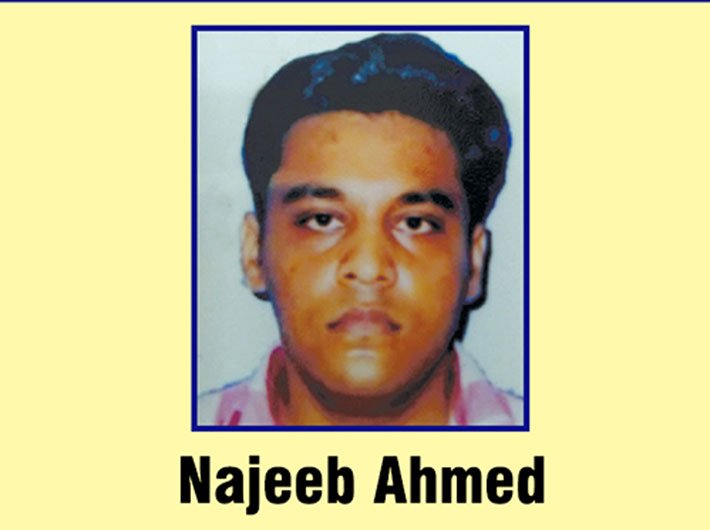
Jawaharlal Nehru University (JNU) student Najeeb Ahmed has been missing for 100 days now after an altercation with Akhil Bharatiya Vidyarthi Parishad (ABVP) activists and sleuths are still groping in the dark.

JNU, the institution known for its robust culture of politics pursued by students, was hit by a double whammy last year – first five of its students were charged with sedition and then Najeeb went missing.

Read: Letter to my daughter: Why JNU matters 

Najeeb’s sudden disappearance on October 15, 2016 had caused considerable tension and was seen as a sign of what ails India’s leading university.

The police registered an FIR on October 16 at police station Vasant Kunj.

In November, the police traced an auto driver who said that he had dropped Najeeb at Jamia Millia Islamia.

An SIT was then formed to trace Najeeb on the direction of home minister Rajnath Singh. However, the SIT failed to make much headway.
The SIT did focus on the psychiatric angle after it came to light that Ahmed was suffering from OCD with depression.

Read: How I fought discrimination at JNU
 

Even as police intensified its search, there was a hypothesis that Najeeb might have moved to a small town to live in anonymity.
On November 26, Najeeb’s mother Fatima Nafees moved the Delhi high court over her son’s disappearance. Senior advocate Colin Gonsalves, who appeared for the mother, said that there was a “political connection in the case” because of the involvement of student group which is close to the ruling government.

Najeeb’s mother alleged that her son was beaten up by members of ABVP “which is affiliated to the RSS and therefore, closely connected with the BJP which is the party in power at the Centre”.

Since the Delhi Police comes under the control of the Central government, it is not likely that any progress will be made in the investigation, she claimed.

In December, the police carried out a thorough search of the JNU campus. As many as 600 police personnel were involved in the search for Najeeb. But, he could not be found.

The massive search was mounted following a Delhi high court order. The court told the police to minutely go through the entire JNU campus including hostels, classrooms as well as rooftops of the buildings with help of sniffer dogs.

The police announced a reward of Rs 10 lakh, a sizeable sum of money which lies unclaimed even 100 days after his disappearance.


Comments


Other News

RBI pauses to assess inflation risks, policy transmission

The Reserve Bank of India (RBI) has begun the new fiscal year with a calibrated pause, keeping the repo rate unchanged at 5.25 per cent in its April Monetary Policy Committee (MPC) meeting. The decision, taken unanimously, reflects a shift from aggressive policy action to cautious observation after a signi

New pathways for tourism growth

Traditionally, India’s tourism policy has been based on three main components: the number of visitors, building tourist attractions and providing facilities for tourists. Due to the increase in climate-related issues and environmental destruction that occurred over previous years, policymakers have b

Is the US a superpower anymore?

On April 8, hours after warning that “a whole civilisation will die tonight,” US president Donald Trump, exhibiting his unique style of retreating from high-voltage brinkmanship, announced that he agreed to a two-week ceasefire with Iran. The weekend talks in Islamabad have failed and the futur

Machines communicate, humans connect

There is a moment every event professional knows—the kind that arrives without warning, usually an hour before the curtain rises. Months of meticulous planning are in place. And then comes the call: “We’ll also need a projector. For the slides.”   No email

Why India is entering a ‘stagflation lite’ phase

India’s macroeconomic narrative is quietly shifting—from a rare “Goldilocks” equilibrium of stable growth and contained inflation to a more fragile phase where external shocks are beginning to dominate domestic policy outcomes. The numbers still look reassuring at first glance: GDP

Labour law in India: A decade of transition

The story of labour law in India is not just about laws and codes, but also about how the nation has continued to negotiate the position of the workforce within its economic framework. The implementation of the Labour Codes across the country in November 2025 marks a definitive endpoint in the process. Yet


Archives

Current Issue

Opinion

Facebook Twitter Google Plus Linkedin Subscribe Newsletter

Twitter






