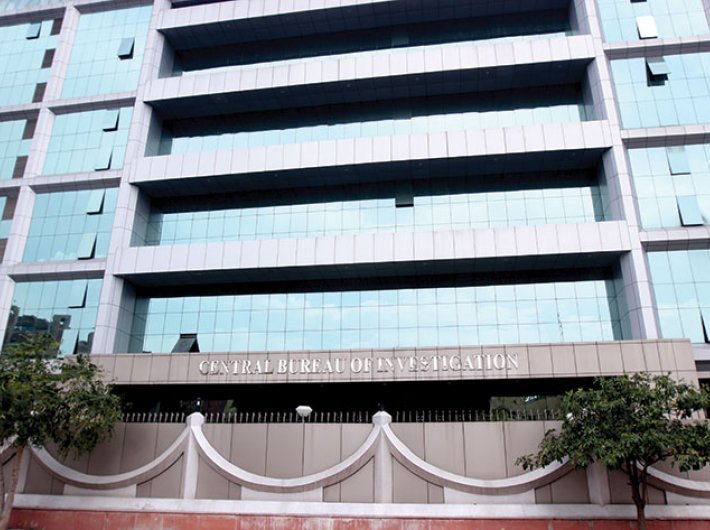
It started with a petty ego clash over induction of officer, snowballed into an outright internecine war with everybody freely hurling serious allegations
Tumse pehle jo shakhs yahan takht-nashin tha
Usko bhi apne khuda hone pe itna hi yakeen tha
(The man who sat on this throne before you was equally convinced of being God)
Urdu couplets often have a unique way expressing baser human impulses. This particular couplet quite aptly describes the persona of CBI director Alok Verma who seemed to have entertained a delusion of holding an office bigger than the whole system.
Perhaps Verma will go down in the history of the Indian police service (IPS) as the man who single-handedly destroyed a critically important institution beyond redemption. Not that his juniors like Rakesh Asthana and AK Sharma were less culpable, but they did not harbour delusions of being Gods. Verma assumed himself to be an omniscient, omnipotent entity whose territory is the entire universe.
Look at the manner in which the trouble began in the Central Bureau of Investigation (CBI) with a petty ego clash and snowballed into one of the biggest administrative crises in the Narendra Modi government. It all began with the induction of chosen officers in the CBI by different groups within the agency.
CBI special director Asthana pitched for certain bureaucrats while director Verma wanted his own nominees to fill the vacancies. The obvious implication was that officers were not selected on the basis of competence but by personal preferences. Verma’s choices were not inducted apparently at the intervention of Asthana.
The fight that began with this one-upmanship turned into a full-fledged internecine war with another much-maligned agency, the Enforcement Directorate (ED), joined it in support of Verma.
(ALSO READ: The Galahads of Indian bureaucracy) Asthana’s name started figuring in a mysterious diary recovered in a probe and it began circulating among various activists-turned-lawyers who have made a business out of PILs in courts. Asthana hit back in his own way by ferreting out details of dubious deals which apparently implicated his director and a host of other officials.
Without going into the merits and veracity of the charges and counter-charges (which will be scrutinised in the court of law), there is no doubt that officers in the CBI and ED operated exactly like gangs of criminals. And, prima facie, the mendacity and treachery involved in the case surpasses even the standards of the underworld. The manner in which officials have been dragging each other’s family members in their accusations is outright obnoxious. And Verma not only let this happen but was an eager complicit in the skullduggery – ignoring the fact that this was destroying the very institution he presided over.
What compounds Verma’s crime is his deliberate indiscretion in the recent past. Look at the manner in which he gave audience to Arun Shourie and Prashant Bhushan who approached him to seek investigation into the Rafale deal. Given the history of the CBI, the director has never personally entertained any complaint which is political in nature. In essence, Verma was apparently fortifying his position with the help of Shourie and Bhushan in the event of an administrative action against him. He was conscious of the fact that the CVC was seized of the issues of corruption against him and has initiated action. His meeting with Shourie and Bhushan was calculated to pre-empt any action by the government against him. That the story conformed to the premeditated script is evident in the manner in which the opposition started targeting the government on the Rafale deal after Verma’s forced vacation.
There is no doubt that Verma has earned name for himself as the first CBI director restrained from entering the headquarters of the agency he headed. But it would be wrong to assume that the denouement came suddenly.
On the other hand, the terminal decline of the CBI began about three decades back, during the Rajiv Gandhi era, when the agency was used to settle political scores. If one has any doubt, one should recall the lurid details of the diary of slain badminton star Syed Modi’s wife, Amita Modi, leaked deliberately by the CBI investigators to the media. The CBI indulged more in character assassination than solving the crime. As a result, the Syed Modi murder still remains a mystery. The agency’s investigation into the Bofors pay-off yielded nothing for decades on end except manipulation by officials to serve the interests of their political masters. There are umpteen instances when the CBI manipulated evidence and planted witnesses to take the case to a particular direction. Apparently this overt criminality on the part of CBI investigators has been not only consistently overlooked but actively encouraged by those assigned to play the leadership role in the agency. It suited a depraved political executive to have a corrupt and pusillanimous federal investigating agency that meekly kowtows to the political masters.
In this context, there are no tears that need to be shed for the exit of Verma or Asthana who fell prey to encouraging a criminal culture. By all indications, the charges against Asthana appear a frame-up ordered by the director. But imagine the extent of criminality to which an investigator in the CBI could go against his own special director, not to say of a common man! Verma has displayed hardly a sign of sagacity as a leader and sided with officials with dubious integrity to carry on the ego clash like a street fight. The denouement of his actions has invariably ruined the institution irreparably. That is because Verma had delusions of being God, unlike some of his worthy predecessors who were content with playing demigods with feet of clay.
[This comment has appeared on FirstPost.com in a different version.]