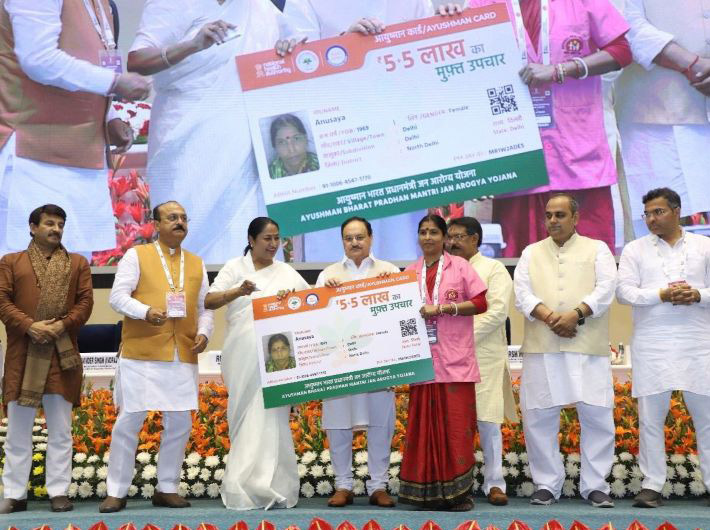
A few tweaks can set the largest health insurance scheme on the right track to realise its vision
The Pradhan Mantri Jan Arogya Yojana (PM-JAY), a welfare scheme which covers approximately 45 crore beneficiaries across India, provides cashless health cover of Rs. 5 lakh per family per year. It is the largest health insurance scheme which helped crores of poor families by reducing out-of-pocket expenditure. The scheme aims to holistically address the healthcare system at secondary and tertiary levels and provide benefits to vulnerable families. It is the ninth year of the scheme since it has been launched, but challenges and problems remain a major concern for the families. The major policy concern is the weak enforcement mechanism and delayed state reimbursement, which deteriorates the essence of the scheme.
Promise vs Reality
PM-JAY promises timely and equal reimbursement to private and public hospitals. The scheme provides cashless treatment across government-funded and private hospitals through a network of healthcare providers. The National Health Agency (NHA) has full autonomy and directive to implement PM-JAY through an effective and transparent decision-making process.
Despite its visionary design, evidence suggests that the scheme has faced significant challenges at the implementation and institutional levels. One major common concern is delayed reimbursements where several empanelled private hospitals suspend their services, forcing beneficiaries to pay or seek treatment elsewhere. The problem is even at institutional level where NHA faces limited executionary power. These issues lead to weaken the scheme’s intended financial protection.
Understanding Implementation Gap
To understand the implementation gap, PM-JAY can be analytically divided into four dimensions.
First, the financial gap: the scheme promises cashless treatment to beneficiaries, however, it depends on the timely reimbursement of claims. But the State Health Agencies (SHA) often face budgetary restraint and delayed fund release, due to which many private hospitals experience shortage of funds and are unable to avail the benefits. A case in point is from Haryana where around 650 hospitals suspended the services after reimbursement dues remained unpaid for six to nine months.
Second, the administrative gap: the incompetencies in the claim process due to red-tapism. The procedural delays contribute to claim rejections or delays and hospitals then face shortage of funds.
Third, the governance gap: the weak enforcement mechanisms across implementation levels. The complex system within the institution created distributed liabilities, poor coordination, weak transparency, and delays in reimbursements. The CAG Performance Audit (2023) also mentions weak monitoring system and institutional weaknesses.
Fourth, the behavioural gap: the problem of ‘Passive Empanelment’ where hospitals formally remain part of the scheme, but their meaningful participation is absent because providing treatment is no longer financially feasible – again, thanks to inadequate reimbursements.
Institutional Analysis
Institutions can be analysed at three levels: at macro level (simply national level), the NHA implements policy and prescribes guidelines but has limited control over its execution. It does not have direct authority to enforce timely reimbursements once the funds are transferred. At meso level (state level), there are shared responsibilities among several institutions, thus, no one bears accountability for ensuring timely claim settlement. SHA is the principal body to implement and the State Finance Department is accountable for releasing the funds to hospitals. This is the critical point of failure as reimbursement delays occur due to inadequate budget allocation, slow financial approval, and poor coordination between SHA and State Finance Department. SHA process for the claims but for funds, it depends on the State Finance Department.
At micro level (district level), District Empanelment Committee (DEC), Pradhan Mantri Arogya Mitra (PMAM) and empanelled hospitals are the frontline institutions, but they lack decision-making powers. DEC monitors implementation but cannot enforce payments, PMAMs cannot resolve problems of pending claims and hospitals lack control over reimbursement.
Thus, the implementation failure is between financial administration and institutional coordination, particularly between the State Health Agency, State Finance Department and empanelled hospitals.
Legal Lens
1. Constitutional Lens: Right to Health comes under Article 21 of the Constitution, which means citizens can enforce their right against the state and institutions led by state. It is primarily enforceable against the state, not against a private entity or a private hospital. Where a hospital refuses to treat or stops the scheme's services, the beneficiary will only be able to complain about the action taken by the SHA/NHA. It is also the obligation of the State under Article 47 to improve the health of the public; however, this is not an obligation that can be enforced in court.
2. The nature of the SHA: Empanelment of the nature of the SHA is done on an MoU (contract) signed between the SHA and the hospital based on the Indian Contract Act, 1872. Thus, late payments are a clear violation of a contractual obligation. The arbitrary decision of the court of the SHA can also be challenged by filing a writ petition as it is a public functionary.
3. Judicial Precedents: The recent court judgment in Maatri Medicity v. State of Himachal Pradesh (2026), the Guwahati High Court's order on hospitals in Nagaland (2025) and the judgment in Monica Pathania v. State of J&K (2025) are examples of judicial precedents that illustrate the development of jurisprudence where non-payment is seen not only as a contractual matter but as an intent on infringing the Right to Health. Courts have also permitted a “purposive” reading of the rules of a scheme. The major disadvantage of PM-JAY is its lack of independent legislation and is mostly dependent on executive instructions.
4. Administrative Law: Hospitals often don't have information to look at when claims are rejected or payments are delayed, thus presenting a due process problem. A CAG audit cannot directly ask for any monetary amount, but it can pinpoint the delays and place them in the limelight. Furthermore, an automated fraud detection system could also violate the principles of natural justice since hospitals may not have an equal opportunity to challenge incorrect decisions.
5. Centre-State Legal Dynamics: Although the scheme follows a 60:40 centre-state funding model, hospitals generally deal directly with the SHA. This presents a dilemma, as hospitals could have unpaid bills sent to the SHA, but mostly owed by the centre or State Finance Department.
What Needs to be Done
1. Give PM-JAY a Statutory Foundation
The primary reason for PM-JAY's shortcomings is its weak foundation, leading to poor implementation. The policy itself is a guideline rather than a full-fledged Act of the Parliament. A change here could have a positive impact on the payment process, beneficiaries' rights to proper treatment, the rights of beneficiaries to access affordable healthcare, and hospitals' duty to their patients. This must initially be approved by the Parliament and the Ministry of Health and Family Welfare. The scheme should fix its repayment policies and have a guaranteed payment schedule. This will establish a legal right that a hospital can directly enforce, reducing the red tape.
2. Statutory Interest and Direct Recovery on Delayed Payment
There should be a proper creation of borrowing and statutory interest for the timely non-payment of reimbursement. A legal mandate for compound interest on delayed reimbursement will create a special payment council, which will be responsible for recovering payments from the hospital within three-four months. The hospital will not file a case in a civil court but will seek resolution from state-based payment facilitation councils.
3. Independent Medical-Financial Tribunals for Dispute Resolution
There should be state-level PM-JAY tribunals or quasi-judicial bodies to resolve disputed claims and rate disputes that involve the payment facilitation councils at the state level. The time frame for such administered cases shall not exceed 90 days. This will result in a faster, cheaper resolution mechanism for hospitals and beneficiaries.
4. Ring-Fenced, Statutorily Protected SHA Trust Accounts
Build a solid legal ground for the previously existing administrative phenomenon ‘30-day autopayment'. The Ministry of Health can establish such an intergovernmental institution with the support of the State Finance Department, to resolve the "institutional coordination failure" that might lead to delays after the SHA approval.
5. Public Reporting of Payment and Grievance Data by Disaggregation
Need to have accountability and tight statutory mandates to publish State-wise, District-wise list of the conversion rate for reimbursement, rejection rate and a Public Dashboard, rather than aggregate claim/authorisation numbers. This will expose the poor implementation of schemes in a specific State rather than the entire scheme.
Praveen Mohan is pursuing an M.A. in Public Policy and Law at the Tata Institute of Social Sciences. Mansi Shrivastava is pursuing an Integrated M.A. in Public Policy and Law & LL.M. in Law and Social Policy at TISS.
References
1. National Health Authority. (n.d.). Ayushman Bharat Pradhan Mantri Jan Arogya Yojana (PM-JAY). Government of India.
2. National Health Authority. (n.d.). Ayushman Bharat Pradhan Mantri Jan Arogya Yojana (PM-JAY). Government of India.
3. Press Information Bureau. (2025). Toward Universal Health [Ayushman Bharat Pradhan Mantri-Jan Arogya Yojana].
4. Comptroller and Auditor General of India (CAG). (2023). Performance Audit of Ayushman Bharat-Pradhan Mantri Jan Arogya Yojana – Union Government (Civil) National Health Authority Ministry of Health and Family Welfare. (Report No. 11 of 2023).
5. Bukhari, A. (2025, August 19). Private Hospitals Suspended Services for India’s Health Insurance Members, Leaving Millions Without Care. Health Policy Watch.
6. Perappadan, B. S. (2023, August 11). Health Ministry defends PMJAY as CAG audit exposes multiple frauds. The Hindu.
Case Citations
1. M/s Maatri Medicity and Orthocare Hospital v. State of H.P. & Ors., CWP No. 2080 of 2026 with connected matters, order dated 25.03.2026 (H.P. H.C.).
2. S.T. Yapang v. State of Nagaland & 6 Ors., PIL/2/2025, order dated 14.02.2025 (Gauhati H.C., Kohima Bench).
3. Monica Pathania v. State of J&K & Ors., SWP No. 1062/2016, judgment dated 26.04.2023 (J&K & Ladakh H.C., Jammu).