
The issue of the shrinking commons in expanding cities is often dismissed as an unavoidable cost of modernization, but a closer look at the spatial data reveals a deeply fragmented urban crisis
Shashwat Bhatnagar | June 12, 2026
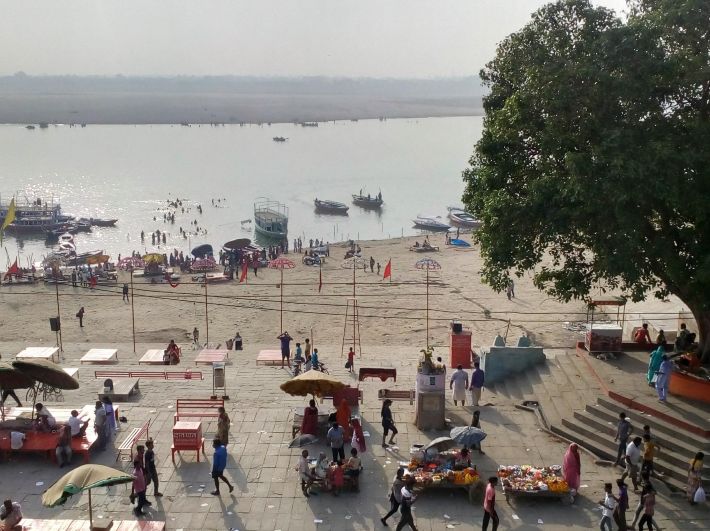
For centuries, the urban framework of Varanasi was defined not just by its relationship with the sacred Ganga but by its multifaceted network of urban commons. Historic kunds, seasonal talabs (ponds), and open maidans served as the city’s basic ecological infrastructure. They acted as natural flood mitigators during the intense monsoon spells and critical groundwater rechargers during the blistering Indian summers.
However, as India’s tier-II cities experience an unprecedented real-estate and infrastructure boom, the nature of these spaces is changing fundamentally. Walk through the peripheral expansion of Varanasi today along the newly made ring roads, and the expanding airport corridor, and the ancient topography is unrecognizable. The open fields where communities gathered are rapidly being paved over by concrete grids. The issue of the shrinking commons in expanding cities is often dismissed as an unavoidable cost of modernization, but a closer look at the spatial data reveals a deeply fragmented urban crisis.
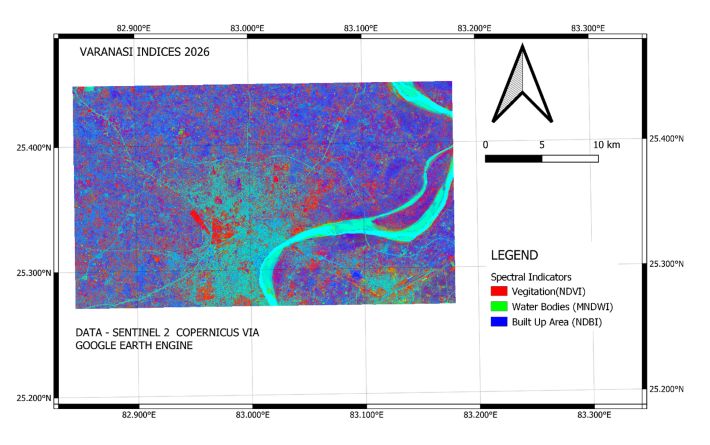
The 2026 spatial layout reveals a deeply fragmented urban landscape, exposing a stark contrast between Varanasi's historic urban core and its rapidly evolving peri-urban fringes. By analyzing the intersection of spectral indicators,which map vegetation via the Normalized Difference Vegetation Index (NDVI), surface water via the Modified Normalized Difference Water Index (MNDWI), and concrete infrastructure via the Normalized Difference Built-Up Index (NDBI), The map highlights how aggressively the physical footprint of the city is changing along its fringes.
Last summer, the two of us spent several weeks in rural Madhya Pradesh with a non-profit that works on gender justice through women’s self-help groups. We went in with a notebook full of laws. The Protection of Women from Domestic Violence Act. The Dowry Prohibition Act. Free legal aid for every wo
Digital payments have become a reflex for urban India, but the confidence earned in paying has not yet carried over to borrowing. That is the central finding of `How Urban India Pays Report 2026`, released by Pahlé India Foundation in collaboration with Amazon Pay. Based on a survey of 5,149 consu
Commerce and industry minister Piyush Goyal has called upon businesses in India and the United Kingdom to translate the opportunities created by the India-UK Comprehensive Economic and Trade Agreement (CETA) into expanded trade, investment, partnerships and job creation. Addressing the Bu
The Gandhian movement in India, after Gandhi’s death, failed, says Ramachandra Guha, and blames Vinoba Bhave for it. But the movement found new, fertile grounds around the world and succeeded in bringing about a change in South Africa, the US and elsewhere. It is high time it returned home. Of cour
Tavleen Singh, noted journalist and political commentator, has turned to fiction, with her debut novel ‘The Actor’ (HaperCollins India). Set in the near future, it has a superstar, Amit Singh, turning to politics, when the political landscape is dominated by prime minister Guru Gaynendraj
The union cabinet, chaired by prime minister Narendra Modi, on Tuesday approved the setting up of a Special Purpose Vehicle (SPV), called Integrated Transport & Logistics Authority (ITLA), to strengthen research, planning, appraisal, monitoring and impact assessment within the broad domains of Transp










