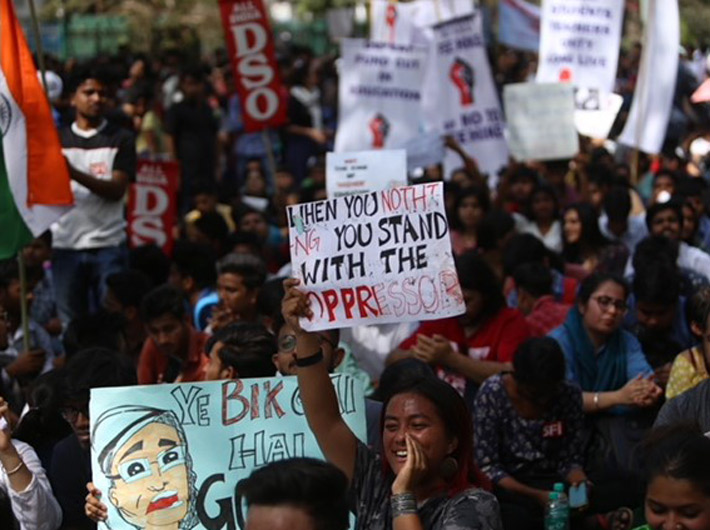
Over half the population is under-30, and yet young Indians are frequently excluded from decision-making processes that affect their future
Over a decade and a half ago when I was still a student, millennials felt the burning need to break down the barriers of gatekeeping in traditional media. Young voices, brimming with ideas and opinions, were often sidelined, their perspectives deemed too marginal or unrefined for mainstream discourse. This led to the start of my own journey with the founding of Youth Ki Awaaz in 2008, which was also around the time when Facebook and WhatsApp made inroads in India.
Social media began with the goal of connecting and empowering the youth. Today, the digital landscape has expanded beyond recognition, with numerous platforms amplifying young voices. This proliferation has somewhat mitigated gatekeeping, facilitating easier expression. Yet, the challenge persists. Multiplying channels of expression doesn't necessarily translate into real-world impact. It needs guaranteeing that these voices are systematically incorporated into the frameworks shaping their lives: from public policies to consumer products.
This brings us to a critical gap in the current ecosystem — the lack of real-time, comprehensive data about young people in India. As per the NFHS-5 data, over half the population (52%) is under the age of 30. And despite being one of the largest demographics, young Indians frequently find themselves excluded from the decision-making processes that affect their future.
Policies and products are often designed based on outdated stereotypes or superficial market research that fails to capture the complex, evolving nature of young India's needs and aspirations.
For instance, the rollback of the GST on sanitary napkins in India after a year-long protest led by young menstruators is a testament to how a lack of citizen-generated data can lead to misfires. This situation could have been preempted by informed policymaking if robust, youth-generated data – both quantitative and lived experiences – had been available. Same with India’s Transgender Persons (Protection of Rights) Act, 2019 which received widespread criticism from trans folks and experts from across India.
Conversely, Costa Rica’s youth-driven climate policies offer a global example of how young people’s engagement in environmental issues can lead to progressive governmental actions. The country went ahead and established a National Youth Advisory Network, as well as a National Council on Public Policy for the Young Person to ensure consistent platforming of youth voices.
This gap is echoed in the trend of ethical consumerism as well. Our 2019 study on ethical consumerism with Oxfam India (https://www.youthkiawaaz.com/2024/04/82-back-ethical-goods-but-only-a-third-pay-extra-for-them) revealed that a significant majority of young Indians prefer ethically produced products. They expect the government to enforce ethical standards, not just leave it to market forces. Such data could critically inform production and consumption policies, ensuring they align with the values of young consumers. This isn’t a lofty dream, but a market reality.
The stakes are high. When young people are not effectively consulted, policies can miss their mark, and products can fail to resonate. This disconnect is not due to a lack of willingness to engage from young people. This stems from a systemic absence of structured mechanisms to capture and analyze their inputs. Real-time data is pivotal; it brings to the table evidentiary support that can transform young voices from mere opinions into powerful catalysts for innovation and policy reform.
For instance, on climate change, the presence of data gathering and listening initiatives has contributed to creating a youth engagement framework for city governments across India by the National Institute of Urban Affairs, ensuring that young voices are at the forefront of urban planning for climate resilience. Or take another example where a study on menstrual hygiene informed significant contributions to India's draft Menstrual Hygiene Management policy, demonstrating how data can lead to impactful legislative inputs. This can go beyond inputs, to the inclusion of youth voices from start to end in decision-making processes.
Now imagine policy-making that incorporates up-to-the-minute data on youth opinions about climate change, employment, education, and digital rights. Consider product developers having access to youth trends, preferences, and ethical considerations. This isn't just about making better policies or products; it's about co-creating these with the youth, ensuring that their real needs and desires shape the development process from the ground up.
To bridge this gap, a multidimensional approach is needed. First, we must invest in technologies and platforms that not only gather but also intelligently analyze youth data across diverse segments of the population. An easy way to achieve this is by encouraging startups that prioritise ethical standards of data analysis and supporting them to have cross-industry partnerships to achieve better data-driven outcomes. This should be aimed at helping deliver insights that are both granular and scalable.
Second, fostering partnerships between governments, private sectors, and the youth themselves can ensure that the data is not just collected but acted upon. These collaborations can drive the creation of youth-informed policies and innovations that are truly reflective of young India’s diversity and dynamism. From setting up of youth advisory councils in ministries and government think tanks which have cross industry representation, to large FMCG and D2C brands establishing such advisory groups to better inform new product development, or the net promoter score.
Moreover, establishing forums where young people can regularly interact with policymakers and business leaders can help ground abstract concepts into practical, actionable insights. These interactions should go beyond tokenism to become regularized platforms for continuous exchange, where youth data is not an afterthought but a fundamental aspect of the planning process. Companies like Google are establishing GenZ advisory councils to overcome such challenges. Various large-scale organizations like the United Nations also follow a similar approach. Costa Rica has also been hailed for a similar approach to youth inclusion.
The call to action is clear: as stakeholders in India's future, it is imperative to reimagine our approach to engaging with the youth. By turning to real-time data-driven strategies, we can transform how young voices are heard and how their needs are met. Let’s ensure that the India of tomorrow is shaped by those who stand to inherit it, making youth data not just a tool for change but a blueprint for a more inclusive, responsive society.
Anshul Tewari is Founder, Youth Ki Awaaz, a platform that uses polling, surveys and storytelling to transform youth voices into actionable insights for social transformation.