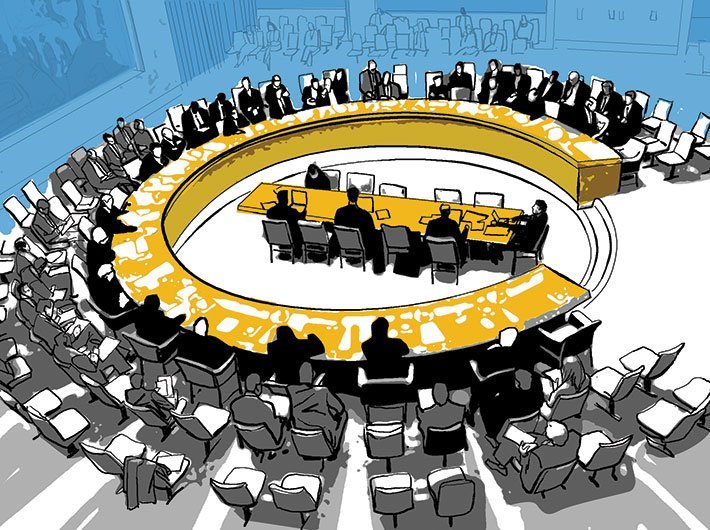
Right from reform in the Security Council to carrying forward sustainable development goals, UN needs to be overhauled to tackle the modern day challenges
When Portugal’s former prime minister António Manuel de Oliveira Guterres succeeds Ban Ki-moon as the next UN secretary-general, he will find himself pitted against a host of challenges, particularly reforming the international organisation that was set up way back in 1945.
UN’s membership and working systems are from an era that is bygone. It looks ill-suited for the much edgier geo-politics that is in play now. Dominated by wartime victors who conveniently – and permanently – gave themselves veto rights, the UN is in urgent need of reforms so that it can give proper due to countries like India which have today emerged as world leaders.
India has been rightly asking for a seat in the UN Security Council. Along with Brazil, South Africa, Germany, India has repeatedly stressed that it deserves to sit on the security high-table. There has, however, been no headway. This non-inclusion is particularly unfair to India as it has proved beyond a shred of doubt of being a responsible nuclear state.
In September 2015, prime minister Narendra Modi said at the United Nations Sustainable Development Summit that there's an urgent need to reform the United Nations Security Council to give it teeth and make it more credible.
“On UN Security Council reforms, President [Barack] Obama reiterated the support that he has publicly articulated in favour of India being a permanent member of the UN Security Council,” MEA spokesperson Vikas Swarup said in December in 2015 after Modi met US president Barack Obama.
The rotating seats in the Security Council too are not able to strike a regional balance. The under-representation of Asia is something that is worrying since it is home to a populous region. Not to forget the entire continents of Latin America and Africa which find no representation at all.
The international body needs to be upgraded if the UN is to continue to fulfill its vital global role in the twenty-first century.
An area of concern is a leaner budget. A major reform needs to be aimed at much higher spending. According to a report, spending on all UN bodies and activities – from the Secretariat and the Security Council to peacekeeping operations, emergency responses to epidemics, and humanitarian operations for natural disasters, famines, and refugees – had totaled about $45 billion in 2013, roughly $6 per person on the planet. That is a significant underinvestment.
The UN needs to strengthen its expertise in areas such as renewable energy systems, disease control, technological innovation, public-private partnerships, and peaceful cultural cooperation.
It is not that nothing good is happening. There has been the successful conclusion, after 15 years, of the millennium development goals for the most effective global poverty-reduction effort ever undertaken.
The UN is now looking at the sustainable development goals (SDGs) which will aim to end extreme poverty in all its forms everywhere, reduce inequalities, and ensure environmental sustainability by 2030.
A lot more needs to be done so that the United Nations does not meet the same fate as the League of Nations and gets replaced by a new world body that is powered by India and other like-minded nations.
Also read: Reforming the UN for the 21st Century