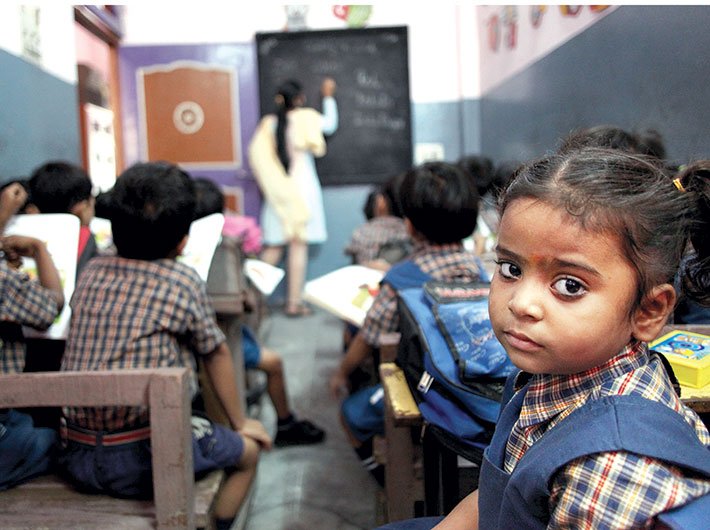
A teacher was appointed in 1999, before the Right to Education (RTE) Act came into force, and appointed under the rules that existed at that time. She gave the necessary test, passed it, passed the interview, and was appointed. Over the next 26 years, she taught thousands of children, faced transfer orders, salary changes, administrative changes, and two years of school closures due to the pandemic. She did what she was told to.
In September 2025, the Supreme Court of India told her she must now pass the Teacher Eligibility Test (TET) – an entrance examination introduced in 2010 – or lose her job.
It's a time for a question, not just a legal one; it is an issue of institutional integrity: Does India treat teachers as any other class of public servant or not?
The True Meaning of the Law
The minimum qualifications for teachers in government and government-aided schools are provided in the RTE Act, 2009. The National Council for Teacher Education (NCTE) notified in August 2010 that TET was a condition of eligibility under Section 23 of the Act. The test has been created for future appointments.
Then came the 2017 Amendment. Parliament inserted a proviso to Section 23(2) specifying that teachers in service as of March 31, 2015, who had not yet attained the prescribed qualifications, would have four years (until 2021) to do so. When teachers failed to comply en masse and challenged the provision in court, the Supreme Court extended the deadline.
A bench of Justices Dipankar Datta and Manmohan gave its landmark verdict on a batch of petitions on September 1, 2025. It clearly stated that all in-service teachers with more than five years of service remaining must clear the TET by August 31, 2028, or they would not be able to continue in service. In May 2026, the review petitions challenging this ruling were rejected. The deadline stands.
The court is right to say that the words “a teacher” and “every teacher” are used in Section 23 and not “a person seeking appointment.” The legislature never intended that the existing teachers would be the only ones to meet the minimum qualification requirement at some time in the future, the court said. TET is not only an eligibility criterion but also a constitutional requirement under Article 21A, which guarantees the right to quality education, it said.
This is not an unfounded claim. But the issue of merit is not the final one in the inquiry.
The Numbers That Should Give Us Pause
The scale of this ruling is staggering. As many as 98 lakh teachers in the country could be affected, according to the All-India Primary Teachers' Federation. Estimates of the number of people directly affected by the need to clear TET (more than five years to superannuation in non-minority schools) range from 20 to 30 lakh. In Maharashtra, the number of teachers required to comply with TET is almost 60 lakh, which is 70-75% of the total number of teachers. Tamil Nadu has stated that 3.28 lakh teachers who have served for over five years will be affected. Kerala estimates 50,000. Meghalaya, 32,000.
Plot these numbers on top of the TET pass rates. The pass percentage of the state TET 2024 in Telangana was 31.21%. Uttarakhand TET 2025 Paper 1 had 38.2% and Paper 2 had a significant 19.96%. The average of Kerala's K-TET has been 26% in the past. In 2024, 22 lakh candidates appeared in the central examination (CTET), of whom 2.38 lakh passed, for a pass rate of 10.8%.
This is not a data note. It is the main policy issue. If teachers who are not trained in the TET pedagogical model have to take an exam and more than 60-80% of the candidates fail, then we are not measuring competence. We are massively disqualifying ourselves.
The Question the State Has Not Answered
No Ministry circular explains this, no court bench, and no NCTE notification: Does India follow this logic for any other category of public servants?
Imagine the case of an IAS officer. He appeared in the UPSC Civil Services Examination in 1998 and got allotted to his cadre. In 2010, UPSC revised the eligibility, competency, and interview criteria. The IAS officer of the 1998 batch was not called for re-sitting the UPSC exam. No one threatened to shoot him if he didn't re-prove his eligibility in the new format. His contract was his letter of appointment, and it has been fulfilled.
Think of a government doctor. She has been working at a district hospital for 30 years and completed her MBBS in 1995 from a state medical college. NEET was started for admission to undergraduate medical courses in 2013. She has never had to reappear before the NEET to demonstrate her fitness to practice.
Consider a judge or a police officer or a forest official. In each case, the state will make the hire in accordance with the rules in force at the time of the hire, and any changes will take effect on the date of the change. New players will be subject to new standards – no re-election of incumbents.
Why, then, is the teacher different?
The Supreme Court's answer – TET is a “constitutional necessity” – that children have a fundamental right to quality education under Article 21A – is a legitimate interest. However, it establishes a disturbing imbalance. The children who appear before the court are also constitutionally protected when appearing before a judge who did not have to re-qualify. Patients of a government doctor who was not obliged to re-sit NEET should also be provided quality healthcare. If applied selectively, the principle of constitutional necessity is no principle at all.
The State refuses to own the infrastructure gap.
Another dimension missing from the judicial and legislative discussion is the lack of preparation of the state's teachers.
The UDISE+ 2024-25 data shows that approximately 12% of teachers (or 1.2 lakh) are not professionally qualified. The National Education Policy 2020 itself acknowledged the huge gap in the capacity of in-service teacher training. The District Institutes of Education and Training (DIETs) are designed to be the backbone of professional development for school teachers, but have been underfunded and understaffed for years. The CAG report of 2023 revealed that faculty positions in some states were over 40% vacant in their DIETs.
The TET is a paper-based test, with qualifying marks fixed at 60% for general category candidates and lower for reserved category candidates. It evaluates the theory of child development, language skills, and subject pedagogy. These are skills that can be taught. They need training, study materials, and time, though. A teacher in a remote block school in Vidarbha or the Sundarbans, with five classes to teach, no library, and an unreliable internet connection, is not the same as an urban aspirant sitting at a private coaching centre.
The state must set the examination standard, and if the state does not provide facilities for preparation, then it is not a test of competence but a test of failure.
What a Just Policy would look like
The state has a legitimate interest in teacher quality. Still, it is important to remember that serving teachers have legitimate expectations that should not be ignored, and a binary pass-or-exit model is not the most appropriate approach.
First, the TET requirement should not be for teachers within 10 years of superannuation, but within five years, as the current ruling provides. It is not fair to impose a disqualification sword on a teacher who joined the service in 1995 and is due to retire in 2028, which was not available when she was recruited. The court's extension of the deadline to 2028 is recognition of this fact, and should have been read as a more general categorical exemption.
Second, the state needs to invest in preparatory infrastructure for TET before implementing TET compliance. NCTE should insist on structured in-service training programs in states that are residential in nature and specifically designed to the TET syllabus, rather than generic refresher courses. This is not an innovative idea, but it is what the National Education Policy 2020 itself recommends in paragraph 5.13. It's just not yet implemented.
Third, TET performance should be a part of a mentorship and professional development program, not a termination program. A teacher who does not pass the TET should not be given a pink slip but should be put on a structured improvement program with departmental support. Quality assurance is not about reducing staff, it's about enhancing standards.
Fourth, Parliament should review the 2017 Amendment with a new purpose of the legislation. The proviso to Section 23(2) was intended as an olive branch and has been used as a statutory tool for mass termination. A new amendment to remove the disqualification penalty for pre-2010 appointees and to ensure that all future appointees are subject to TET could help address the inequity while maintaining the quality goal.
The Deeper Problem
There are 1.4 crore school teachers in India. The government school system, which is widely regarded as a failure, is the main educator of the bottom 60% families by income distribution. The government school is the only school in aspirational India for crores of children. Distributional effects should be carefully considered when implementing any policy that affects this workforce, regardless of its intent.
The TET decision, as it is, could be a substitute for another education failure. If 98 lakh teachers are unable to clear the TET within the stipulated time, we will not have better teachers. There will be empty classrooms.
The court was right to state that the RTE Act is a child-centric legislation and must be read accordingly. However, a child-centered interpretation of the law should consider what happens to the child the next day, when she is left without a teacher because her teacher failed a paper-and-pencil test that is routinely failed by over 60% of those taking it. Constitutional requirements must be fulfilled constitutionally, that is, in a way that is proportional, equitable, and respects the expectations of those who have lived their lives according to a different set of rules.
Unlike its officers, doctors, or judges, India's teachers were not accorded the grace. It's not a legal quirk that that imbalance exists. It's a statement of the services the state provides and those it will discard.
Ayush Kumar Upadhyay is an Advocate and Master’s student in Public Policy and Governance & LLM in Social Policy at Tata Institute of Social Sciences (TISS), Hyderabad.