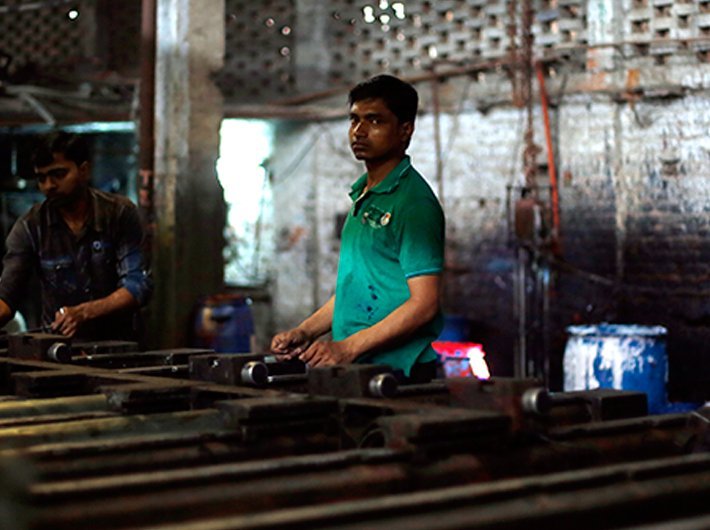
Weak placement systems, weak entrepreneurship support system, inadequate employer linkage, poor post-placement follow-up, and limited relocation assistance prevent trained candidates from converting their credentials into sustainable employment
India’s skill development programmes were designed with a goal to make the young population ready with market-required skills and competencies, and to provide them with better employment opportunities. Yet the outcomes have fallen short of that goal: though over 1.6 crore individuals were trained across various schemes, only around 24.3 lakh candidates secured employment [The Economic Times (2025). ‘Over 1.6 crore trained through skill programmes but employment rates remain low’]. This article explores the extent to which post-training support mechanisms, placement assistance, employer linkage, and skill-gap assessment determine employment outcomes after certification.
The key performance indicator (KPI) for a training programme’s success is whether trainees can secure employment. That depends on post-training support: skill-gap and skill-match analysis, counselling, placement assistance, employer linkage, and structured integration into the labour market.
Placement Support: A Persistent Gap
Despite strong enrolment figures, the employment conversion rate remains strikingly low, ranging between just 8% and 23% [PRS India (2024). Implementation of Skill Development Programmes. PRS Legislative Research]. Researches consistently point to weak industry linkage and minimal employer engagement, both of which erode whatever placement infrastructure does exist. The evidence makes clear that earning a certification does not, by itself, translate into a job offer.
Training-to-Employment Conversion
Trained Candidates |████████████████████████████████| 1.6 Cr+
Placed Candidates |████ | 24.3 Lakh
Employer Linkage and the Demand-Supply Gap
Beyond these placement statistics, there exists a demand-supply mismatch that further undermines outcomes. According to a report, 71% of small manufacturing firms surveyed said government skill-training programmes had not helped them – a finding that, while specific to the manufacturing sector, points to a broader disconnect between training design and actual industry needs. The absence of rigorous skill-gap analysis and market demand assessment in the selection of training roles is identified as a primary driver of poor placement results under these schemes. [The Times of India (2025). Policy Miss: 71% of small manufacturers say government skill schemes haven’t helped. Times of India, India Business.] This points to a fundamental failure in aligning training content with employer requirements within post-training placement systems.
The Follow-Up Failure
Weak systematic monitoring further adds to these deficiencies. Weak attendance and a feedback-tracking system have narrowed the scope for retrospective correction, limiting the scheme’s chances of improvement. As many as 35% of trainees surveyed reported being entirely unaware of available opportunities. In comparison, 62% indicated that they had anticipated better employment opportunities but ultimately settled for average or unsatisfactory placements [PRS (2022). Implementation of Pradhan Mantri Kaushal Vikas Yojana, Annexure 3.3, September 29, 2022]. Physical inspections revealed that over 40% of training centres do not have a dedicated placement desk, leaving trainees without any point of contact for placement facilitation—a critical structural gap in post-training support.
Geographic Barriers and Relocation Support
A further barrier that has received insufficient attention is geographic accessibility. Many trainees struggle to find employment within commutable distance of their homes, and those willing to relocate receive little or no logistical support in doing so, as documented in a report on post-training unemployment. [PRS Legislative Research (2022). Post-Training Unemployment and Relocation Challenges under Skill India. PRS India.] Collectively, these mobility barriers form an integral part of the post-training support deficit, and their neglect is a direct contributing factor to the sub-15% overall conversion rate among enrolled candidates.
The Entrepreneurship Pipeline
Under the skill development programme spanning 2016–20, 34.32 lakh candidates were enrolled, and 32.99 lakh successfully completed training [Ministry of Skill Development and Entrepreneurship (2018). 34.32 lakh candidates have been enrolled under PMKVY 2016-20 Scheme. Press Information Bureau, 31 December 2018]. Yet a mere 7,128 registered for financial assistance through the designated portals [Ministry of Skill Development and Entrepreneurship (2018). Lok Sabha Unstarred Question No. 3803, Answer by Minister Shri Anantkumar Hegde, as on 04.01.2018]. Only 251 were ultimately able to avail loans for self-employment [Ministry of Skill Development and Entrepreneurship (2022). Skill Development and Capacity Building under PMKVY. Press Information Bureau, 07 December 2022].
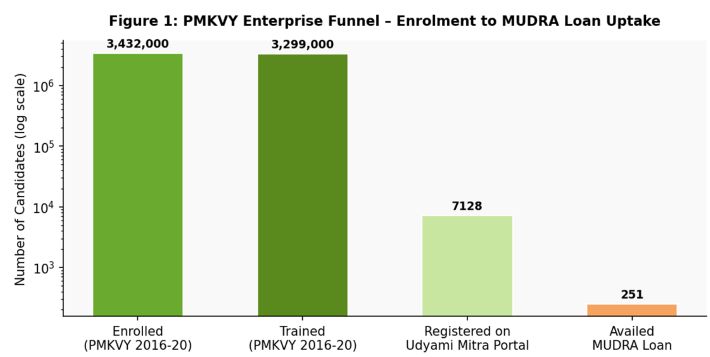 Enterprise Funnel – From Enrolment to Loan Uptake (as of 2018)
Designated handholding centres were established at training facilities to assist candidates in accessing microfinance loans, yet the results were negligible. An evaluation by the Indian Institute of Public Administration (IIPA) concluded that significantly stronger facilitation support is required to move beyond the prevailing status quo [Indian Institute of Public Administration, New Delhi (2021). Evaluation Study Report of the Scheme Pradhan Mantri Kaushal Vikas Yojana (PMKVY) 2016-2020. IIPA, New Delhi]. The root cause appears to be the weak integration between skilling programmes and post-training financial support systems designed to foster enterprise creation. The gap between those who complete training and those who go on to start their own enterprise suggests that these programmes function primarily as reskilling exercises rather than as livelihood and enterprise development initiatives.
So, What Does it tell?
The evidence presented here thus points to an argument that certification-driven employability schemes alone do not produce employment. The core problem which cuts across such programmes is the absence of a robust post-training support system. Despite impressive enrolment figures and large numbers of certified graduates, weak placement systems, weak entrepreneurship pipeline/ support system, inadequate employer linkage, poor post-placement follow-up, and limited relocation assistance collectively prevent trained candidates from converting their credentials into sustainable employment. Closing this gap demands not a scaling of training numbers, but a fundamental strengthening of the ecosystem that receives trainees on the other side.
Shivendra Pratap Singh is a Master's student in the Master of Arts in Cities and Governance programme, offered under the aegis of the School of Public Policy and Governance, Tata Institute of Social Sciences (TISS), Hyderabad.