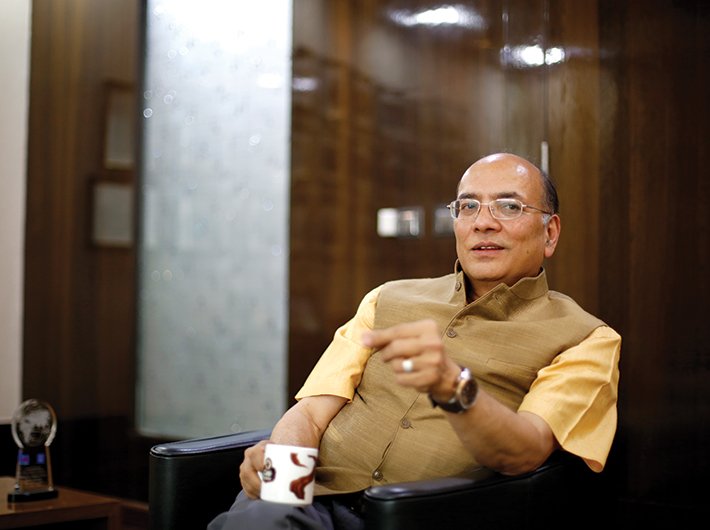
OVL's MD talks about the company’s growth trajectory and the hiccups faced in between
The overseas investment arm of the state-owned Oil and Natural Gas Corporation (ONGC), OVL has been witnessing profits due to higher oil output. In an interaction with Praggya Guptaa, OVL’s MD Verma talks about the company’s growth trajectory and the hiccups faced in between.
Please share a snapshot of ONGC Videsh’s growth journey.
OVL completed 50 years in 2015, but the company’s initial growth happened in 2000. Before that OVL was a single asset company – with the asset in Vietnam where we discovered gas, but were struggling to develop it. After 2000, OVL has grown into a multiple asset company with acquisitions in Sudan and Sakhalin. This gave acceleration to OVL. After that, we expanded in Syria, Libya, Brazil, Colombia and Azerbaijan. Then we acquired Imperial Energy Corp in Siberia. Currently, we are in 20 countries with 41 live projects. In the last three years, we have increased our production by more than 70 percent and reached 9.1-9.2 million metric tonnes (mmt) in 2011. However, because of the Sudan and Syria crisis we shifted back to producing 7.5 mmt, but then started growing again. When I took over as the managing director, the production was 8 mmt and now it has reached 14.1 mmt.
In the last two years, we have acquired two major assets – one is Vankorneft in Siberia is producing more than 5 mmt. The other, we have acquired a 10 percent stake in a large offshore oilfield in Abu Dhabi – the first by any Indian oil company in Abu Dhabi. In recent times we have focussed more on exploration projects, and have entered Bangladesh, Myanmar and New Zealand. We are planning to drill in Bangladesh. Recently, we drilled in Kazakhstan which was not a commercial success and that was a setback but nevertheless this happens in exploration.
You have filed an arbitration claim against Sudan over unpaid oil dues.
Sudan has been a key project for us. In early 2000 we participated in Sudan with Petronas and China National Petroleum Corp (CNPC). We were happy with the project as it was yielding good results and production. But after division of Sudan the situation changed and declining oil prices added problems. The Sudan government has not honoured its commitment. In fact, we laid down a pipeline for them. As part of the agreement, they had to pay us in instalments; $98 million are yet to be paid by them. After the division, their oil production reduced substantially but they needed crude oil to run their refinery. They started over-lifting our share of oil, and have not paid back. Total revenue of $435 million is still pending with them. We have been pursuing them consistently and had to file arbitration and things are now in process. It takes a couple of years to get the matters resolved as it is in an initial stage. Also, there is a recent change in the ministry in Sudan, and they have invited us for a discussion along with our partners; so let’s hope something positive may happen. Meanwhile, legal actions are going on.
Cash-strapped Venezuela has stopped your payments of oil dues. How will you handle this?
It is another area of concern for us as we have two projects in Venezuela. In one of the projects, we have 40 percent stake where we are producing 20,000 barrels of oil (per day). However, again dividend declared is not paid by them. We have been pursuing them. Last year we agreed to receive the payment in instalments. However, only three instalments of $89 million have been paid. They stopped the payment due to their local situation. We are still pursuing them. Their minister has met us and has promised to resume the payment in April 2019.
Do you think the scenario is such that they can manage to pay the money?
They are producing oil and we hope some oil is diverted. That is the only hope we have.
How do you see the future of countries which rely heavily on oil, considering the inconsistency in oil prices seen over the years?
Venezuela, Colombia and Brazil’s some portion is producing heavy oil. So that has been sold on discount, and many companies and refineries which are capable of processing oil are reaping benefits. For example, a vast volume of oil is coming to India from Venezuela through Reliance and Essar. They get good refining margins because they purchase the cheaper crude oil and sell us at the same price. That is a good business proposition. However, after the US sanction in Venezuela, its production capacity has been curtailed. Recently their dispatch facility was taken over by a US company under international judgement. We have to see how things evolve in future.
Will this impact Indian companies getting oil from them?
It may or it may not. Still, Indian companies may get cheap oil provided you arrange the logistics because Venezuela is desperate to sell due to its economic conditions.
What kind of challenges does OVL foresee?
Oil price volatility is a major challenge. It directly impacts us, so we try to mitigate it by cross-hedging and exposing our portfolio to diverse geographies. Diversity is our tool to handle volatility. We try to engage ourselves in exploration projects, which gives us a value multiplier with a low investment but of course risk of investment is there as exploration is not always successful. Then again carbon footprint concerns and renewables are putting new threats into exploration and production (E&P) industry as a whole. Globally things are volatile. Companies are engaging in renewables in great magnitude.
How are you planning to address the challenge of reducing the carbon footprint?
Under COP 21 reduced carbon footprint is there. The government of India is also committed to reduce the carbon footprint. One way is that we make the process efficient and increase our focus towards gas, away from liquid hydrocarbon – this can reduce the carbon footprint. Participating in renewables is a call that we will take in future. However, our parent company ONGC is already engaged in renewable, particularly in the wind.
How about bringing transformation digitally?
Artificial intelligence, big data, robotics and nanotechnologies are converging into digital space where E&P operations are also getting impacted, so we are quite flexible in adopting technologies. ONGC Videsh is India’s first company which is using technology in operating framework. We have live video conferencing facility. We are establishing a GnG centre, which will be linked globally on a real-time basis. In operations, we have adopted some of the latest technologies and are moving shoulder-to-shoulder with our counterparts.
Please share some of the upcoming significant projects of OVL.
We are engaged in the development of Mozambique, which is a major investment for us – of $4 billion. It is in the pipeline for a final investment decision. There is another project in Venezuela which is in the development stage. We have already invested in this project that will go into its commercial phase. There are some developments in Sakhalin as we renewed the contract for 25 years. The Azerbaijan contract has also been renewed. Apart from that the bulk of our growth is done by business development.
[email protected]
(The interview appears in the July 15, 2018 issue)