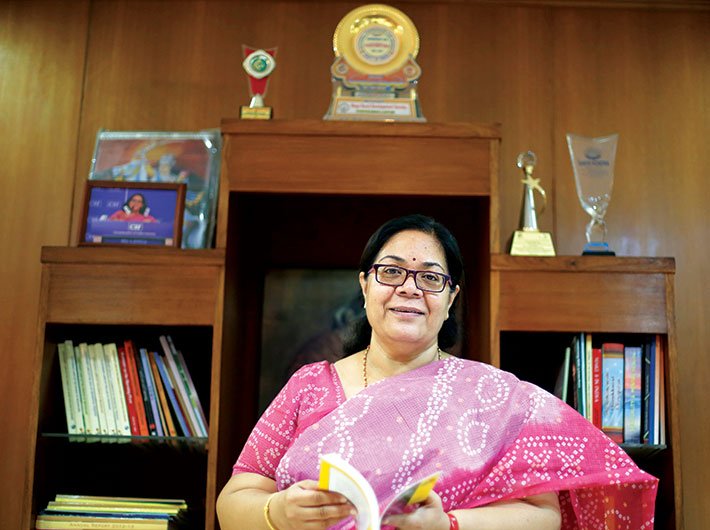
The national commission for women (NCW) aims to be more proactive. It is seeking more powers. However, the demands for punitive powers to arrest and imposition of penalty have been opposed by the law ministry. The chairperson of NCW Lalitha Kumarangamalam shares her views with Sweta Ranjan on these and other issues.
You have been in the commission for sometime now. What is your perception about its role?
I think that the commission’s powers are limited. Though we have a lot of face value, we can only make some noises as our hands are tied up on many issues. We are allowed to take suo moto cognizance which means even if the case is not brought by the complainant herself and somebody else has brought it, or it has been reported by press or someone calls me or sends me an SMS, we take suo moto cognizance. However, we can only talk to the police or demand an action, nothing more. I have written to people and those who respect the system send us replies. However, many don’t bother because for most women’s problems are not important.
It’s secondary…
Not even secondary. Secondary is I think being very optimistic. Sometimes it is on the bottom of their list.
You are talking of more powers but the law ministry has red-flagged a proposal to provide powers to arrest and penalise those guilty of harassing women and ignoring NCW’s summons.
The law ministry said we shouldn’t have the power to arrest, which is fine. What we have asked now is that if we recommend that an arrest has to be made then it has to be done.
Do you think NCW needs the power to arrest?
It’s a very subjective thing. But I think prevention is better than cure, especially in violence against women. We get about 240 to 250 complaints every day. Women don’t even know they have rights. The average woman is not educated enough. Even educated women don’t know their rights and even if they know, they don’t want to use them because of the lack of social inclusiveness.
NCW has also raised the issues faced by single mothers? What exactly are your concerns?
The old-fashioned, patriarchal attitude of our society towards girls does not give any importance to a single woman until she is economically well off. First of all, the definition of a single mother has to be defined. Single women are not just widows. In India a woman’s entire identity is linked to a man. If she is a widow it means her husband is dead. If she is a divorcee it means she is separated from her husband. Does a woman have an identity of her own?
The definition of single has to accept the fact that women are individuals. In Manipur we did a research on problems of single mothers. Many women are not married but have children because they have been raped. They are also humans. They should also be brought under the ambit of single mothers.
We have seen a number of cases of harassment of women at the workplace. How difficult is it to handle such cases?
It’s very difficult. Despite the rules, a lot of companies do not have a complaint committee for sexual harassment. The committees are supposed to have external members but most of them don’t follow it. Often the cases are hushed up. In these cases it is best to have a paper trail; a written complaint has to be given. Overall, I am finding it easier to deal with the government undertakings than the private sector undertakings.
You have advocated legalising sex work. Will it improve the condition of women?
I have worked for HIV AIDS prevention since 1991. We found that where we are able to organise the sex workers the health conditions of not only the women, but also of their clients were improved. The HIV/AIDS cases dropped drastically.
Sex workers’ children are unable to get out of that quicksand even though 99 percent of sex workers don’t want their children to follow them. But their children don’t have the rights. They can’t go to a school and say that they are the children of sex workers.
There is a stigma against them. They don’t have any right under the law, which is unfair.
So, you mean to say legalising prostitution will will help improve conditions of sex workers?
It will definitely improve the working conditions of the sex workers. And very importantly, their children will have a choice. If a woman wants to get out of her situation she can. If she doesn’t then you can’t blame her. One should not find faults with her if she makes certain amount of money.
You have also voiced concerns about the need for flexible working hours for women. What is the update?
We have started talking about this in meetings with industrial bodies like CII, FICCI, and the export council. I have started saying that they should look at flexible working hours.
Any response from corporates?
No, but we are working on it. We need to have a complete package to be able to offer them with complete figures and statistics. It will take another six months to a year again.
There has been a lot of image issues of the commission because of stress on more high-profile cases recently. What is your position?
I feel it’s very unfortunate because the NCW was set up with the intention of providing relief to women who are traumatised or troubled, who are not able to find justice anywhere else. Along the way somewhere I think it got skewed. I think the NCW should be more about trying to guide policy matters regarding women.
[email protected]
(The interview appears in the July 1-15, 2015 issue)