
Increasing penalty for eco-vandalism will help: Expert

Interview with Dr Chandra Bhushan, deputy director general of Centre for Science and Environment

sakshi

Sakshi Kuchroo | March 31, 2016 | New Delhi

#Law   #Environment   #Yamuna   #Sri Sri Ravi Shankar   #Art of Living   #NGT   #Centre for Science and Environment  


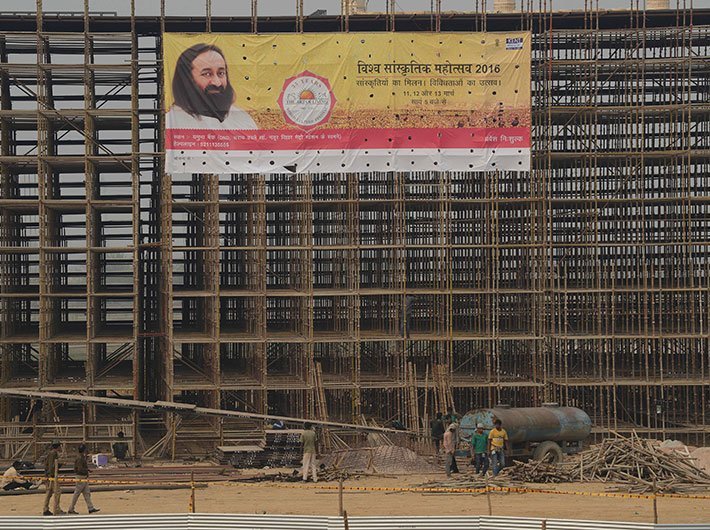
Close to the World Cultural Festival organised by Sri Sri Ravi Shankar’s Art of Living (AoL), purportedly, causing damage to the flood plain of river Yamuna in Delhi, the centre is mulling changes in the environmental laws to make such vandalism unaffordable. The proposed changes in the law would scale up the fines to a minimum of Rs 5 crore as against Rs 1 lakh. Will this act as a deterrent?
 
Governance Now spoke with Dr Chandra Bhushan, deputy director general of Centre for Science and Environment (CSE), to find out if hiking penalty for environmental damage would act as a deterrent against misuse of natural resources. Excerpts from the interview:
 
Is increasing the penalty for environmental vandalism from Rs 1 lakh to Rs 5 crore a wise move?

Our current system of compliance is of criminal nature, but we hardly send anyone to jail for violating environmental laws. So, the present scenario does not have adequate deterrence. We need a system of compliance which includes financial penalty of credible deterrence. I think the hike in penalty was long overdue. It is necessary to increase the amount which throws an impact on the violators. But that is just one aspect. We also need to build strong infrastructural reforms that will be required for this hiked fine in becoming effective.
 
The proposed law has provisions for adjudicating authority comprising two environmental experts and a district judge to assess the damage. Will this help?
 
I don’t think so. I am fine with the idea of forming an authority that will assess the damage but this individual committee will just lead to multiplicity in the system and not coherence. Rather than creating an individual body, what we need is that such a committee should be integrated with the already existing mechanism. For example, the preferred appellate will probably be in all states, so it should be a part of the state pollution control board as they already have the mechanism which will assess the details of the damage. Also, three people cannot govern each and every aspect of the problem; you need to have a team, a definite mechanism that will deal with every minute detail of the violation. So rather than creating more confusion by this multiplicity, we need to start working coherently.
 
The proposed law also aims to categorise violations into minor, non-substantial and substantial. Do you think it will minimise the discretion of state boards?
 
Well, they need to define these three categories. Exactly what sort of violation will be considered minor? Recently, some dead fishes surfaced at the area around Ulsur lake in Bangalaore in the first week of March, imagine the level of contamination. Will this be considered a minor category? Isn’t it a serious issue?  They really need to outline what will comprise these categories, otherwise it’s useless.
 

Comments


Other News

EU–India FTA 2026: A high‑stakes prescription for Indian pharma and healthcare

India’s pharmaceutical industry stands as one of the world’s market leaders of generic pharmacy with market valuation of USD 50 billion in 2026. Characterised by high volume, low-cost generic manufacturing, with an annual growth rate of 10-12% primarily propelled by exports and domestic demand,

Legends, vignettes and tales from the freedom movement

Robin Hood of Kathiawar and Other Extraordinary Stories from India’s Freedom Movement By The Paperclip  HarperCollins, 348 pages, Rs 499  

Solicitor General Tushar Mehta tells quirky tales from the world of law

The Lawful and the Awful: Quirky Tales from the World of Law By Tushar Mehta Rupa Publications, 336 pages, Rs 995  

Cabinet meet discussed `Ease of Living`, `Ease of Doing Business`

The Council of Ministers has deliberated upon valuable perspectives and best practices relating to boosting ‘Ease of Living’ and ‘Ease of Doing Business’, prime minister Narendra Modi said on Friday.   As he shared details of the Council meeting held the d

India should deepen energy partnerships with Africa

The vulnerability of Strait of Hormuz continues to influence energy politics globally. India is highly dependent on imported crude oil as a significant portion of its oil imports still come from the Gulf ultimately making such disruptions particularly consequential and has immediate economic ramifications

The rupee stumbles: Can India Inc. chip in?

Every time the Indian rupee weakens to a new record low, the conversation follows a familiar script. The RBI intervenes. Economists debate the current account deficit. The government appeals to citizens to cut consumption. And within a few news cycles, attention moves on, until the next record low arrives.


Archives

Current Issue

Opinion

Facebook Twitter Google Plus Linkedin Subscribe Newsletter

Twitter






