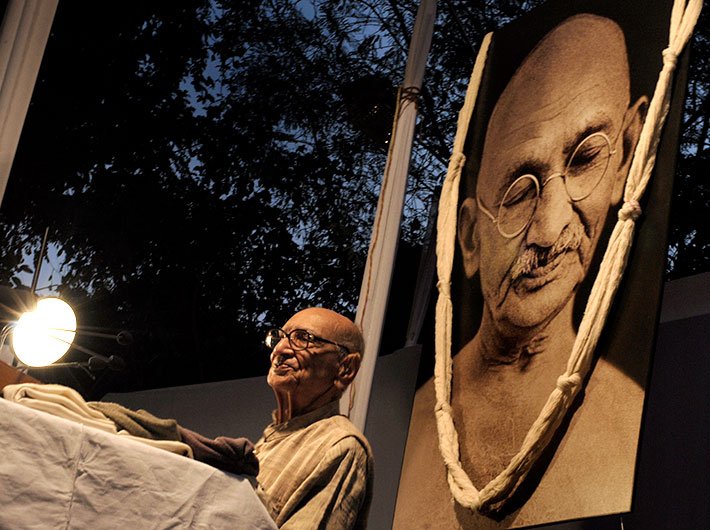
I want to share the joy I feel inside me: Narayan Desai

Down the memory lane: Interview with Narayan Desai

ashishm

Ashish Mehta | April 10, 2015


#Narayan desai   #mahatma Gandhi   #narayan desai interview  


From the archives: Narayan Desai spoke to Ashish Mehta in November 2010, when he was in Delhi for the 88th Gandhi Katha. Excerpts from the interview:

You started doing ‘Gandhi Katha’ in Gujarat in June 2004, two years after the communal violence in the state. What prompted you to take this innovative way of propagating Gandhi’s ideals?

As a citizen, I feel I am responsible for all the social injustice – or if we use a religious term, paap (sin) – taking place around us. If Gandhi was around, he would have said, ‘I am guilty’. I thought: how could this happen in my Gujarat, rather than ‘Gandhi’s Gujarat’?

I carried out a peace march, adopted two children (of violence victims). Then I thought of doing some constructive work to atone my paap. The most influential model for constructive work I have seen in my life is Gandhi. Vinoba (Bhave) is also a very influential model, but Gandhi is the most influential. So I try to interpret him as much as I can and put my interpretations before people.

As I was sending the final installment of the manuscript [of the four-volume, 2,300-page biography of the Mahatma in Gujarati, ‘Maru Jivan E Ja Mari Vani’, 2003] to the press, I thought it had turned out to be a rather large work. How many people would read it? I was looking for a more popular medium to bring the Gandhi story to more and more people. I found that most periodicals and TV channels were directly or indirectly influenced by advertisers. I was looking for a medium which was not controlled by advertisements. I found katha to be such a medium.

You plan to do 108 Gandhi Kathas, each lasting usually for three hours over five days.

Sometimes I feel it’s alright if I overexert, it does not matter if all my energy is drained in this process, but it would be better if I can do this more often. Of course, it would be better if I can do so while also taking care of my health. I feel it would be nice if I can do 108 kathas. At the rate of two events in a month, I should be able to achieve the target in 20 months.

How is the response to the Kathas so far?

I see more and more youngsters now.

Is that due to the revival of Gandhi as a popular icon among the youth after a series of films on the Mahatma?

Those who used to encash the name of Gandhi no longer feel any need to do so. The Congress party does not feel so. Foreign leaders coming to India for arms trade no longer need to go to the Rajghat (to pay token obeisance). But the young generation does not have faith in politics; they don’t see depth in today’s politics. So, some of them are turning to Gandhi. Given the way people respond to the Gandhi Katha at various places, I have reasons to be satisfied.

Why did you take up social work?

That was the question Jiddu Krishnamurti once asked me, when I had arranged a meeting between him and Vinoba. I had said: I do social service because I want to share the joy I feel inside me.

Comments


Other News

AI: Code, Control, Conquer

India today stands at a critical juncture in the area of artificial intelligence. While the country is among the fastest adopters of AI in the world, it remains heavily reliant on technologies developed elsewhere. This paradox, experts warn, cannot persist if India seeks technological sovereignty.

RBI pauses to assess inflation risks, policy transmission

The Reserve Bank of India (RBI) has begun the new fiscal year with a calibrated pause, keeping the repo rate unchanged at 5.25 per cent in its April Monetary Policy Committee (MPC) meeting. The decision, taken unanimously, reflects a shift from aggressive policy action to cautious observation after a signi

New pathways for tourism growth

Traditionally, India’s tourism policy has been based on three main components: the number of visitors, building tourist attractions and providing facilities for tourists. Due to the increase in climate-related issues and environmental destruction that occurred over previous years, policymakers have b

Is the US a superpower anymore?

On April 8, hours after warning that “a whole civilisation will die tonight,” US president Donald Trump, exhibiting his unique style of retreating from high-voltage brinkmanship, announced that he agreed to a two-week ceasefire with Iran. The weekend talks in Islamabad have failed and the futur

Machines communicate, humans connect

There is a moment every event professional knows—the kind that arrives without warning, usually an hour before the curtain rises. Months of meticulous planning are in place. And then comes the call: “We’ll also need a projector. For the slides.”   No email

Why India is entering a ‘stagflation lite’ phase

India’s macroeconomic narrative is quietly shifting—from a rare “Goldilocks” equilibrium of stable growth and contained inflation to a more fragile phase where external shocks are beginning to dominate domestic policy outcomes. The numbers still look reassuring at first glance: GDP


Archives

Current Issue

Opinion

Facebook Twitter Google Plus Linkedin Subscribe Newsletter

Twitter