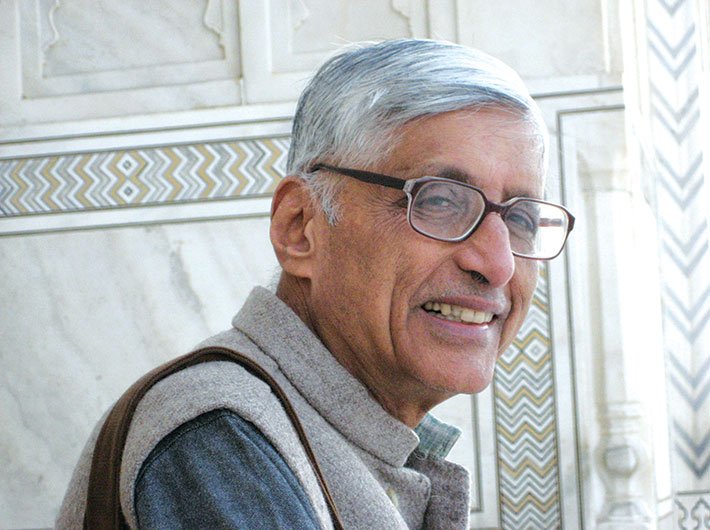
The story of Prince Gopaldas Desai, an egalitarian ruler, is indeed extraordinary. You have noted in the preface that you had heard about him from your father in the 1950s. But what exactly was the trigger to write this biography at this juncture?
After my father’s mention to me of Darbar Gopaldas in 1950 or so, I “ran into” Darbar Gopaldas in 1987-88 while I was researching for my Vallabhbhai Patel biography. As a result Darbar Gopaldas and [his wife] Bhakiba featured significantly, though on the sidelines, in my Sardar book.
It was my friendship with DG’s youngest son Dr Barindra Desai in the United States and discovering more fascinating information from him about Darbar Gopaldas that led to my writing ‘Prince of Gujarat’. Until then I had known that Darbar Gopaldas was unusual but had not realised the degree of his radical thinking and living, nor realised that his radical approach extended to so many fronts.
Moreover, Dr Barindra Desai also possessed or had access to correspondence and papers that threw new light on important phases of the freedom movement.
Gopaldas’s values and priorities – putting people before the ruler, for example – seem exceptional today, but we realise they were largely exceptional even in his own day, except when seen as part of the freedom movement. You have raised a rhetorical question, “Is today’s India a departure from these times or a continuation of long-known conflicts and trends?” Would you like to attempt an answer?
You are entirely right. Darbar Gopaldas was exceptional even during that rare and amazing time – he was exceptional even among a set of unusual and gifted women and men.
We forget that the workers for freedom were fighting also to change society on many fronts – on questions like untouchability, caste inequalities and hierarchies, the adivasis, the gulf between the rich and the poor, the status of women.
Theirs was a tough fight and their foes were many. Apart from British rulers, many leaders of India’s society and business were open or secret foes of the freedom fighters. It was risky to fight the Empire. Relatives were likely to be forced out of jobs or colleges. And it was risky to demand change from traditional Indian society.
Today all of us salute the freedom movement and its heroes, but during the years of struggle the freedom fighters were often a lonely bunch. Likewise, those who would want to change today’s society and politics also face opposition even though they have the good wishes and prayers of the humble masses. So in some ways history is repeating itself.
You have advised “the many Indians involved in the present-day struggles” to learn from the freedom movement, “from its inclusiveness, from its ethical and moral tone”. Last year, you contested the Lok Sabha elections, again from a party that has arisen out of a struggle. Do those values, according to you, resonate less today with people at large? Or, is the might of majoritarianism a temporary phenomenon?
As I see the picture, the vast majority of India’s people want fairness and inclusiveness. At times, however, they may be swayed by bias and prejudice, which human beings can never be fully free of. So they need sane and clarifying voices. Again, while most of us want a corruption-free India, we are at times capable of cutting corners for personal advantage.
The Lok Sabha election of 2014 was a triumph of marketing plus a verdict on the poor record of the UPA government. The people of India wanted to give Mr Modi and the BJP a chance. But already there are strong signs that a departure from fairness and pluralism, or stoking the fires of ill-will against particular groups, does not go down well with the Indian people.
In the net results they come out with, the people of India always turn out to be wise.
Gandhi, Patel, Rajaji, Ghaffar Khan and now Gopaldas: biographies dominate the list of your published works. Who are the other personalities you would like to write about some day?
Personalities that cry out for biographies are so many! But I hope that many others will take up biography-writing.
Apart from biographies, I have also been lucky enough to be able to write a few histories. Readers’ warmth for my history of Punjab – not just India’s Punjab but the large Punjab region that existed before 1947 – has encouraged me to attempt another regional history. This time I will try to tell the story of South India as a whole, from the arrival of the Europeans to say the year 2000. But this is a long-term project and will take a few years.