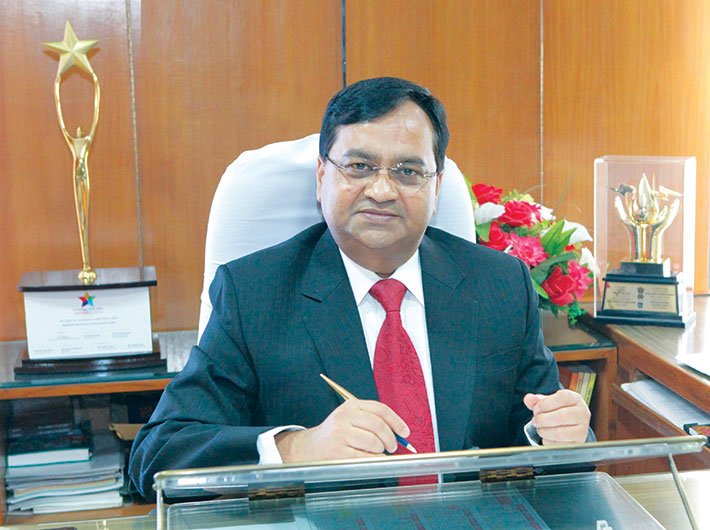
Rajasthan Electronics and Instruments Limited managing director AK Jain talks to Governance Now about the company’s story so far and future plans
Rajasthan Electronics and Instruments Limited (REIL), is one of the few profit-making mini ratna central public sector companies. REIL will now become an independent central public sector enterprise as the government has decided to hive it off from its parent company, Instrumentation Ltd. REIL managing director AK Jain talks to Pragya Gupta about the company’s story so far and future plans.
What will be the roadmap now that REIL is to be an independent central public sector enterprise?
The cabinet approval for de-linking REIL, Jaipur, from its parent company Instrumentation Limited will result in conversion of REIL into an independent CPSE under DHI [department of heavy industry, under the ministry of heavy industries and public enterprises] with greater autonomy to capitalise on the available business opportunities and freedom to approach capital markets as well as forge joint ventures for its expansion. It will help REIL attain a level of growth commensurate with its hidden potential by aligning its activities with current mission of the government of India such as Make in India, Jawaharlal Nehru National Solar Mission, National Dairy Plan, Digital India and Skill India.
Which business segments contributed to REIL’s 2015-16 profit?
The net worth of the company has increased by 7 percent from Rs 94.44 crore to Rs 101.37 crore and the company has earned a profit before tax of Rs 17.46 crore on a turnover of Rs 213.42 crore. Major business segments for REIL are milk analysis & dairy automation solutions, and solar. The dairy sector is 80 percent of our entire business and major profit comes from there. The growth is directly linked to the growing population, milk factories and milk products such as ice creams, yogurts and sweets.
Analysis of the milk is a key to the success across the value chain for milk business for both buyers and consumers as quality drives the entire chain. Milk chain is a 24x7 business and we want to be a part of an entire business chain. Milk analysis and dairy automation are our core areas where we are continuously growing, along with this, we are now entering the cold chain segment for business diversification.
A few years back our turnover was just a few lakhs. Then it became a few crores and gradually it touched the mark of Rs 100 crore in 2011 when I took over as the managing director. Getting it from Rs 100 crore to Rs 200 crore and maintaining it throughout was not an easy journey. We have approximately 240 people and we did not increase the manpower. To achieve it and continue with it, motivating people played an important role. To motivate them further we have also started performance-based bonus, which worked as a great motivating factor.
We started with the Danish collaboration as they were the best in the world. Despite collaborating with them for a solution to measure the quality of milk, they broke the agreement with us at a very critical stage in 2012 when the country was going through an adulteration phase. Then we collaborated with an IIT to develop the solution. Within nine months, we developed a model which was better than the Danish one, which analysed urea, salt, ammonium sulfate, etc. in the milk, whereas Danish technology only used to tell us if the milk is good or bad. This is how we managed competition over last many years by developing technology, products and solutions that are required by the market.
How did REIL diversify from the dairy to the solar sector?
In 1985, we diversified into solar photovoltaic vertical as our business was in villages where there was no electricity. Solar power reach-out to villages was first thought about in 1982-83 and it actually reached around 1986-87.
REIL and Central Electronics were the foremost in taking solar power to villages. We produced a lamination technology for solar photovoltaic cells, which is still being used. After that, we did many pilot projects with solar photovoltaic cells.
The solar market, from 1985 up till 2010, was dependent on government subsidy. There were no private players, technology was expensive and there was no competition either. We used to do 50 percent of the turnover from solar business. Initially, solar was 70 percent and dairy was 30 percent of our business. Then I focused on the expansion of dairy business and improved it further.
In 2010 when the Jawaharlal Nehru National Solar Mission was declared, I initiated solarisation of villages under the union government’s department of rural development and stressed on taking solar power to villages. After a lot of persuasion, I convinced the department for the Rs 300 crore pilot project in Rajasthan in which Rs 100 crore was contributed by the central government and Rs 200 crore was contributed by the state government using NREGA funds.
We created the largest off-grid 11 MW project spread over 3.5 lakh square metres. It was a first web-enabled project which had an online progress monitoring system along with a complaint redressal mechanism. It was accessible by sarpanches, secretaries, chief secretary and the chief minister. It was the largest project in the rural area that served the purpose of rural governance.
This one-of-its-kind project has changed the face of REIL. Also, it helped our dairy business. There is a huge role of ICT in automation and if digital has to reach to the village, power is mandatory.
The solar sector these days has a lot of private intervention, which has increased the competition so much that there was no control over quality in the market. REIL did not want to compromise on quality. So we strategically decided to become a significant player and limited ourselves to quality oriented projects and clients. We have entered into project management consultancy for solar power plants.
Any other future plans?
Apart from the cold chain – bulk milk cooling and chilling, the other areas we are focusing on are solarisation of the dairy sector, which is a significant consumer of electricity. I am pushing hard to solarise the entire industry, beginning from the farmer’s residence to consumer centres, including dairy plants and chilling plants.
We have also developed security and surveillance solutions utilising REIL’s own IT team. We diversified into this area to fully utilise our IT resource. Now we are doing well in security and surveillance space too. We are also working on mobile jammers technology that will be useful for examination halls and for jamming radiations for medical purpose.
How much do you spend on R&D?
Earlier we used to spend one percent of the profit; now we spend upto one percent of the turnover. However, the ministry’s mandate is 0.2 to 0.3 percent of the turnover.
Many big CPSEs are making losses. What do you think is the core issue?
The main issue is that big PSUs never have a plan B of their own, which contributes to their downfall. Over the years, some of these big organisations kept their focus only on one business sector and did not diversify into other verticals. n
[email protected]
(The interview appears in the April 1-15, 2017 issue of Governance Now)