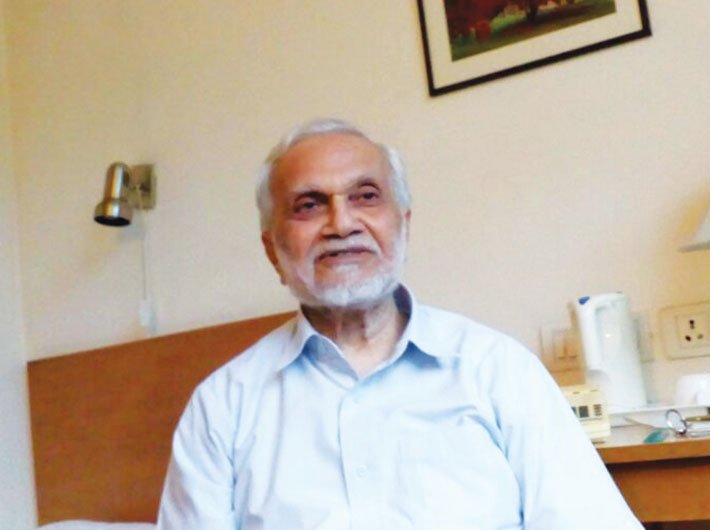
Bhikhu Parekh, political scientist and gandhi scholar took out time for us during his recent India visit. Here is what he said
During Prof Parekh’s recent India visit, Ashish Mehta sat down with him for a chat on Gandhi. Here is what they talked:
At 82, Baron Bhikhu Parekh remains as sprightly as ever. He is no longer teaching in classrooms but continues his academic pursuits. After ‘Debating India: Essays on Indian Political Discourse’ (Oxford University Press, 2015), he is at work on his next book. He is an active participant in select conferences and workshops, which keep bringing him back from Britain to India regularly. As a political scientist, his interests range from contemporary concerns to philosophical matters. But Mahatma Gandhi has remained a topic of special interest. During Prof Parekh’s recent India visit, Ashish Mehta sat down with him for a chat on Gandhi. Here is what they talked:
Can you tell us a little about your journey from Amalsad town in south Gujarat to the UK? And how you came to discover Gandhi along the way?
In a way, Gandhi’s discovery came for me right in the childhood. I was born in 1935, when the aftereffects of the Salt March were still felt: my town, Amalsad, is close to Dandi and Dharasana. Elders at home often discussed Gandhi. He was a presence as a political and moral person. However, I had no wish to take up any intellectual study on this subject.
Later, my PhD thesis was on the topic of equality, and there was no reference to Gandhi in it. I returned to India in 1981, as vice chancellor of the Maharaja Sayajirao University, Vadodara, and my term ended in 1984. It was then that I thought I should work on a new subject. My work on Marx had just come out [‘Marx’s Theory of Ideology’, 1982]. I obviously thought of working on an India-related subject, and started studying Gandhi. Once Gandhi grips you, he won’t leave you soon. I thought it would be over in a year or so, but the project got extended. In 1989, two books were published: ‘Colonialism, Tradition and Reform: An Analysis of Gandhi’s Political Discourse’ [Sage] and ‘Gandhi’s Political Philosophy: A Critical Examination’ [Macmillan]. Later when Oxford University Press approached me to write an introduction to Gandhi, I completed it in three months [First published in the Past Masters series in 1997, and then in the Very Short Introduction series in 2001].
There is a perennial debate about two Gandhis: the political and the spiritual, dealing with the external world and in the internal world. The two are of course interlinked, but each Gandhi scholar foregrounds one. What would you say to that?
The two aspects are of course related, in two ways: in his thinking, spirituality underlies and illuminates his political views. Likewise, in his life too, his spirituality leads to his political values. Both aspects are critical: one won’t do.
There are several studies delineating evolution of Gandhi’s religion, with clear milestones in his readings and practices. What about the evolution of his political views?
On Gandhi’s political education, the key sources are obviously Leo Tolstoy, John Ruskin and HD Thoreau. In spirituality, his key sources are the Gita and Christianity. Gandhi says he learned true non-violence from Tolstoy. ‘Non-violence’ for him is ‘love’. In Hindu tradition, non-violence is a passive, inactive notion. In its active form, it is love. Ruskin’s ‘Unto This Last’ is important for Gandhi. From Thoreau, he learned civil disobedience; that whatever the government does, we are responsible for it. [Through that and also from Tolstoy,] Gandhi developed his critique of the state: that it is not an abstract entity; it is made of people. India is its people. The interest of a state means interest of its people. Whatever the state does is done on behalf of and in the interest of its people.
From the Gita, he learned nishkam karma [selfless action]. From Christianity, via Tolstoy, he developed missionary spirit, understood the importance of suffering. Through suffering you can touch the hearts of other people.
In today’s post-Trump, post-Brexit world, Gandhi’s relevance should be obvious, but how can one put the values he preached into practice... In terms of methodology, the way Gandhi invented and innovated upon the instruments and techniques of political resistance and social justice?
Some of the things associated with Gandhi are no longer in currency, which is good. For example, brahmacharya and opposition to family planning. Or prohibition. People did not agree with his views on these matters.
Then there are other values, eternal values: truth, non-violence, and the notion that property does not belong to me, I am merely a trustee of it. These are very important values and they will remain eternal. Gandhi forged the instrument of satyagraha out of them. When differences crop up, when one needs to fight against injustice, how should one give the fight? The fight has to be a just one. Rational discussion is not sufficient; violence is not acceptable. Then what shall one do? Gandhi’s answer is satyagraha.
Unfortunately, in independent India, the tradition of satyagraha seems to have died down. It is not the organised relentless movement it used to be. Satyagraha is not out-of-date, it can be effective today too. It can take new forms by adopting, for example, social media.
After Gandhi, satyagraha has taken two forms: Vinoba’s and JP’s [Jayaprakash Narayan’s]. Vinoba himself was not clear about the role of satyagraha after independence. He’d say, ‘Can we go on satyagraha against our own government?’ JP’s answer would be, yes, it should be done even against our own government when needed. Vinoba’s views did not lead to much; whereas in JP’s case, a satyagraha was started out of the student movements of 1974-75. However, its leadership went out of his hand and it took the form of organised militancy.
The crucial element in satyagraha is love: you don’t hate the other side. Would it have worked against Hitler? No, not after he came to power. But it would have been effective when he was rising to power. It matters when it is deployed, and whether people are made aware. Satyagraha is effective when it generates popular pressure.
In contemporary India, Medha Patkar has been engaged in a praiseworthy work, but you can’t resort to satyagraha too frequently. That is not the way. Also, hunger strike is not satyagraha. Hunger strike is merely to pressurise the other side. It is different from fasting, which is to purify oneself.
What books you’d recommend for further study of Gandhi – apart from your own work in the ‘Very Short Introduction’ series?
One must read the primary sources – Gandhi in his own words. Among other works, ‘The Impossible Indian’ by Faisal Devji, ‘The Moral and Political Thought of Mahatma Gandhi’ by Raghavan N Iyer, and ‘Gandhi: Struggling for Autonomy’ by Ronald Terchek. Also studies by Judith Brown for historical perspective, and Ramachandra Guha’s biography [‘Gandhi Before India’].
You are better known abroad for your work on multiculturalism. During 1998-2000, you headed the Commission on the Future of Multiethnic Britain. The conservative press once called you “the most dangerous, subversive academic in Britain”. Now, in the post-Brexit days, how do you look at British society?
I see the boundaries of tolerance are shifting.
[email protected]
(The interview appears in the October 15, 2017 issue)