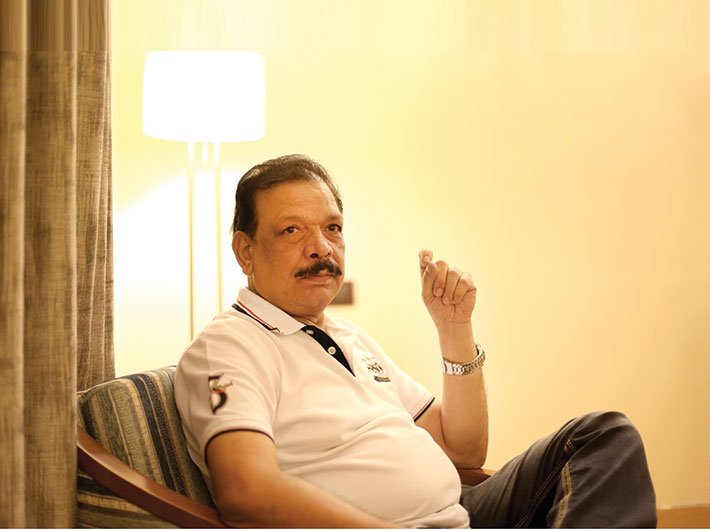
Govind Namdev's performances, whether on stage or in films, are always memorable for their fine touches of characterisation, presence, style. He attributes them to his rigorous training at the National School of Drama (NSD) and long years as a stage actor. His most well-remembered performances on stage are as Ashwattama in Dharamvir Bharati's Andhaa Yug and later as an emotive voice-over in the same play. He remains committed to the stage despite coruscating success in films. The actor was in conversation with S B Easwaran:
On his forthcoming movies:
Among my forthcoming movies this year is Dussehra, which is about Bihar and how politicians have ruined it. I play the role of a politician. Then there is Kashi in Search of Ganga, in which the main character, played by Sharman Joshi, is from the Dom community, which performs funeral rites. Again, I play the role of a politician. In Jhalki, which is about child labour, I am a character who goes from village to village to gather children and bring them to big cities to work, pocketing much of the money they earn. Poor villagers are seen waiting for my arrival so they can hand over their children to me. One of the most positive roles I have played is in the forthcoming Junction Varanasi, as a doctor who comes to live in a village and provide free treatment to everyone. He has a mentally-challenged son, and the doctor hopes people's blessings will do the child some good. It's a role I've played with sensitivity. To be released on January 26 next year is Gandhi: The Conspiracy, a Hollywood-Bollywood production, directed by Karim Traidia of Algeria. It's the last film in which I worked with Om Puri.
On theatre in education:
I strongly recommend that students be taught theatre seriously in schools from the sixth standard onwards. For theatre is a great guru. Vishwa ka sabse bada guru hai theatre! What does it not teach? First and foremost, it teaches humanity, it gets us in touch with our humanity and through that makes us relate to others. It teaches us to respect others and work with others. It teaches us the discipline of working with others, following and giving directions, coordinating with others involved in the play. It teaches us the discipline of working on ourselves, internally and externally, preparing for a role. For instance, you absolutely have to remember your lines and work on them in time for the performance. You cannot slack off. It teaches us how to project onself on stage through a role – and in this there are physical, external elements, and psychological, inner elements. I have seen the transformative power of theatre in the workshops I conduct at schools: students who play truant start working and learning seriously and their overall performance in studies improves. If you ask me to tell you what theatre teaches, I can off-hand draw up a list of at least 50 points!
Theatre in education should not be an extracurricular activity as it is today. It should be taught as a curricular subject, and there should be a final performance test for which students are graded. Along with other theatre persons, I have been recommending this strongly to the government, and at last, with much reluctance, policy-makers are coming around to our view.
On creativity in the digital age:
Addiction to cellphones and what the internet offers 24x7 is antithetical to any creative work, which demands work, discipline, focus, inner involvement, and time. Over the last 10 years or so, I've noticed the change in the workshops I do across the country. After class, students hardly find the time to work on the exercises, to work on themselves. I call it an illness, this addiction to social media, whether it is Facebook or Instagram. Focus is gone and everyone seems to want to enjoy themselves all the time. As far as work goes, they want to achieve great things – but instantly. This attitude is going to affect us in a big way in future.
On the effect of cosmopolitanism on art:
The cosmopolitan culture, in which whole families lose touch with their Indian roots, is making us hollow, khokhla! There are schools that punish the use of Hindi or local languages. We have allowed ourselves to be overpowered by external culture. Sanskrit is dying out. But thankfully, now, people are realising what is going wrong and trying to revive connections with their roots. Teachers of Sanskrit and Indian languages are again being treated with respect. We have to learn from China and Japan and many African countries which insist on using their own languages, saying, if you want to understand us, we can have interpreters, but we will use our own language. Using one's own language builds identity, gives a sense of belonging, and makes one confident.
On small towns making it big in films:
At one time glamour, opulence, romance, locations that few in India had seen – these were what Bollywood depicted, and it was also what people seemed to want. Then filmmakers like Shyam Benegal and Govind Nihalani broke that mould with hard-hitting films showing the real India...Nishant, Ankur, Ardh Satya and so on. Now those two extremes are no longer enough. The recent switch to stories based in small-towns and villages is perhaps dictated by business, but it's happening in a big way. Even big stars like Salman Khan, Aamir Khan, Akshay Kumar are doing such films. For example, Dangal, Toilet: Ek Prem Katha, Sultan, Bareilly Ki Barfi. It's happening in ads too. The ordinary guy, the man or woman in the street – they are also finding a place on screen. The thing is, these days there is scope for all kinds of films, on all kinds of topics, to succeed – big budget films, medium budget films, tiny budget films.
On the revival of theatre:
I conduct many theatre workshops across the country and run a theatre group in Sagar, Madhya Pradesh. Many of those who join up to learn and perform are finding that they are able to earn a decent living. It's no longer true that theatre cannot earn you a livelihood.
On preparing for a role:
My preparation is based on the training I received from Ebrahim Alkazi at the NSD. When I work on a character, I start with the physical aspects –appearance, walk etc – and then on the inner, psychological aspect. I use elements from method acting and other disciplines. Over time, I have evolved my own personal method, which is what I teach in my workshops. Much of my character-creation is borrowed from real life. My first appearance in cinema was as Inspector Tiwari in David Dhawan's Shola aur Shabnam. I decided to have the inspector chewing on paan, which changed the whole colour of the character. It changed his gait, his speech, his expressions. For my role as the wily, concupiscent Shriram, a Thakur, in Bandit Queen, I picked the idea of having a towel draped over my head from my father. We lived in Sagar and my father used to wear a damp towel against the Bundelkhand heat when he came home from his shop for lunch. For the role of Bhau Thakurdas Jhawle in Satya, I looked at pictures of several underworld characters and saw that many of them had a gap between the two halves of their moustaches. I played around a bit with the idea and decided that instead of a gap, Bhau would have some white hairs right in the middle of the moustache, which would seem like a gap and yet be original.
On personal discipline as an actor:
Every morning I devote 45 minutes to a series of exercises – stretching, asanas, breathing exercises, meditation. If I don't do them, I feel ill at ease, as if I've missed something as routine and important as brushing my teeth. For more than 30 years, I worked daily on my voice. Now, I have more or less internalised the effect I want my voice to have, so I don't perform voice exercises daily. But a few days before dubbing sessions, I start warming up and preparing my voice. My teaching is another important discipline that keeps me alive as an actor. I learn something new at every session. Recently, I've been working with my Sagar group on an Othello production for which we are using Bundelkhandi folk styles.
On his favourite actors and directors:
Dilip Kumar is the greatest Indian male actor. Among women I admire Sridevi, who could get so many variations, so many emotions, in just one take. Alia Bhatt is another favourite – so young and so talented. They let Raazi ride entirely on her shoulders! Among directors, Sanjay Leela Bhansali stands out for sheer versatility – he writes, he directs, he composes music, he puts together such grand spectacles! The new lot of actors and directors is also doing very good work. They are original and willing to experiment.