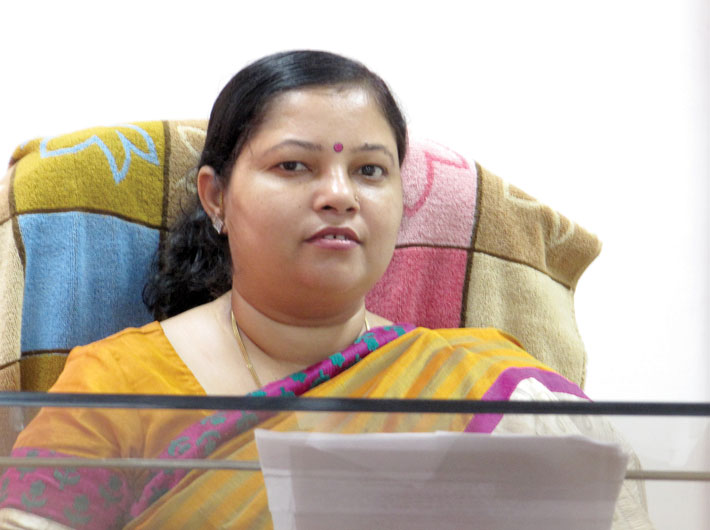
At 40, Arun Kumar Kori wears more than one hat. She is the only woman, and a dalit to boot, in the Akhilesh Yadav cabinet in Uttar Pradesh and runs the women welfare department — an important portfolio at a time when crime against women is such a raging national issue. She also has the culture portfolio.
Having joined the Samajwadi Party at a young age, Kori contested the Lok Sabha election in 1999 when she was barely 26. In 2012, she won from the Billhaur assembly constituency for the second time by over 15,000 votes. Interestingly, she took oath as “Arun Kumari” due to a slip-up, as ‘Arun Kumar’ sounds like a male name. A graduate in sociology from Kanpur University, Kori said she spends three days a week in her constituency to work for her constituents.
In an interview with Governance Now, Kori shares her views about the party and the government. Excerpts:
Samajwadi Party (SP) is usually seen as anti-dalit. As a dalit, why did you join the party?
I have been an SP member since my college days, and I have full faith in (party supremo) Mulayam Singh-ji, who is my mentor. Like him, his son, the young and dynamic chief minister Akhilesh Yadav, is also concerned for the poor. They respect all religions and communities and work for the uplift of farmers, artisans, peasants and the poor. So I fail to understand how people can call SP anti-dalit. Our political opponents can say that but by and large the people of Uttar Pradesh, and even those outside, don’t believe it.
But on assuming power, the new government under Akhilesh Yadav immediately scrapped several programmes run in the name of dalit icon BR Ambedkar and the names of several others. Ambedkar Gram Vikas Yojana is one such programme which has expanded its scope from benefitting scheduled castes to reaching out to all poor people in the state. How do you explain that?
It is not anti-dalit at all. The whole idea of the government is to uplift the poor and downtrodden people of society, irrespective of the caste or community they belong to. I can tell you with certainty that most of them (beneficiaries of these government programmes) are people from scheduled caste communities, and that Neta-ji (Mulayam Singh) and Akhilesh-ji will never discriminate between people along caste lines. They are socialists and I know them very closely and trust them.
As many as 57 MLAs elected on SP ticket this time are dalits. The difference between my party and the Bahujan Samaj Party (BSP) is that SP respects the average dalit, while in BSP only Mayawati-ji is respected. My party made me — a Dalit woman — a minister but the BSP does not repose faith in any other dalit, and especially a woman, except Mayawati.
Mulayam is generally seen as opposed to the women’s reservation bill, and advocates reservation within it. As a woman, do you support that?
Yes, I support that from the core of my heart. Neta-ji is not against the women’s reservation bill but there should be a quota for dalit and minorities (women in that).
But you are the lone woman minister in the cabinet. Would you not agree that it is gross under-representation of women in the cabinet?
The SP gave tickets to more women than any other party in last year’s assembly elections, and we also have the largest representation of women in the assembly, with 20 women MLAs. Similarly, SP has more women as village heads, block heads and zila panchayat members (than any other political party in UP).
Let’s talk about steps you are taking as the women welfare minister for the uplift and betterment of women in UP?
The 2013-14 budget proposed allocation of over '751.47 crore for women’s welfare. That is '2 crore more than last year’s budget, and it shows our commitment for the cause. We also have several schemes, like the widow pension scheme, under which '608 crore has been earmarked to help 16 lakh women in the state.
Our government has also proposed to help families that have lost their male members and women have to get their daughters married. Such families would be provided '7,000 in this fiscal year. Similarly, we have proposed a budget to help victims of dowry harassment and the government has proposed a budget for them. My ministry is looking after child development as well, and we have created 22 juvenile homes with the help of voluntary organisatons.
The integrated child protection scheme is working well on the ground.
You also hold the portfolio of culture. What are you doing on that front?
We have proposed over '80.53 crore for the culture department in budget 2013-14, which is '4.22 crore more than the previous fiscal. This year we plan to award ‘Yash Bharti’ to talented artistes who are doing exemplary work. Each such artiste will be awarded '11 lakh, and the budget proposed for this plan is '1.61 crore.
Besides, we will give '2,000 as pension to artistes who are over 60 years and are unable to earn. For this, our proposed budget is '80.10 lakh.
As per the 13th financial commission, '100 crore has been sanctioned to do up museums and historical places between 2012-13 and 2014-15. So we have proposed '25.87 crore for the purpose in 2013-14. Besides, we are planning to promote art and culture at the sub-divisional level and have proposed '1 crore for that in the budget.
SP is always accused of running a ‘goonda raaj’ whenever it comes to power in UP. Do you think people, more specifically women, are safe in the state under an SP government?
Such canards are spread by the BSP and other opposition parties for political gains. The SP has formed the government in UP on several occasions, so why are people reposing faith in us again and again if we unleash a ‘goonda raaj’? Our government under chief minister Akhilesh Yadav has put special focus on law and order to ensure all sections of the society can live in peace and harmony.
Finally, did you join Samajwadi Party because your father-in-law Buddha Chandra enjoyed a good relationship with Mulayam Singh and was made a member of legislative council after retiring as a DIG?
It’s true that I entered politics because of my father-in-law but I was also influenced by the dynamism, honesty and simplicity of Neta-ji. I got a chance to know him (from close quarters) due to his relationship with my family, and that’s how I learnt about the values of SP.