
A new book shows how geopolitics, technology and nationalism are reshaping international commerce
GN Bureau | July 20, 2023
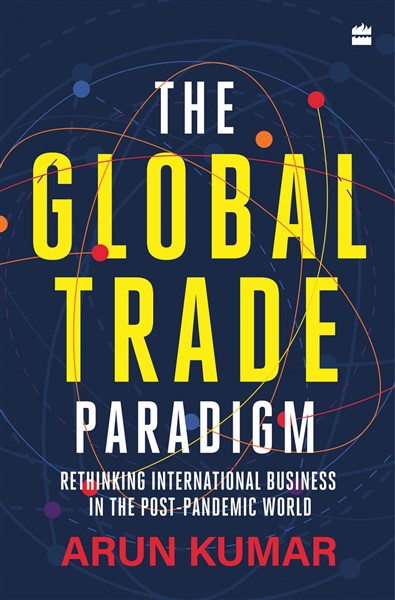
The Global Trade Paradigm: Rethinking International Business in the Post-Pandemic World
By Arun Kumar
HarperCollins, 352 pages, Rs. 699
Since the end of World War II, there was a consensus among nations and their policymakers that freeing of global trade from barriers was the key to avoiding further conflicts and promoting peace and prosperity in the world. For a whole variety of reasons ranging from economic, political and imperfections of the global trade system itself, the last few years have been highly turbulent for global trade and commerce. The COVID-19 pandemic was a Black Swan event, whose impact on the global trade will be difficult to predict.
In ‘The Global Trade Paradigm’, Arun Kumar, a global executive with forty years of experience spanning multiple sectors including with the US Department of Commerce, takes a deep dive into the international business ecosystem and points at the gaps within it. A managing partner at Celesta Capital and formerly chairman and CEO of KPMG in India, the author provides a roadmap for a fair, efficient and inclusive global trade system.
“In today’s world, we are all beneficiaries of global trade in almost everything we do, from the products and services we use to the way we communicate across the world, and the unprecedented level of global influences in our lives,” Kumar says in a statement. “The story of trade should thus be of interest to us, whether we are businesspeople who manufacture things or observers of international trends and dynamics. ‘The Global Trade Paradigm’ aims to tell a story of how we got here and key questions before us in the realm of international business.”
In the preface, he recalls working under the leadership of Commerce Secretary Penny Pritzker in the Obama administration – he was the lead official to enhance exports and market access for US businesses as well as attract FDI into the country. That was the assignment that made him realise “that the story of international trade is at its core a human story, of aspirations that have led in the long term to higher living standards but have, along the way, seen heart-rending suffering and exploitation. It is a story of cycles, of countries opening up the world, expanding their reach using military muscle or other means of getting their way, and of retreating. It is a story of alliances and animosities that change over time. We are today at a critical point of such a cycle. Will the global trade paradigm of expansion and integration now change to one of isolation and retreat?”
Here is an excerpt, from the Epilogue:
The Flows of the Future
For long, globalization was viewed as an irrevocable universal force lifting all boats and promoting the greatest good of the greatest number. That near-global consensus around the benefits of globalization is now under challenge. A troika of forces—geography-related uncertainties accentuated by sweeping pandemics like COVID-19, resurgent nationalism and consequential geopolitical distrust, and economic headwinds—have combined to create downward spirals in the fragile structures underpinning globalization.
In recent years, we have thus seen major economic powers like the UK and the US take a step back from the global stage—with Brexit and Trump-era policies respectively. We saw global coordination in response to the urgencies of the COVID-19 crisis constrained in many ways—particularly on account of US–China tension. We have witnessed the economic consequences of the Russian invasion of Ukraine, as it continues to disrupt energy and commodity markets; triggering worldwide inflation, and reviving the ancient spectre of food-scarcity. We see debt distress rising across emerging and developing markets. All these factors have fostered a retreat from the pathway of increasing global integration that just a few years ago appeared inexorable.
These developments have had substantive impacts on the global economy, weakening global supply chains, and reducing openness to international trade. Until recently, most nations were converging around the elevated idea that they could come together in a collective global endeavour to create goods, services, and value in the most optimal locales; with seamless and robust global supply chains connecting production centres with target consumers. We are again seeing the rise of regional and bilateral trade agreements, security alliances, as well as the localization of supply chains, involving what has come to be called inshoring or nearshoring – and friend-shoring (locating in a trusted country.)
On the other hand, even as we have seen trends signifying a pause, or even a retreat from global integration over the last few years, the world has been moving towards a borderlessness that was previously inconceivable. The rise of technology is opening new frontiers and inducing new flows that naturally tend to make economies more open, and more globally integrated.
The ubiquity of digitization and the ready availability of instantaneous communication channels thus holds the potential to blur boundaries. Borders are being assailed by the flow of data and information, reducing the asymmetries induced by knowledge arbitrage. Meanwhile, ease of communications, which facilitated borderless working during the pandemic, has given an unprecedented impetus to the global deployment of talent from anywhere to anywhere.
The instantaneous movement of information between computers spanning across national borders facilitates service delivery across countries, manages global supply chains, increases collaboration in research and development, and generally enhances communications. Applying a philosophy of openness to data flows has been a key objective of the US international trade policy, and will be increasingly reflected in its trade agreements.
However, such ease of flow of data needs to be balanced by considerations relating to privacy and ownership. Privacy has been recognized in the UN Declaration of Human Rights, as well as in most national jurisdictions, as a fundamental human right. In this context, the right to privacy is also associated with the right to freedom of expression, protecting individuals from surveillance or intrusion by the State while expressing personal views. At the same time, the upsurge of information flows spanning borders also raises concerns around information and data-related threats to national security.
The interplay between ubiquitous cross-border data flows and concerns related to online privacy will have to be carefully balanced while developing regulation and trade rules that provide for personal protections, but do not raise unwarranted barriers to digital trade. An example is the United States Mexico Canada Agreement (USMCA) that includes rules and disciplines on privacy, cross border data flows, and security. The US trade policy has sought to balance the goals of consumer privacy, security, and open commerce.
Personal data privacy and security has been a dominant European concern, shared by many in the US. The online data of consumers has emerged as a prime generator of value, and as the volumes of such data grow, issues relating to protecting its ownership and managing access have become important for consumers. The EU, through the General Data Protection Regulation (GDPR), has clearly signaled the priority that they have accorded to the protection of personal data rights, over the free cross-border flow of data. Many developing countries have largely not tilted the balance towards privacy concerns vis-à-vis the imperatives of governance and business.
Currently, most countries around the world are defining or refining their national privacy or broader data strategies; in fact over 120 countries presently have laws related to personal data protection. The differences in national approaches to privacy issues creates its own barriers to the seamlessness of cross-border business and trade, thus increasing the cost of doing business.
[The excerpt reproduced with the permission of the publishers.]
About forty people walked the roundabout on Teen Murti Marg to the gate of Chanakyapuri police station, a distance you could cover in under a minute, on Friday to protest against Elon Musk’s Starlink. The walk was called by the Swadeshi Jagaran Manch. Nobody joined them on the way, and nobody seeme
The Golden Chisel: The Story Behind the Making of Ram Lalla By Seethalakshmi S. and Rahul Nandan Rupa Publications, 168 pages, Rs 395
Mumbai’s real estate market keeps growing, yet homeownership remains out of reach for much of its population. Three experts – urban researcher Hussain Indorewala, urban planner Vidyadhar Phatak and developer Kamlesh Thakur of NAREDCO Maharashtra, agree that simply constructing more apartments
US secretary of state Marco Rubio has said he was unfamiliar with the Wall Street Journal report suggesting Elon Musk had decided to throttle Starlink services in Ukraine, but rejected claims that Washington had ordered the restrictions to pressure Kyiv. “There was no
Breast cancer has become a public-health challenge in India. The greatest opportunity is to find cancers earlier. Artificial intelligence (AI) is opening a new era in breast cancer detection. AI systems can analyse mammograms and other breast-imaging studies, identify subtle abnormalities and assist radi
Indian agriculture is experiencing significant climate volatility, while the world economy seems to be in a highly volatile situation. Economic indices from various countries show that they need to recalibrate their strategies to withstand economic headwinds. In such a challenging situation, a country li










