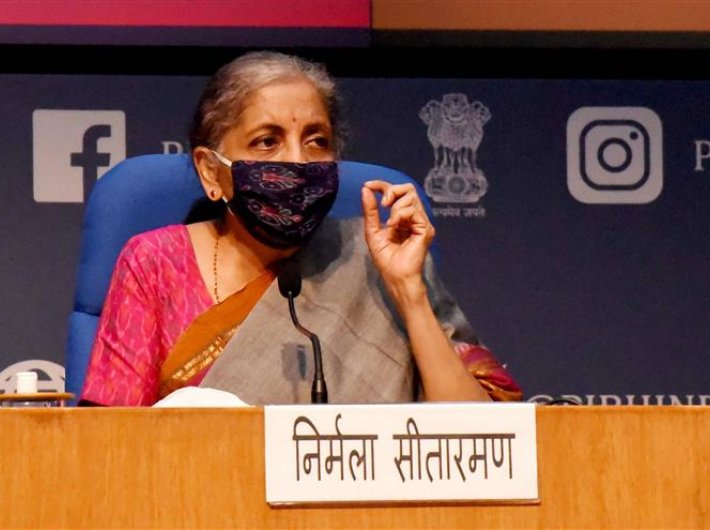
The cabinet has cleared the formation of ‘National Asset Reconstruction Company Limited’ (NARCL) which will acquire “stressed assets” of about Rs. 2 Lakh crore in phases within RBI regulations in order to address the problem of humongous amounts of bad loans in public sector banks. Finance Minister Nirmala Sitharaman made the announcement Thursday, saying the proposal was cleared in the cabinet meeting of Wednesday.
The government guarantee of Rs.30,600 crore to back security receipts issued by NARCL for acquiring stressed loan assets was approved by the cabinet.
NARCL proposes to acquire stressed assets of about Rs. 2 Lakh crore in phases within extant regulations of RBI. It intends to acquire these through 15% cash and 85% in security receipts (SRs).
Here are the answers to some Frequently Asked Questions explaining various aspects regarding central government guarantee to back SRs issued by NARCL for acquiring of stressed loan assets, going by a finance minister press release.
>>What is National Asset Reconstruction Company Limited (NARCL)? Who has set it up?
NARCL has been incorporated under the Companies Act and has applied to Reserve Bank of India for license as an Asset Reconstruction Company (ARC). NARCL has been set up by banks to aggregate and consolidate stressed assets for their subsequent resolution. PSBs will maintain51% ownership inNARCL.
>>What is India Debt Resolution Company Ltd. (IDRCL)? Who has set it up?
IDRCL is a service company/operational entity which will manage the asset and engage market professionals and turnaround experts. Public Sector Banks (PSBs) and Public FIs will hold a maximum of 49% stake and the rest will be with private sector lenders.
>>Why is NARCL-IDRCL type structure needed when there are 28 existing ARCs?
Existing ARCs have been helpful in resolution of stressed assets especially for smaller value loans. Various available resolution mechanisms, including IBC have proved to be useful. However, considering the large stock of legacy NPAs, additional options/alternatives are needed and the NARCL-IRDCL structure announced in the Union Budget is this initiative.
>>Why is a Government Guarantee needed?
Resolution mechanisms of this nature which deal with a backlog of NPAs typically require a backstop from Government. This imparts credibility and provides for contingency buffers. Hence, GoI Guarantee of up to Rs 30,600 crore will back Security Receipts (SRs) issued by NARCL. The guarantee will be valid for 5 years. The condition precedent for invocation of guarantee would be resolution or liquidation. The guarantee shall cover the shortfall between the face value of the SR and the actual realisation. GoI’s guarantee will also enhance liquidity of SRs as such SRs are tradable.
>>How will NARCL and IDRCL work?
The NARCL will acquire assets by making an offer to the lead bank. Once NARCL’s offer is accepted, then, IDRCL will be engaged for management and value addition.
>>What benefit do banks get from this new structure?
It will incentivize quicker action on resolving stressed assets thereby helping in better value realization. This approach will also permit freeing up of personnel in banks to focus on increasing business and credit growth. As the holders of these stressed assets and SRs, banks will receive the gains. Further, it will bring about improvement in bank’s valuation and enhance their ability to raise market capital.
>>Why is it being set up now?
Insolvency and Bankruptcy Code (IBC), strengthening of Securitization and Reconstruction of Financial Assets and Enforcement of Securities Interest (SARFAESI Act) and Debt Recovery Tribunals, as well as setting up of dedicated Stressed Asset Management Verticals (SAMVs) in banks for large-value NPA accounts have brought sharper focus on recovery. In spite of these efforts, substantial amount of NPAs continue on balance sheets of banks primarily because the stock of bad loans as revealed by the Asset Quality Review is not only large but fragmented across various lenders. High levels of provisioning by banks against legacy NPAs has presented a unique opportunity for faster resolution.
>> Is the guarantee likely to be invoked?
Government guarantee will be invoked to cover the shortfall between the amount realised from the underlying assets and the face value of SRs issued for that asset, subject to overall ceiling of ₹30,600 crore, valid for 5 years. Since there shall be a pool of assets, it is reasonable to expect that realisation in many of them will be more than the acquisition cost.
>> How will Government ensure faster and timely resolution?
The GoI guarantee will be valid for five years and condition precedent for invocation of guarantee will be resolution or liquidation.Further, to disincentivize delay in resolution, NARCL has to pay a Guarantee fee which increase with passage of time.
>>What will be the capital structure of NARCL and how much will Government contribute?
Capitalization of NARCL would be through equity from banks and Non-Banking Financial Companies (NBFCs). it will also raise debt as required.The GoI guarantee will reduce upfront capitalization requirements.
>>What will be NARCL’s strategy for resolution of stressed assets?
NARCL is intended to resolve stressed loan assets above ₹500 crore each amounting to about ₹ 2 lakh crore. In phase I, fully provisioned assets of about Rs. 90,000 crores are expected to be transferred to NARCL, while the remaining assets with lower provisionswould be transferred in phase II.