
Bank takes NPA too seriously, gets notice from NHRC

Central Bank of India names girl and her father as defaulters over non-payment of education loan

GN Bureau | March 3, 2016

#NHRC   #Central Bank of India  


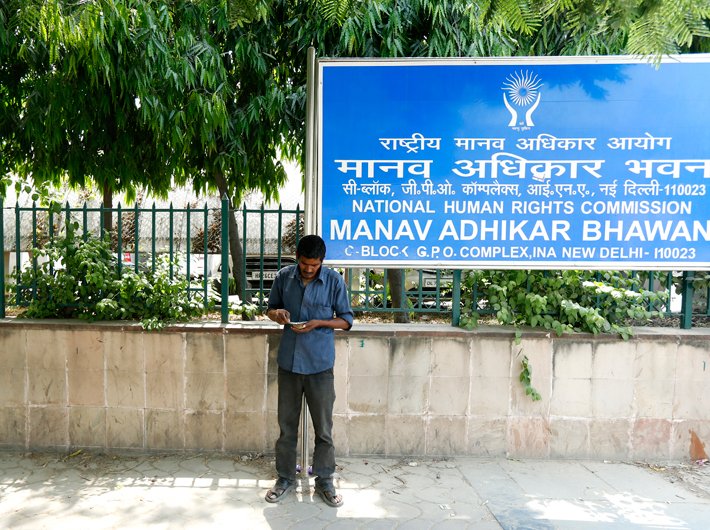
Unable to pay up her education loan, a girl in Tamil Nadu had to face serious embarrassment at the hands of a public sector bank which named the beneficiary and her father as defaulters. Taking cognizance of the matter, the National Human Rights Commission (NHRC) has issued a show cause notice to the chairman of Central Bank of India asking why it should not recommend monetary relief of Rs 1 lakh to the beneficiary for being insulted.

Apparently, the Manjoor branch of the bank in the Nilgiris district of Tamil Nadu displayed the girl as well as her father’s photographs captioning them wrongly as ‘missing’ and ‘defaulters’. Threatening telephonic calls were also made to her ailing father.

The commission’s show cause notice follows the admittance of error by the bank which has been given six weeks’ time to respond. In its report submitted to NHRC, the bank says that due to erroneous data entry in the system the victim’s loan account was wrongly classified as ‘non-performing asset’ (NPA). The bank’s move was against the advice of ministry of finance to all banks which says that names and photographs of students, who are unable to repay education loan or where there is a delay in the repayment, should not be published.

Justice D. Murugesan, member, NHRC, while issuing the show cause notice, observed that the display of photographs of the victim and her father on the notice board was a violation of their right to live with dignity, which is recognized as dereliction of article 21 of the constitution as well as human rights.

The victim had taken an education loan for Rs 2 lakh from the Manjoor branch of Central Bank of India to pursue her B.E. degree course. She completed the course in 2013 and according to the model IVA scheme, the first repayment had to commence from July, 2014 as per the moratorium. The moratorium included study period and a year after that to start the process of repaying the loan in 120 installments.  She had paid half of the loan amount in the first month itself after the moratorium. She said that the coercive methods adopted by the bank that too against the established norms of education loan repayment amounted to violation of human rights. It is also alleged that her ailing father had died due to shock after receiving threatening telephone calls from the bank.
 

Comments


Other News

From one cow to a dairy business

In 2012, Anita Dash wasn`t dreaming of building a dairy brand. She wasn`t studying business models or planning market expansion. Like countless mothers across India, her focus was on something much simpler: giving her children a better future.   At the time, her most valuable

Ethanol blending: The two sides of a story

India`s crude oil consumption is estimated to be around 88.5% imported from abroad. This one single figure is also responsible for why ethanol has become both an economic strategy and fuel policy at the same time. In an economy like India, which depends so heavily on foreign oil, any increase in internat

Food inflation: Not a macroeconomic statistic but a developmental indicator

India`s retail inflation shows a reassuring picture at first glance. According to the latest data, Consumer Price Index (CPI) inflation edged up to 4.38% in June 2026 from 3.93% in May 2026, but continued to remain within the Reserve Bank of India`s (RBI) target band of 4% (+/- 2%). However, beneath this

Skin in the game or masterful market timing?

When a company founder opens their personal chequebook to buy shares in their own business, stock markets usually applaud. To the average retail investor, it feels like the ultimate vote of confidence, a sign that the people running the show have real skin in the game and believe brighter days are ahead.

India’s freedom struggle was shaped by wider Asian political thought

As we mark 80th anniversary of independence, ‘Asianism and the Fall of Empire’ (HarperCollins India) by historian Mithi Mukherjee offers a new perspective on Ind

What is colonialism? A relook at modern history

The Chromatic World Order: The Fiction That Rules Our World  By Sajid Mohamed Aakar Books  

Upcoming Conferences


-->

Archives

Current Issue

Opinion

Facebook Twitter Google Plus Linkedin Subscribe Newsletter

Twitter






