Given the government guidelines under which units have to work and lack of bank support to the MSME sector, a V shape recovery cannot be expected, and the road ahead will be slow and painful.
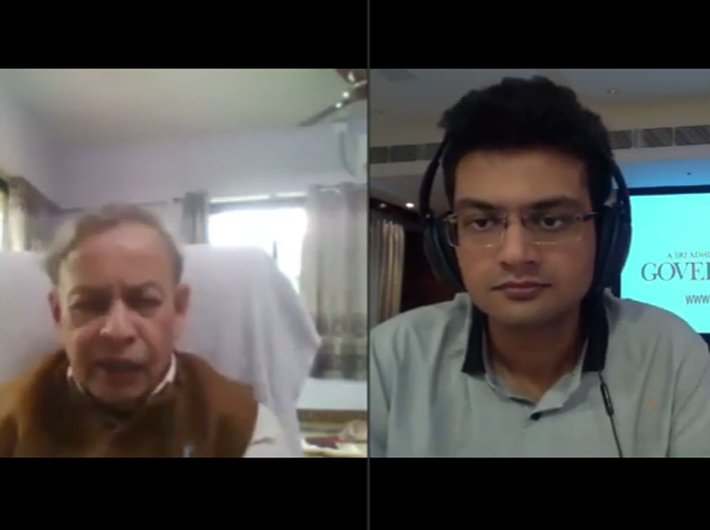
“Pent-up demand that took place immediately after Unlock 1 was announced has slowed down now, and discretionary spending has sharply come down and not expected to come up soon. As per reports around one lakh crore (33%) of the announced amount of Rs 3 lakh crore under the MSME support scheme has been disbursed and with only 10% employees allowed to work most units have not been able to start. All these issues have made things difficult for revival to take place. Additionally, MSME units have been saying that support from the banking sector is not forthcoming,” said Satish Marathe, director (part-time), Reserve Bank of India. He was speaking with Kailashnath Adhikari, MD, Governance Now, on “Rebooting the Indian Economy post-COVID-19 shock” in the second episode of Visionary Talk Series held by the public policy platform.
Watch the video:
Marathe said that Ahar (Indian Hotel and Restaurant Association) has told the government that required distancing norms is rendering their business unviable and pointed that with cinema halls closed since lockdown people have now opted for streaming of movies at home. The new business model is going to be permanent.
Responding to a question on cooperative banks lacking transparency and how he viewed the centre passing the ordinance to bring cooperative banks under RBI control after the PMC Bank fraud leaving depositors in lurch, Marathe said that for the last three-four years and particularly after the PMC bank scam they at the Sahakar Bharti [referring to the NGO working in the cooperative sector of which he is a founder member] have been asking the centre to bring urban cooperative banks fully under RBI control. Though the finance minister announced the same, the amendment of the Act could not happen due to Covid-19.
The new ordinance coming into place has given RBI more than adequate powers to regulate these urban cooperative banks as well, and there will now be no need to pressurise banks to convert themselves into private sector banks. Along with 17-18 amendments, most importantly, the RBI will have the power to remove directors and even supersede the board unlike earlier. The ordinance also requires the appointment of a CEO by the apex bank for five years and subject to satisfactory review for an extension.
Earlier urban cooperative banks had very limited access to capital. Now with the permission of RBI, they will be able to raise equity, in the form of tier-I capital or raise capital via bonds, i.e., tier-II capital. These could be via a public issue or private placement. Urban cooperative banks require capital for capacity building, upgrading technology, cybersecurity and a whole lot of activities which have changed banking due to their disruptive nature.
“These three important measures will go a long way in the interest of depositors, where cooperative banks are concerned,” said Marathe. He also said that though some politicians of different hues have sounded opposition to this ordinance because for the first time the ordinance says cooperative banks and nor urban cooperative banks. The state and district cooperative central banks will also get included over which now the RBI will have full powers. Except for rural and agricultural development banks, all cooperative banks are now under the ordinance.
On further consolidation and feasibility of public sector banks, he said that despite massive opening of accounts under Jan Dhan Yojana out of our 130 crore population at least 40-50 crore people are devoid of bank accounts in the country. He pointed out that many have more than two accounts. “With 6.5 lakh villages, banks have not so far reached more than 35% of villages in the country not necessarily through a bank branch but through BC [business correspondent] or technology or otherwise. There is a huge demand in rural areas which is still not part of the organised financial system. Financial inclusion is the only way forward to address poverty.”
Asked what measures could help our economy which is primarily agrarian at heart, he said the Aatm Nirbhar Bharat scheme will go a long way to boost income levels of farmers in the long term. He, however, pointed out that as 30% of agriculture produce is lost due to inadequate infrastructure. The farmer only gets 25% of what the consumer pays for produce when he is losing substantial, as compared to developed countries where 80% of agriculture produce is processed and in south-east Asian countries where it is 55%-60% in India only 18%-20% agriculture produce is processed. "With the government announcing measures to push the processing sector along with steps being taken for drip farming, creating warehouses, horticulture will go a long way in augmenting rural sector and farmers,” he said
Former RBI governor Raghuram Rajan warned that RBI could face another round of NPAs. Where would these bad debts arise from? Marathe said that if real estate sector and affordable housing do not pick up soon it will affect various associated sectors with major impact on steel and cement sector. Despite the extension of the moratorium, these installments will need to be paid eventually. In the last 3.5 to 4 months, as a country we have lost gross income amounting to almost Rs 75-80 lakh crore. Those affected includes everybody from individuals to large corporates. Eventually, if people are not able to pay installments and interest even after a holiday, accounts are bound to become NPAs which affect banks. While banks may revive with government pumping in money, there will be a huge national loss to the country and assets will be sold as junk if thousands of MSMEs shut down. There will be distress in society and social tension if economic activity is disturbed. Over the years, the success rate of revival and rehabilitation of units has been very low in our country.”
Marathe said that this is an unprecedented situation, and we have to take bold steps to handhold those who are suffering. The banks will have to go beyond rescheduling loans. He said that we will have to consider that covid induced lockdown has come on the backdrop of a slowdown which was already there for almost two years and that it has brought tremendous hardship on people.
The Unified Payments Interface (UPI), launched on August 25, 2016 by the National Payments Corporation of India (NPCI) under the regulatory oversight of the Reserve Bank of India (RBI), has completed 10 years of transforming digital payments in India. UPI has emerged as the backbone of India’s digi
Success in today’s professional organisation is no longer solely determined by academic qualifications, technical expertise or years of experience. While these attributes do matter, organisations increasingly value individuals who demonstrate the right mindset and behavioural qualities. The ability
Prime minister Narendra Modi interacted with CEOs and Founders of 20 Space Startups at Seva Teerth on Friday.
CEOs of leading companies in the space sector working in diverse fields ranging from building rockets and reusable semi-cryogenic launch vehicles, avionics, satelli
In 2012, Anita Dash wasn`t dreaming of building a dairy brand. She wasn`t studying business models or planning market expansion. Like countless mothers across India, her focus was on something much simpler: giving her children a better future.
At the time, her most valuable
India`s crude oil consumption is estimated to be around 88.5% imported from abroad. This one single figure is also responsible for why ethanol has become both an economic strategy and fuel policy at the same time. In an economy like India, which depends so heavily on foreign oil, any increase in internat
India`s retail inflation shows a reassuring picture at first glance. According to the latest data, Consumer Price Index (CPI) inflation edged up to 4.38% in June 2026 from 3.93% in May 2026, but continued to remain within the Reserve Bank of India`s (RBI) target band of 4% (+/- 2%). However, beneath this