
India’s first home-grown gene therapy for cancer launched

Accessible and affordable car-t cell therapy provides a new hope for the whole of humankind: President Murmu

geetanjali

Geetanjali Minhas | April 4, 2024 | Mumbai

#Droupadi Murmu   #President   #IIT Bombay   #Cancer   #Healthcare   #Health  


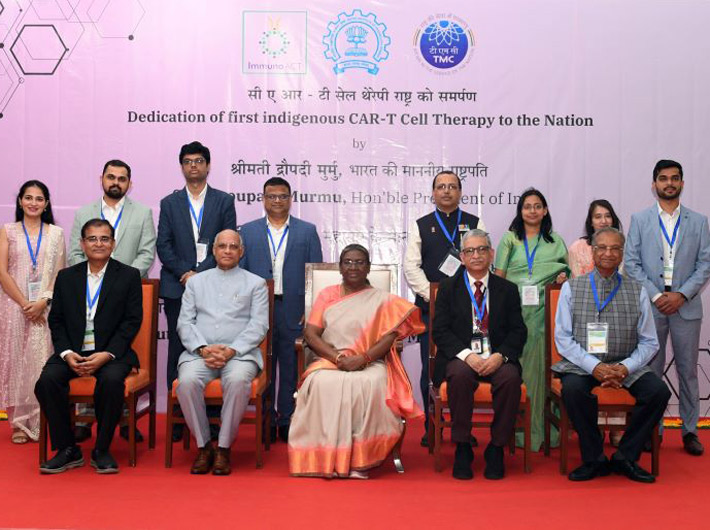
President of India Droupadi Murmu launched India’s first home-grown gene therapy for cancer at IIT Bombay here on Thursday.

Speaking on the occasion, the President said that the launch of India’s first gene therapy is a major breakthrough in our battle against cancer. As this line of treatment, named “CAR-T cell therapy”, is accessible and affordable, it provides a new hope for the whole of humankind. She expressed confidence that it will be successful in giving new lives to countless patients.

She said that CAR-T cell therapy is considered one of the most phenomenal advances in medical science. It has been available in the developed nations for some time, but it is extremely costly, and beyond the reach of most patients around the world. She was happy to note that the therapy being launched today is the world’s most affordable CAR-T cell therapy. She said that it is also an example of the ‘Make in India’ initiative; a shining example of the ‘Atmanirbhar Bharat’.

The President was happy to note that India’s first CAR-T cell therapy is developed through collaboration between the Indian Institute of Technology, Bombay and Tata Memorial Hospital in association with industry partner ImmunoACT. She said that this is a praiseworthy example of academia-industry partnership, which should inspire many more similar efforts.

She said that IIT Bombay is renowned, not only in India but across the world, as a model of technology education. In the development of CAR-T cell therapy, technology is not only being put in the service of humanity, but partnerships have been with an eminent institution from another field as well as with industry. This has been made possible by the focus IIT, Bombay has placed on research and development over the last three decades. She said that with the knowledge base and skills of the faculty and students of IIT Bombay and other similar institutions, India as a whole, would benefit greatly from the technological revolution underway.


Comments


Other News

Caring for cancer patients: the expanded network of facilities

Health is a State subject, and the primary responsibility for providing healthcare services, including cancer care, rests with the respective state governments. However, the Department of Health and Family Welfare provides technical and financial support to States and Union Territories across the country

Capabilities, aspirations of India’s youth limitless: Modi

The capabilities and aspirations of India’s youth are limitless, prime minister Narendra Modi said in his remarks to the media at the start of monsoon session of the parliament on Monday.  "In the past month, the country has achieved many milestones, filling citiz

India gets the first hydrogen train

Prime minister Narendra Modi on Friday laid the foundation stone and dedicated to the nation various development projects worth around ₹14,700 crore in Jind, Haryana.   The PM positioned the city as a shining reflection of the good governance model. Emphasizing that the entire Haryana

Climate change is stealing sleep

Climate change has at least doubled the temperature-related sleep loss across 1,338 major cities worldwide over the past five decades, highlighting an emerging but often overlooked public health consequence of rising global temperatures. A new study by Climate Central estimates that between 2020 and

Cabinet approves Mobile Phone Manufacturing Scheme

The union cabinet chaired by PM Narendra Modi has approved the Mobile Phone Manufacturing Scheme (MPMS) with a budgetary outlay of Rs 62,500 crore. It aims to further scale up the production, deepen domestic value addition, strengthen supply chain resilience, enhance global competitiveness. It

Building infrastructure is only half the job

Recent stories of stolen railway wires, disappearing communication towers and missing public infrastructure are often treated as bizarre law-and-order failures of India. Yet they raise a more fundamental question. Why does the State often discover the disappearance of a public asset only after it has alrea

Upcoming Conferences


Archives

Current Issue

Opinion

Facebook Twitter Google Plus Linkedin Subscribe Newsletter

Twitter






