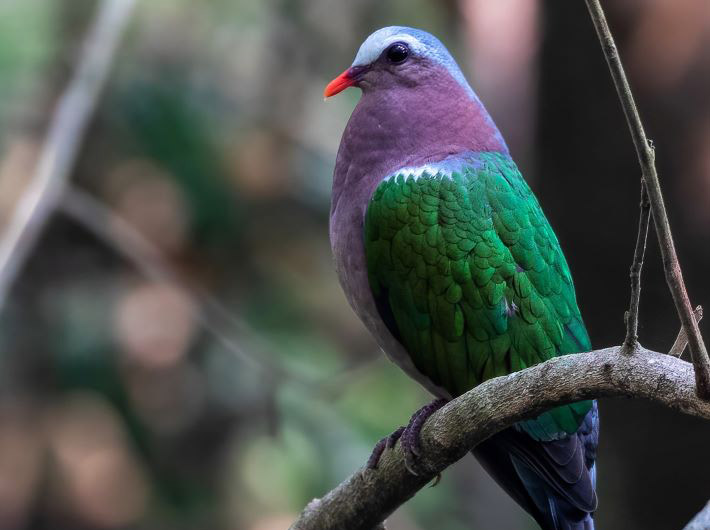
In 2024, India proudly secured the third position globally for the number of reported species
During the four days from Feb 16, more than a thousand birdwatchers throughout India are coming together with the goal of documenting as many birds as possible across the country’s diverse locations.
Over one lakh birdwatchers globally participate in the annual Great Backyard Bird Count (GBBC), and last year India not only ranked as the second-highest contributing country, but also discovered more bird species than any other, Bird Count India said in a release.
Bird Count India is a consortium of organisations and groups working together to increase our collective knowledge about bird distributions and populations. The partnership conducts periodic bird-related events and activities, offers support and resources to birding groups for conducting their own events, and provides information on bird monitoring.
In 2024, India proudly secured the third position globally for the number of reported species, closely following Colombia and Ecuador. Additionally, it claimed the second spot for number of uploaded bird lists, trailing after the United States. Among the most frequently observed birds in India were the Himalayan Bulbul in the Himalayas, House Crow in both the north and the south, Red-vented Bulbul in the eastern and central regions, Feral Pigeon in the west, and Plume-toed Swift in the Andaman & Nicobar Islands.
GBBC not only serves as a delightful event for novice and seasoned birdwatchers alike, but also contributes to citizen science, aiding in understanding the status of avian populations in India. As Sagarika Gupta, a passionate birdwatcher from Chennai, aptly expressed, “GBBC for me is a way to contribute to larger good. Something that’s fun but with a purpose. However, looking back I realise that it made me a better birder, over the years it has helped appreciate the bird life in my immediate surroundings.
“I started noticing birds and bird calls throughout the day, a tailor bird somewhere, a myna or a flock of parakeets or a pair of treepies or a lone Shikra. The post noon soaring of Painted Storks and Indian Spot-billed Ducks to flocks of Yellow Wagtails and Glossy ibises moving to roost in evening, to egrets feeding their fledgling to crows attacking Koel, were observed from my balcony. I realised that one doesn’t need to be in a birding hotspot to observe bird habit and behaviour.”
Dibyendu Ash, a naturalist and bird guide from Sikkim, said, “For me, four days of GBBC is a wonderful exercise where various people can participate and enjoy watching birds. In India birdwatching is getting popular and events like GBBC and CBC offer opportunities to get more people connected to nature and birds.”
GBBC in India is coordinated by Bird Count India, an umbrella group of a large number of birding, nature and conservation organisations.
Participants are encouraged to list all bird species seen at a particular location over a period of 15 minutes or more, at any time during the four days, and upload the list to the bird recording platform eBird, which makes checklist creation easier This can be repeated as often as possible. During GBBC, a lot of local birdwatching walks and talks are planned across the country for the public to join in.
Along with GBBC, educational campuses across India also take part in the sister event “Campus Bird Count”, aimed at monitoring bird populations in educational and institutional campuses. Outside protected areas such as national parks and wildlife sanctuaries, these institutions are becoming increasingly vital habitats for our wildlife.
Sarabjeet Kuar, a Ph.D. Scholar at the Wildlife Institute of India, Dehradun, said, “I will always cherish my first Campus Bird Count …. The four days proved an unforgettable learning and shaped my path in the field of Ornithology. Resolutely, I have never missed a single Campus Bird Count since 2017 for it was a stepping stone and I realised how important it is to methodically carry out monitoring with a group of like-minded people and inspire others to look at it with an altered perception.”
The global GBBC is organised by Cornell University and the Audubon Society in the USA.