Dr Dinesh Verma’s ‘The Self-Cure Code’ draws on scientific research and Indian philosophy to explore how the mind and the body are connected in the healing process
Why do some people recover from illness against all odds? Can our beliefs, emotions and consciousness influence the body’s ability to heal? Drawing on over three decades of experience in medicine, research and medical innovation, internationally trained ophthalmologist and author Dr Dinesh Verma explores these questions in his fourth book, ‘The Self-Cure Code: How Consciousness, Dreams, Belief, and Genes Converge to Heal’ (Readomania).
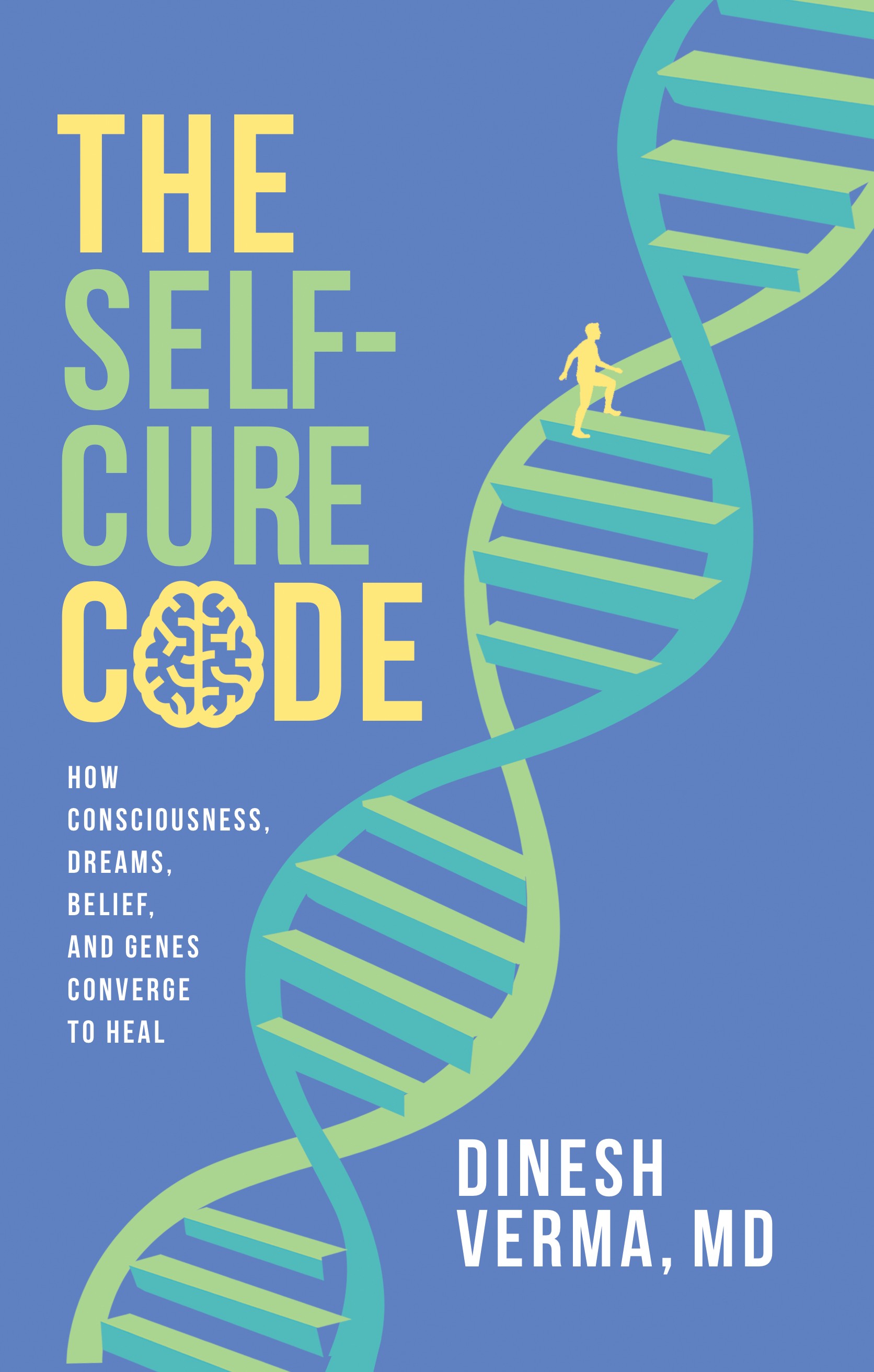
The book draws on scientific research, epigenetics, the placebo effect and Indian philosophy to explore how the mind and the body are connected in the healing process. It also weaves in Dr Verma’s personal experiences of family illness, grief, loss and spiritual growth, bringing together science, consciousness and the human experience of healing.
Part memoir, part scientific exploration and part spiritual quest, ‘The Self-Cure Code’ invites readers to consider a profound question: Could the key to understanding healing lie in the complex relationship between our biology, beliefs and consciousness?
Here is an excerpt from the book:
In the ancient Indian language Sanskrit (like the Latin of Europe), Ayurveda means the ‘science of longevity’ or even ‘the science of life’. We don’t really know the exact origins of Ayurveda but there is evidence that it was practised in the Indus Valley civilisation about 4,500 years ago. The archaeological findings of two cities on the banks of the river Indus—Harappa and Mohenjo-Daro (now in Pakistan) prove that they had an elaborate sewer and waste-disposal system, centuries before the Romans. There were bathhouses with purification rituals. It seems they were well aware of infectious diseases, their mechanism of spread and how to prevent the epidemics through a clever public health system. Thousands of terracotta figurines and small seals have been discovered. Some of the figurines show people in yoga postures. Then came Aryan invaders who established the tradition of Brahmanism, the forerunner of Hinduism. The sacred scriptures of Brahmanism are known as the Vedas. These were initially chanted in Sanskrit but were eventually written down. One of these Vedas dealt with healing and was called Ayurveda. But yoga practice also appeared in the Rigveda, the oldest of ancient Vedas, dating back to 1500 BC. This was followed by detailed yogic techniques in scriptures called Upanishads dating back between 800 and 500 BC.
Yoga is based on the Samkhya philosophy, which is one of the earliest Hindu philosophical systems which introduced the concept of Purusha, the Cosmic Consciousness. The classical Yoga of Patanjali was written sometime around the 2nd century CE. It was Swami Vivekananda who brought Yoga for the first time to the West more than a hundred years ago. The techniques of Transcendental Meditation were later popularised by Maharishi Mahesh Yogi and were subsequently modified by Dr Deepak Chopra.
“So, what do you suggest?” She suddenly asked. “Should my mother and I just take up Deepak Chopra’s meditation course and live happily ever after?”
“Well, that’s your choice,” I responded, “but his meditation technique is not easy to learn. I have been trying it myself for many years and still have not been able to get to the transcendental stage that Deepak Chopra describes in his books.”
“What is the alternative then?” She asked.
“First of all, I would have to carry out a test to ascertain whether this type of treatment would be effective on your mother and you, and then I would teach you both a special technique of meditation which is much easier to learn and master.”
“I am all for it!” She immediately agreed. “How much would it all cost?”
“Nothing, other than your time,” I reassured her. “Remember, I am not treating you or your mother as a doctor.”
“Yes, of course, otherwise you will have to take the ethics committee’s approval.”
“And also, you would be acting as guinea pigs,” I added. “The technique may or may not work, but I can assure you that, unlike modern medicines, my technique doesn’t have any side effects.”
“That’s a deal then!” She spoke.
Over the next few months, I carried out the tests and taught Emma-Jane my new technique of meditation, called REMIM, which I will describe later in the book. In the process, we became very good friends. She in turn taught the technique to her mother, so I am not seen to be her doctor taking care of her eye condition using an experimental technique. They both carried on with the technique regularly even after I moved away from Cambridge.
In February 2011, I received a call from Emma-Jane. She sounded very excited on the phone.
“Dinesh, guess what?” She sounded excited. “Mum has just seen a consultant ophthalmologist privately in Cambridge and he says that she doesn’t have AMD anymore.”
“Wow, that is amazing!” I was chuffed. “It has worked within a year.”
“Yes, and her vision has also improved dramatically.” She added. “She can now read the newspaper with her old reading glasses.”
“That is truly remarkable, but not surprising,” I said. “I always knew in my heart that it would work.”
“She wants to thank you personally and has invited you to a party at her house in Cambridge next weekend.”
“That’s very nice of her but I am afraid I am going away to India for two weeks.”
“Are you going alone?” She probed.
“No, I am going with my partner, Louise,” I said. “We will first attend a conference in Gujarat and then fly to Delhi for a family wedding.”
“Oh, that’s a shame, but we both hope to see you when you come back.” She sounded disappointed.
“Sure!” I said and put the phone down. My whole body was shaking as the news sank in. Have I found a cure for the late stages of AMD and maybe for other age-related disorders? I wanted to shout at the top of my voice and tell everyone. I wanted to send research papers to all high-impact, peer-review journals around the world. But the elation soon faded when I realised, I had done this to a friend’s mother and she was not my patient at that time. I had not taken any ethical approval from a research committee. I had not randomised my patients into control and treatment groups. I had only one case report which was also not well documented, as would be required by any peer-reviewed journal. The scientific community would laugh at me and my GMC registration would be in jeopardy. The usual story of how innovation is stifled in the Western world, especially if it relates to unfamiliar Eastern philosophy and healing systems. But I could not let this be buried; I wanted everyone to benefit from this breakthrough.
My NHS post was coming to an end in March 2011 and I decided not to extend it any more. Instead, I decided to work on my inventions and write books. The ideas that were buzzing in my mind were beginning to take shape. I was becoming more and more aware of this amazing power of our mind that could heal. I discussed these concepts with my partner Louise, a nurse with a keen interest in alternative and complementary medicine. She came from a Catholic family and was a regular churchgoer. As we were brainstorming to look for a name for this phenomenon, she remembered the ancient Latin proverb appearing in Luke 4:23 ‘Cura te Ipsum’—take care of yourself (or cure yourself). It is also taken as an exhortation to physicians, or experts in general, to deal with their problems before addressing those of others. So together we came up with the term Ipsicura, derived from the proverb. It was very apt, as to prove this concept, I had to first heal myself as a physician.
From then on, I started working on the scientific basis of this phenomenon and that eventually led me to the realisation that the genes are conscious. We can communicate with them, and turn them on or off. Even modify them to cause a positive mutation. That power is within each one of us. We just have to shift our own consciousness to unleash that power.
[The excerpt reproduced with the permission of the publishers.]