India’s next measure of success should not be how many people cross a poverty line. It should be how many people gain stable livelihoods, decent wages, quality healthcare and education, assets, and a real stake in growth
India’s reduction in poverty over the past decade is a development achievement of considerable significance. The World Bank’s April 2026 ‘India Development Update’ estimates that the share of Indians living below the international extreme-poverty line of $3.00 per person per day in 2021 purchasing power parity fell from 27.1% in 2011–12 to 2.6% in 2023–24. Poverty at the lower-middle-income threshold of $4.20 per person per day declined from 57.7 % to 16.1 %, lifting an estimated 496 million people above that line.
These numbers represent a substantial improvement in household consumption and living standards in a country of India’s scale and diversity. The two thresholds measure different degrees of deprivation and should not be mixed. Yet, the direction and magnitude of change are difficult to overlook: even after this progress, about 232 million people remain below the $4.20 line and roughly 35 million remain in extreme poverty.
Poverty reduction, however, is only one dimension of development. Rising consumption does not automatically produce an equitable distribution of income, wealth or opportunity. India has made major progress in reducing deprivation, but significant structural inequalities persist.
Inequality remains a structural challenge
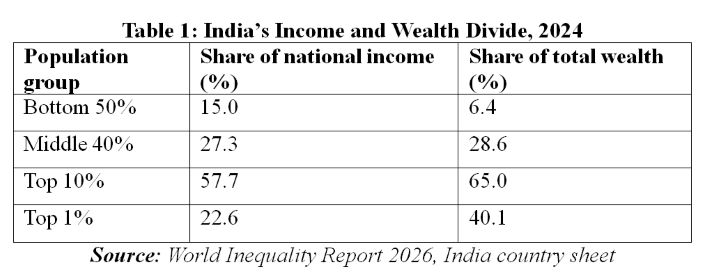
The World Inequality Report 2026 presents a stark picture: inequality in India remains among the highest globally, with little change in recent years. In 2024, India’s top 10% of earners are estimated to receive about 58% of national income, while the bottom 50% receive only 15%. Wealth is even more concentrated: the richest 10% hold roughly 65% of total wealth, and the top 1% alone hold about 40%. The bottom half of the population accounted for only 6.4% of total wealth (see Table 1). Despite economic progress, inequality in income, wealth and access to opportunity continues to shape people’s lives in India, with women facing additional barriers to economic security and advancement.
It is important, however, to distinguish between poverty and inequality. Poverty measures whether people can meet a defined minimum standard of living, while inequality examines how income and wealth are distributed across the population.
A development scorecard
The broader picture becomes clearer when poverty reduction is viewed alongside consumption inequality and women’s labour-force participation (LFPR).
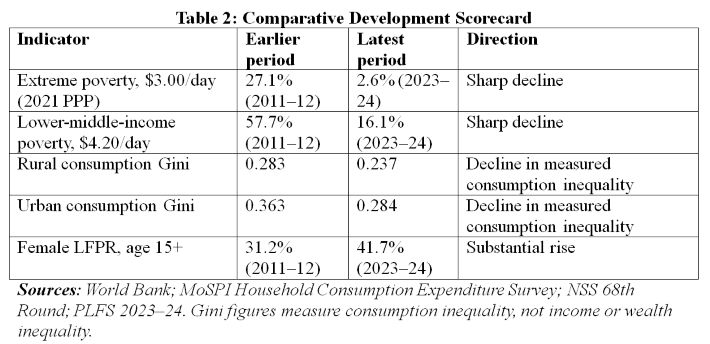
The decline in consumption inequality is an important achievement. MoSPI's Household Consumption Expenditure Survey shows that the rural Gini coefficient declined from 0.283 in 2011–12 to 0.237 in 2023–24. The urban coefficient fell from 0.363 to 0.284 (see Table 2).
The decline in measured consumption inequality is meaningful, but it should not be mistaken for a decline in income or wealth inequality. Consumption surveys capture household spending; they do not fully capture high salaries, financial assets, property or inherited wealth. Consumption inequality is generally narrower than income and wealth inequality.
Women’s participation in the labour force offers another important measure of India’s inclusive development. According to the Periodic Labour Force Survey (PLFS) 2023–24, the female labour-force participation rate among those aged 15 and above rose from 23.3 % in 2017–18 to 41.7 % in 2023–24 under the usual-status measure.
This is encouraging, but participation alone does not establish whether women are obtaining secure, adequately paid or productive employment. Many women continue to work in agriculture, informal enterprises and unpaid family activities. Policy must therefore move beyond counting women entering the workforce and examine the quality, remuneration and security of their work.
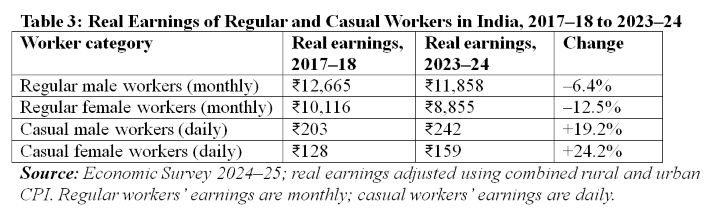
Wage trends reinforce this concern. Economic Survey 2024–25 data show that between 2017–18 and 2023–24, average real monthly earnings among regular wage and salaried women fell by about 12.5 %; for men, the decline was about 6.4 % (see Table 3). Casual workers, by contrast, recorded increases in real daily earnings. Higher participation has not automatically translated into stronger earnings or better-quality jobs.
From poverty alleviation to inclusive productivity
India’s priorities must now evolve from poverty alleviation towards inclusive productivity. That requires employment-intensive industrialisation, stronger small and medium enterprises, higher agricultural productivity, better urban employment and sustained investment in human capital.
MSMEs deserve particular attention. They provide livelihoods to millions, including women entrepreneurs and workers outside major industrial centres, but many remain constrained by limited access to institutional credit, technology, markets and formal supply chains.
Strengthening these links can help enterprises grow, raise productivity and generate more reliable household incomes. Healthcare and education are equally central. Poverty reduction cannot be sustained if households remain exposed to catastrophic medical expenses, poor learning outcomes or unreliable employment. Better public health infrastructure, affordable higher education and effective vocational training should be treated as investments in productive capacity, not merely social expenditure.
Regional differences also require differentiated responses. States with stronger industrial bases and better human-development indicators face different constraints from those where agricultural dependence, low urbanisation and limited employment opportunities persist. A uniform development model cannot address these variations adequately.
The story India should tell
India should speak about its poverty reduction with confidence. The evidence is strong, and the improvement in millions of lives is real, but confidence should not become complacency. High income and wealth concentration, uneven job quality, weak real-wage growth among regular workers and persistent regional disparities show that the development agenda remains incomplete.
India’s next measure of success should not be how many people cross a poverty line. It should be how many people gain stable livelihoods, decent wages, quality healthcare and education, assets, and a real stake in growth.
Dr. Vani Archana is a policy advisor, working on public policy and economic modelling, with a focus on international trade & development, and social welfare.