
Tagore-Gandhi: Two journeys that forged a common path

Historian Rudranghu Mukherjee’s new book on the unique friendship of Gurudev and Mahatma revisits their vision of a more tolerant nation

AM | December 9, 2021
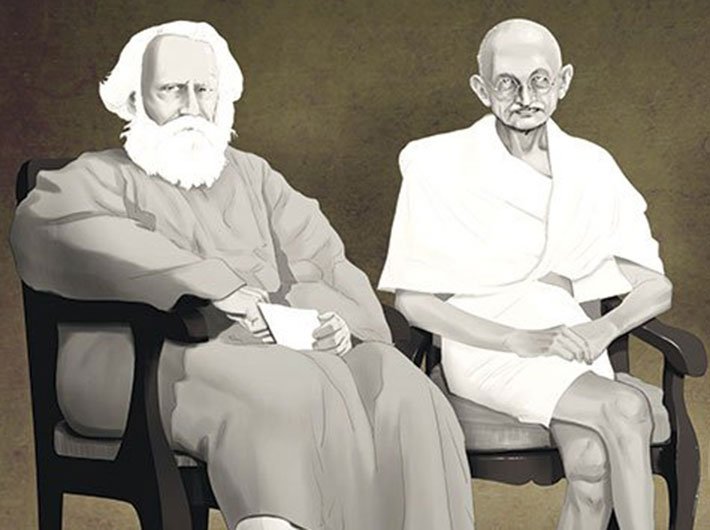

#Mahatma Gandhi   #Rabindranath Tagore   #freedom struggle   #history   #books   #ideas  
(Illustration: Ashish Asthana)

Tagore & Gandhi: Walking Alone, Walking Together
By Rudrangshu Mukherjee
Aleph, 186 pages, Rs 699

Two men born in the 1860s, more than anybody else, gave us an idea of India, an idea of what this country should become. Rabindranath Tagore and Mohandas Karamchand Gandhi. Each an extraordinarily noble mind animated by a deep concern for masses, both exhorting us in these distressing times to rekindle a vision of a more harmonious coexistence. Their friendship was an unparalleled phenomenon, nearly miraculous for the modern India.

It must have been an auspicious constellation under which they met for the first time – soon after Gandhi’s return to India in 1915. The affection and respect was spontaneous and mutual. Though their dreams and sensitivities were alike, the paths they’d forge were slightly different. Gandhi, for example, would call for a boycott of foreign cloth in a campaign that had elements of violence in it. Tagore was unhappy watching bonfires of foreign clothes.

Rudrangshu Mukherjee, in this excellent work, narrates the story of this matchless bonding that was a high point of India’s freedom struggle. Through their correspondence and writings, the book explores the evolution of their relationship and their ideas in their historical context.

What is the most beautiful in their friendship is that they discussed threadbare their differences in a model of public debate, appreciating each other’s motives, respecting each other’s views, without a hit of acrimony or self-righteousness. Their correspondence, indeed, enriches the possibilities of debate itself.

What could be behind their differences? As Mukherjee argues here, the Gurudev was animated by a poet’s heart, a heightened sensitivity, whereas the Mahatma was leading a mass movement against a powerful colonial empire. Yet, in the higher plane of their minds there was a harmony inexpressible in words. “I have found no real conflict between us. I started with a disposition to detect a conflict between Gurudev and myself but ended with the glorious discovery that there was none,” Gandhi said in Santiniketan in 1945.

Their one and the same fervent hope was to see an India free from fear, bigotry and hatred. Revisiting their journeys – when they walked alone and when they walked together – is as timely as necessary today.

Comments


Other News

BMC: 207 officials in ACB net, 112 still on duty, 68 retire before justice catches up

There are significant delays in the handling of corruption cases involving officials of the Brihanmumbai Municipal Corporation (BMC), a Right to Information (RTI) response obtained by rights activist Jeetendra Ghadge has revealed. As of 30 April 2026, 207 BMC officials face Anti-Corruption Bureau (A

The transformation trap: Why efficiency is not innovation

Every company is transforming, or so it claims.   There was a time when the word ‘transformation’ carried weight. It signified bold strategic shifts, reinvention of business models, and breakthrough technologies that fundamentally changed how organizations created

The Sardar biography that throws light on our times

Patel: A Life By Rajmohan Gandhi Aleph Books, 568 pages, Rs 1,199   There are many biographi

Climate change, El Niño rewrite Indian monsoon

The month of July exceeded its rainfall target despite forecasts of a below-normal month under a strengthening El Niño. The reason could be that climate change is amplifying monsoon complexity: West Pacific warming, Western Disturbances and evolving ocean conditions increasingly interact with El Ni&

Mumbai has just 1.28 sq.m. of open space per person: Study

Mumbai`s public space crisis is as much about mismanagement as it is about scarcity, and offers a governance roadmap that can be implemented without new legislation, according to a new report by the Urban Design Research Institute (UDRI) and the NGO Alliance for Governance and Renewal (NAGAR).  

Lok Sabha passes amendment bill to improve public examination system

The Lok Sabha on Wednesday passed the Public Examinations (Prevention of Unfair Means) Amendment Bill, 2026 by a voice vote after an extensive discussion. Replying to the debate, minister of state (independent charge) for science & technology; earth sciences and MoS in the PMO, Dr. Jite

Upcoming Conferences


-->

Archives

Current Issue

Opinion

Facebook Twitter Google Plus Linkedin Subscribe Newsletter

Twitter







